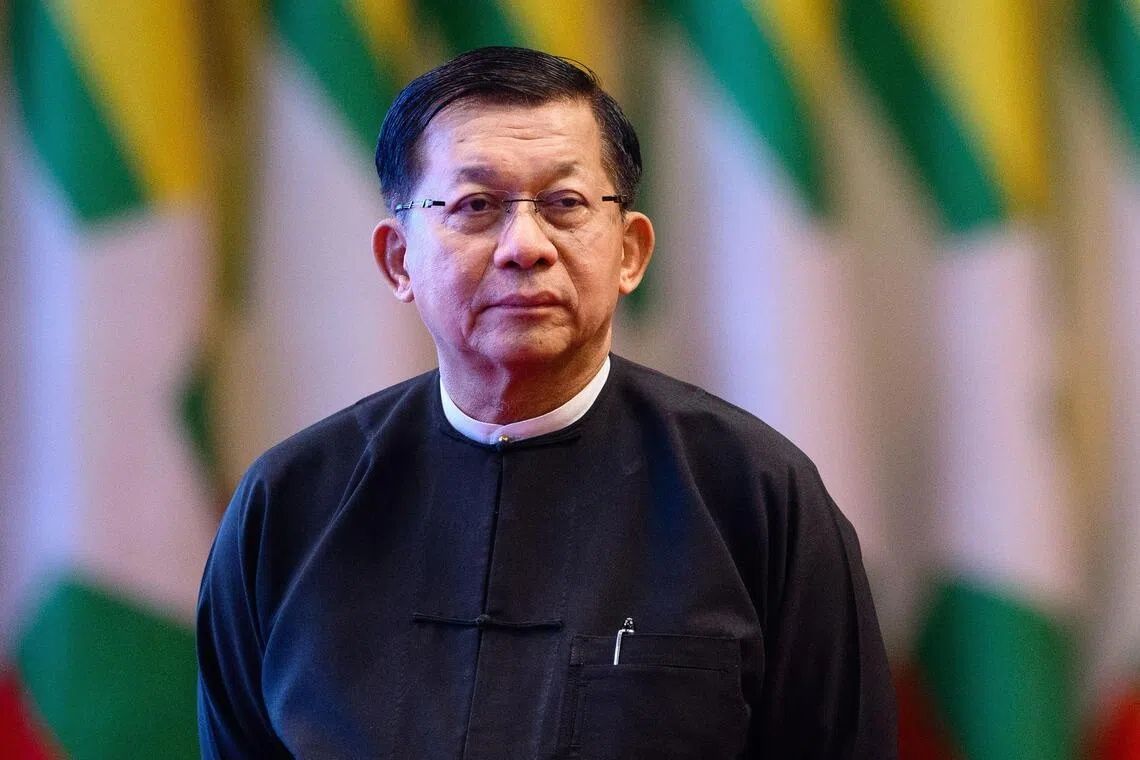
Myanmar's former military strongman Min Aung Hlaing touched down in Bangkok on Thursday for a carefully choreographed state visit that underscores his determined campaign to restore his country's diplomatic credibility within Southeast Asia. The three-day mission represents a significant symbolic gesture—his first travel to Thailand since shedding his general's uniform to assume the civilian presidency, a role he secured through what international observers have dismissed as stage-managed elections designed to provide democratic veneer to authoritarian rule.
The backdrop to this diplomatic manoeuvre remains unforgiving. Min Aung Hlaing orchestrated the February 2021 military coup that toppled Aung San Suu Kyi's elected government, unleashing a cascading humanitarian catastrophe that has claimed more than 100,000 lives across Myanmar's fractured political landscape. The subsequent three years have witnessed an intensifying civil war involving armed resistance movements, ethnic insurgent armies, and a military establishment struggling to maintain control. Yet despite this blood-soaked record, Min Aung Hlaing has methodically transformed his image through constitutional machinations, positioning himself as a civilian leader worthy of regional acceptance.
Thailand's willingness to host the Myanmar leader reflects Bangkok's pragmatic assessment of its own security interests. As Myanmar's immediate neighbour, Thailand has experienced direct spillover from the ongoing conflict—sporadic military clashes routinely cross the shared border, forcing Thai authorities to manage complex humanitarian flows. The kingdom currently shelters approximately two million refugees and migrants from Myanmar, straining social services and complicating border management. Beyond human displacement, Thailand grapples with transnational criminal networks that exploit Myanmar's ungoverned spaces, particularly cybercrime operations targeting Southeast Asian populations and drug trafficking syndicates that funnel illicit narcotics through Thai territory.
The timing of Min Aung Hlaing's visit carries particular weight within ASEAN's institutional architecture. Since the 2021 coup, the ten-member regional bloc has systematically excluded Myanmar's senior leadership from high-level summits and ministerial gatherings, a comparatively mild sanction reflecting ASEAN's traditional non-interference doctrine. Yet cracks in this consensus have appeared. Last month, Myanmar's foreign minister participated in an informal meeting with regional counterparts in Thailand, signalling that complete isolation may be softening. Thailand has emerged as the primary advocate for gradual reintegration, believing that engagement rather than ostracism offers the best pathway toward stability along the volatile border.
Min Aung Hlaing has been deliberately building diplomatic momentum through selective international visits. Trips to India and China—both geopolitically significant powers with overlapping interests in Myanmar—have been carefully documented, while a visit to Laos, an ASEAN member sympathetic to Myanmar's situation, provided a regional validation of sorts. Each journey represents a calculated step toward normalisation, designed to demonstrate that Myanmar's ostracism serves nobody's interests and that the international community should acknowledge the new political reality.
Yet underlying this apparent progress lies a fundamental contradiction that independent analysts have identified. While Min Aung Hlaing projects an image of regional responsibility through official channels and diplomatic courtesies, his government simultaneously rejects the substantive framework that ASEAN established to address Myanmar's crisis. The bloc's five-point consensus, developed to encourage dialogue involving all political stakeholders and civil society, represents the international community's best hope for resolving the conflict through inclusive negotiation. Myanmar's junta-installed civilian government has flatly refused to engage with this framework, instead pursuing a zero-sum military strategy aimed at defeating rather than negotiating with opposition forces.
This paradox exposes the hollowness of Min Aung Hlaing's diplomatic offensive, according to independent Myanmar analyst David Mathieson. The former general simultaneously wants ASEAN recognition as a responsible member state while fundamentally rejecting the institutional obligations such membership entails. This selective engagement strategy allows Myanmar to harvest the diplomatic benefits of reintegration—restored trade relationships, regional legitimacy, relief from collective pressure—without accepting any constraints on its military operations or accountability mechanisms.
Thailand's Foreign Minister Sihasak Phuangketkeow has indicated that bilateral discussions will address criminal networks flourishing in Myanmar's borderlands, where Burmese territory provides haven for cybercrime operations targeting Thailand and wider Southeast Asia. The two sides are expected to formalise a memorandum of understanding on labour cooperation, recognising the economically vital migrant worker flows between the countries. From Thailand's perspective, maintaining functional diplomatic channels creates opportunities to negotiate on security matters that directly affect Thai national interests, even while Myanmar's human rights trajectory remains dire.
Meanwhile, Aung San Suu Kyi's situation continues to reflect the regime's arbitrary exercise of power. The former democratic leader remains under house arrest following controversial trials that human rights groups have condemned as politically motivated show proceedings. Her permitted meeting with an International Committee of the Red Cross representative on Monday represents a marginal concession, the first publicised encounter with any foreign official since her ouster. This carefully rationed access suggests the regime views even minimal humanitarian oversight as a negotiable commodity, a signal it can deploy during diplomatic initiatives to demonstrate reasonableness without substantively altering its governance approach.
Thursday's ceremonial welcome at Bangkok's Government House, complete with honour guard and one-on-one meetings with Thai Prime Minister Anutin Charnvirakul, projects normalcy onto what remains an abnormal situation. The state dinner and business forum attendees will conduct themselves according to conventional diplomatic protocols, yet the guest of honour remains wanted by the International Criminal Court for crimes against humanity and faces sanctions from multiple Western nations.
Critics have grown vocal about Thailand's apparent rehabilitation of the Myanmar leader. Human rights organisations including Justice For Myanmar argue that diplomatic red carpets legitimise a figure responsible for systematic atrocities and that Myanmar's military leadership must face accountability rather than receive international acceptance. This tension between pragmatic engagement and principled accountability will likely define Myanmar's place within regional politics for years to come, forcing Southeast Asian nations to continuously negotiate between strategic interests and human rights commitments.

