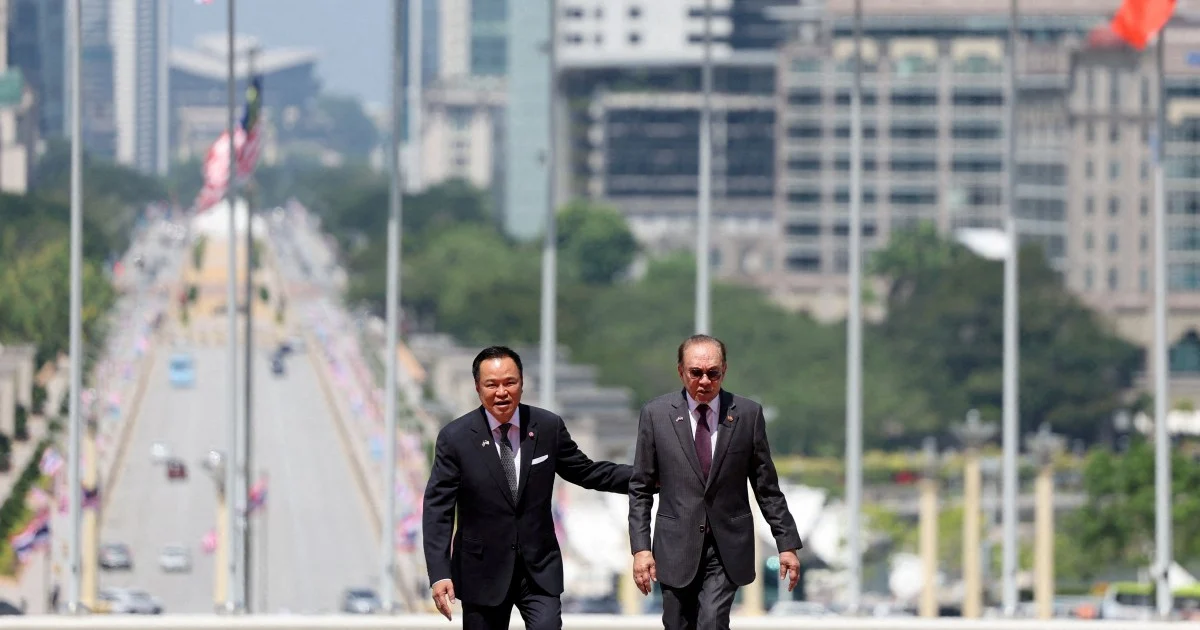
Malaysia's government believes that Myanmar's ongoing political turmoil cannot be resolved through military force or external pressure alone, but rather through structured dialogue involving all significant actors with a stake in the country's future. Prime Minister Datuk Seri Anwar Ibrahim made this position clear during remarks in Putrajaya today, underscoring his administration's commitment to principled engagement on one of Southeast Asia's most destabilising crises.
The statement reflects Malaysia's broader diplomatic strategy towards Myanmar, a neighbouring nation whose instability threatens regional peace and creates humanitarian spillover effects across the Association of Southeast Asian Nations. Since Myanmar's military staged a coup in February 2021, the country has descended into civil conflict, with armed resistance movements challenging junta control across multiple regions. The situation has forced hundreds of thousands to flee their homes, straining resources in Thailand and Bangladesh, while raising concerns about potential refugee flows into Malaysia.
Anwar's emphasis on inclusivity distinguishes Malaysia's approach from those favouring sanctions or isolation of the military regime. This stance acknowledges the complexity of Myanmar's landscape, where power is fragmented among the military council, underground civil disobedience organisations, ethnic armed groups, and competing shadow administrations claiming legitimacy. Each faction controls territory, commands armed forces, or represents significant populations, making genuine resolution impossible without bringing them into the process.
The principle of self-determination embedded in Anwar's comments respects Myanmar's sovereignty while challenging the military's assertion that it alone can speak for the nation. This framing aligns with Malaysia's longstanding support for national sovereignty in ASEAN discourse, yet pushes back against the junta's narrative of internal security operations. By insisting the Burmese people themselves must shape outcomes, Anwar signals that external actors including Malaysia should facilitate rather than impose solutions.
Malaysia's position carries particular weight given its geographic proximity, significant ethnic and cultural ties with Myanmar, and status as a moderate Muslim-majority nation with diplomatic reach across religious and ideological divides. The country hosts substantial numbers of Rohingya refugees, giving it tangible stakes in Myanmar's stability. Additionally, Malaysian officials have previously maintained unofficial channels with various Myanmar factions, positioning the country as a potential honest broker in regional mediation efforts.
The broader context involves ASEAN's awkward balancing act regarding Myanmar. The bloc's consensus-based decision-making and non-interference principles have prevented unified action, while the military junta's defiance of ASEAN's Five-Point Consensus has exposed the organisation's limited leverage. Individual member states including Malaysia have pursued bilateral engagement with different Myanmar actors, though these efforts have yielded limited visible progress.
Inclusive engagement frameworks require difficult practical choices about which parties qualify as legitimate stakeholders. The military's control of state institutions and international recognition contrasts with the opposition's democratic credentials but fragmented military capacity. Ethnic armed groups command territory and armed forces but often pursue narrower regional interests. The opposition's National Unity Government operates from exile, commanding genuine grassroots support but no territorial control. Reconciling these competing claims to legitimacy constitutes perhaps the central challenge for any meaningful dialogue process.
Malaysia's framing also carries implications for how the international community might support resolution efforts. Rather than demanding junta capitulation or immediate elections, inclusive engagement suggests sequenced processes building trust across divides. This could involve humanitarian ceasefires, confidence-building measures, and phased negotiations addressing fundamental questions of governance structure and power distribution before elections occur. The approach requires patience and investment in dialogue infrastructure that many international actors find frustratingly slow.
For Malaysian readers, the stakes extend beyond abstract principles of regional stability. Myanmar's dysfunction affects economic integration across ASEAN, limits trade and investment flows, and creates security challenges along shared borders. Unresolved conflict perpetuates refugee flows and trafficking networks that impact Malaysian communities. A Myanmar trapped in endless civil war fragments ASEAN's collective voice in geopolitical competition with major powers, reducing the bloc's influence in addressing challenges from South China Sea disputes to great power strategic competition.
Anwar's emphasis on allowing Myanmar's people self-determination also implicitly critiques external powers, particularly China and Russia, which have provided diplomatic cover and material support to the military council. By stressing Burmese agency, Malaysia positions inclusive engagement as respecting genuine autonomy rather than replacing military authoritarianism with great power clientelism. This reflects Southeast Asian concerns about becoming caught between competing external powers, a theme resonating throughout the region's approach to Myanmar.
Implementing inclusive engagement faces formidable obstacles. Trust remains devastated after military violence against civilians and opposition figures. Armed factions continue fighting for territorial advantage, suggesting preconditions for negotiations remain unmet. International divisions over Myanmar complicate mediation efforts, with some powers prioritising stability over justice concerns. Malaysian diplomacy will need to navigate these treacherous waters while maintaining credibility with multiple factions and managing domestic political expectations about outcomes.

