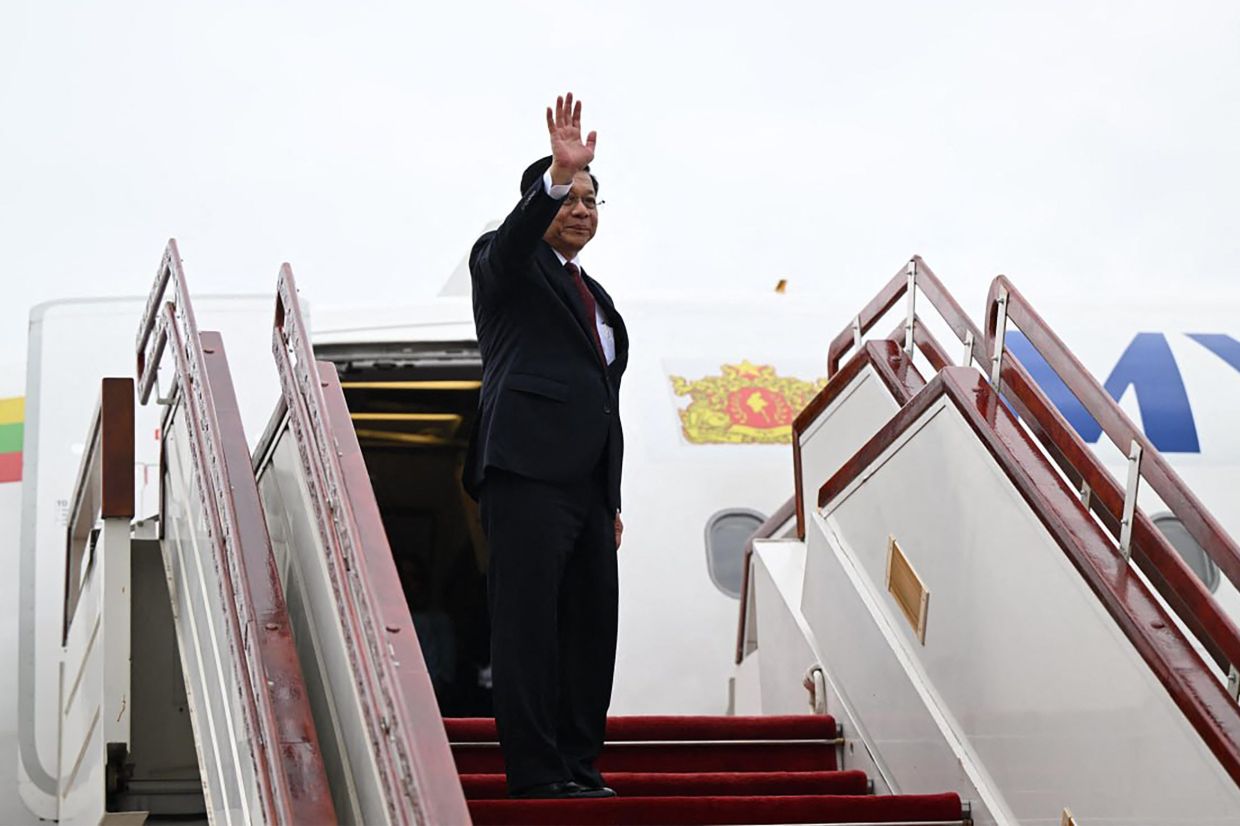
Myanmar's military leader Min Aung Hlaing embarked on a significant diplomatic journey to Moscow on Monday, 17 August, in what represents his inaugural visit to the Russian capital since transitioning to the civilian presidency. The Myanmar government confirmed the departure, underscoring the strategic importance Naypyidaw places on cultivating deeper ties with Moscow at a time when the nation remains isolated from much of the Western world. Accompanying the Myanmar leader are senior government officials, signalling the high-level nature of engagement planned during the visit.
The timing and destination of this mission reflect the peculiar international position in which Myanmar finds itself following the February 2021 military coup that toppled the democratically elected administration of Aung San Suu Kyi. In the aftermath of that intervention, Russia emerged as a steadfast diplomatic ally when most Western powers and regional democracies moved swiftly to condemn the military takeover. This consistent backing has cultivated a foundation of goodwill that extends beyond mere diplomatic courtesy, transforming into substantive strategic partnership.
The human cost of the political upheaval has been staggering. The ensuing civil conflict has claimed over 100,000 lives according to casualty estimates, while displacing millions more across the country's fractured landscape. This ongoing violence has fractured Myanmar's society along military and anti-coup resistance lines, with various armed groups continuing to challenge government control in multiple regions. Against this backdrop of internal strife, Min Aung Hlaing's cultivation of external partnerships serves partly as a stabilising mechanism for his administration's legitimacy.
Min Aung Hlaing's elevation to the presidency came in April through elections that were widely derided by international observers and democracy advocates as fundamentally compromised. The electoral process itself was conducted under conditions controlled entirely by the military, raising fundamental questions about its democratic credentials. Neither Western governments nor prominent monitoring organisations recognised the legitimacy of the outcome, yet this did not deter Russia from continuing its engagement with the newly installed leader.
During his Moscow engagement, Min Aung Hlaing is scheduled to meet with several top Russian officials including Prime Minister Mikhail Mishustin and Vyacheslav Volodin, the speaker of the State Duma, Russia's lower parliamentary chamber. These meetings will encompass both bilateral discussions and a Myanmar-Russia economic forum, indicating that the agenda spans security matters alongside commercial and investment opportunities. The breadth of participation signals Russian commitment to deepening institutional connections beyond presidential-level diplomacy.
The defence dimension of this partnership assumes particular significance given Myanmar's military situation. The country's armed forces have extensively relied on Russian-made combat aircraft in their operations against various resistance movements and rebel factions throughout Myanmar's territory. These jets have been deployed in numerous military operations, many of which human rights organisations and conflict monitors have accused of causing civilian casualties. Some of these incidents have been characterised as potential war crimes under international humanitarian law, though Myanmar's government disputes these allegations.
Formalising military cooperation represents a central pillar of the bilateral engagement. Myanmar and Russia signed a comprehensive five-year military cooperation agreement in February, though specific details regarding the scope and scale of potential arms transfers, training arrangements, or joint exercises remain largely undisclosed. This strategic silence around implementation details reflects both nations' preference for conducting security partnerships away from international scrutiny. The agreement establishes a framework that could encompass everything from weapons procurement to intelligence sharing and personnel exchanges.
Beyond the military sphere, Myanmar's leadership seeks to leverage the Russian relationship for economic revitalisation. Myanmar's economy has contracted significantly since the coup, with international sanctions, investment withdrawals, and tourism collapse combining to create severe fiscal pressures. Russian engagement offers potential avenues for accessing capital, technological expertise, and markets that might otherwise prove unavailable to a pariah state. The bilateral economic forum included in Min Aung Hlaing's schedule reflects hopes that Russian firms might fill investment gaps left by Western and Japanese corporations that have scaled back operations.
For Myanmar, Russia represents a crucial diplomatic lifeline in an otherwise hostile international environment. The visit must be understood as part of a broader rehabilitative strategy pursued by Min Aung Hlaing since his April appointment. He has undertaken multiple overseas trips to China, India, and Thailand, systematically attempting to cultivate diplomatic relationships and present Myanmar as a state returning to normalcy. Each such journey serves to legitimise his government internationally while demonstrating that Myanmar retains strategic importance to major regional and global powers.
From a Southeast Asian perspective, Myanmar's deepening Russian ties carry broader implications for regional geopolitics. As the Association of Southeast Asian Nations attempts to chart an independent course amid great power competition, Myanmar's orientation toward Moscow creates additional complexity. ASEAN's principle of non-interference faces challenges when member states pursue partnerships that other members view with concern. The Russian relationship also positions Myanmar outside the Western-aligned security architecture that increasingly shapes regional dynamics, potentially affecting future ASEAN cohesion on security matters.
The significance of this Moscow visit extends beyond symbolic diplomatic courtesies. It reflects the consolidation of a partnership rooted in Russia's strategic interests in maintaining influence across Asia-Pacific, Myanmar's desperation to access external support, and the narrowing of international options available to the military regime. As Myanmar's civil conflict continues and humanitarian conditions deteriorate, the Russia relationship may become even more consequential for the military leadership's survival and for regional stability more broadly.
Looking forward, Min Aung Hlaing's engagement with Russia and other Asian powers suggests that Myanmar's international rehabilitation will follow an Asia-centric trajectory rather than reconciliation with Western democracies. This realignment has significant implications for Myanmar's role within ASEAN, its relationship with democratic movements within its borders, and the broader distribution of influence across Southeast Asia as regional powers compete for advantage.

