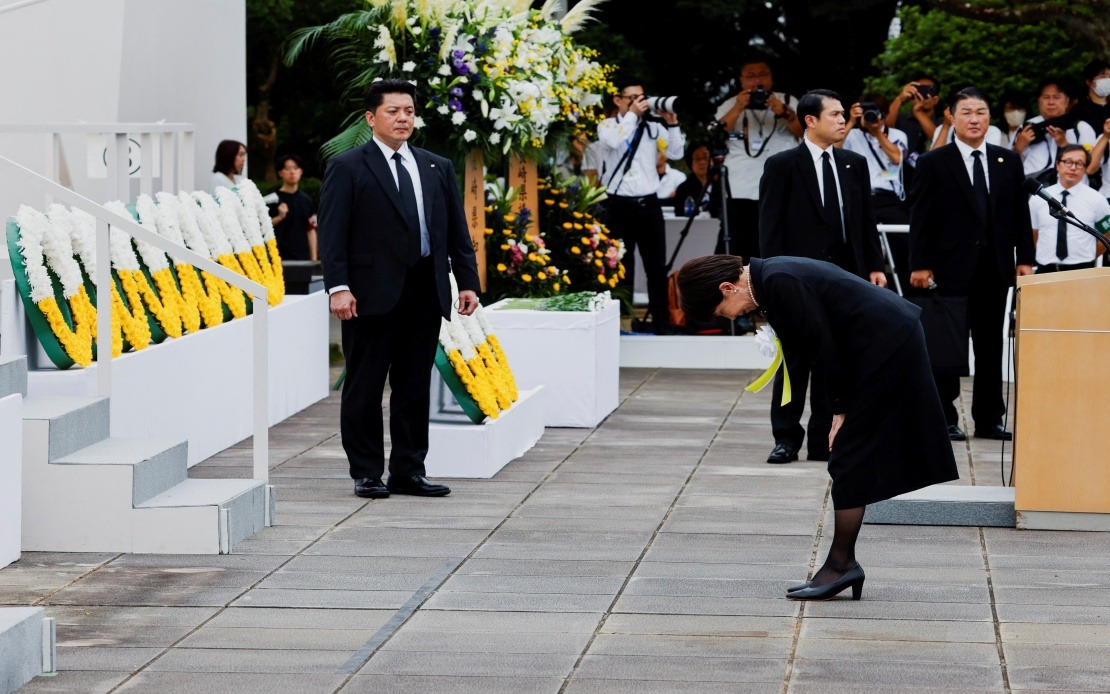
Nagasaki on Sunday observed the 81st anniversary of the American atomic bombing that devastated the southwestern Japanese city during World War II, a remembrance tinged with urgency as contemporary geopolitical tensions have reignited contentious discussions about nuclear weapons and global security. The commemoration arrived amid a landscape where nations face mounting pressure to prevent nuclear proliferation, yet paradoxically, some policymakers question whether traditional non-proliferation frameworks remain viable or sufficient.
The ceremony centered on the precise moment of destruction: 11:02 a.m. on August 9, 1945, when the "Fat Man" plutonium device detonated above the city, making Nagasaki the last place on Earth to endure a nuclear attack. Mayor Shiro Suzuki was expected to address the gathered survivors and world representatives, emphasizing that coexistence between humanity and nuclear weapons remains fundamentally impossible. His remarks reflected the moral and existential argument that underpins survivor advocacy—that the horrors unleashed upon Nagasaki and Hiroshima must never be repeated, and that this reality should compel governments toward disarmament rather than deterrence.
Prime Minister Sanae Takaichi attended the ceremony, alongside a statement from UN Secretary-General António Guterres, underscoring international attention to the occasion. The government leadership's presence signals Japan's enduring commitment to its non-nuclear stance, a positioning that has become increasingly complex as regional security dynamics shift. For Malaysian and Southeast Asian observers, Japan's stance carries particular weight, as the region's stability partly depends on how major powers navigate nuclear weapons policy.
The bombing's human toll remains staggering: approximately 74,000 people perished in Nagasaki by the end of 1945, with countless others experiencing lifelong radiation-related illnesses and psychological trauma. Japan surrendered six days later on August 15, concluding World War II. Yet the historical devastation serves merely as context for present-day discussions; what animates contemporary debate is whether Japan should reconsider its three non-nuclear principles—not producing, possessing, or permitting nuclear weapons on its soil—in light of emerging threats from North Korea and China's military modernization.
Following the Hiroshima ceremony on August 6, Takaichi explicitly reaffirmed that the government "is upholding" its non-nuclear policy, a statement that attempted to settle internal disputes. However, the fact that such clarification was necessary reveals cracks in the national consensus. Some Japanese defense analysts argue that extended deterrence from the United States, coupled with the ambiguous possibility of future nuclear capability, may better deter adversaries than a rigid non-nuclear stance. This debate, while distinctly Japanese in character, mirrors broader Asian security concerns where nuclear weapons loom as a tool some nations view as essential for survival.
The international dimension of Nagasaki's commemoration gained further relevance through the May review conference of the Nuclear Non-Proliferation Treaty (NPT), held in New York. For the third consecutive time, the monthlong meeting concluded without consensus, highlighting deep fractures in the global disarmament architecture. The NPT, designed to prevent the spread of nuclear weapons and promote eventual disarmament, has become increasingly ineffective as geopolitical rivalries intensify and emerging powers question whether the treaty perpetuates an unjust hierarchy of nuclear "haves" and "have-nots." For Southeast Asian nations, particularly those without nuclear weapons, the NPT's erosion raises uncomfortable questions about long-term security arrangements.
The hibakusha—atomic bomb survivors—and their advocacy networks have become crucial voices in contemporary nuclear discourse. With the average age of officially recognized survivors now exceeding 86 years, these witnesses to nuclear devastation face a race against time to transmit their experiences to younger generations. Their testimonies offer something no policy document or strategic analysis can provide: visceral, embodied knowledge of what nuclear weapons actually do. As these voices diminish with each passing year, the moral urgency they represent risks being subsumed by abstract strategic calculations.
For Malaysian policymakers and the broader Southeast Asian community, Nagasaki's anniversary invites reflection on regional non-proliferation frameworks and the credibility of security guarantees. Malaysia, as a non-aligned nation participating in regional forums like ASEAN, has historically advocated for denuclearization, particularly regarding the South China Sea and the broader Indo-Pacific. However, the weakening of global disarmament commitments, exemplified by the failed NPT conferences, suggests that regional actors cannot rely solely on international treaties. This reality necessitates deeper thought about how ASEAN might strengthen collective security without triggering an arms race.
The tensions between deterrence and disarmament that frame contemporary nuclear debate reflect genuine dilemmas without easy resolution. Japan's position—maintaining non-nuclear status while benefiting from American extended deterrence—represents a delicate compromise that increasingly appears unsustainable to some Japanese observers. Yet abandoning it would fundamentally alter Northeast Asian security dynamics and potentially trigger a regional arms race. For Southeast Asia, watching how Japan navigates this choice carries direct implications for regional stability and the viability of non-proliferation norms.
Nagasaki's 81st anniversary thus transcends historical commemoration. It serves as an anchor for moral arguments about nuclear abolition while simultaneously illustrating how geopolitical realities often override such moral imperatives. The attendance of high-level Japanese officials, combined with the explicit reaffirmation of non-nuclear principles, signals resolve. Yet the very need for such reaffirmation, emerging amid a time of rising tensions, suggests that this resolve is being tested as never before since the end of the Cold War.

