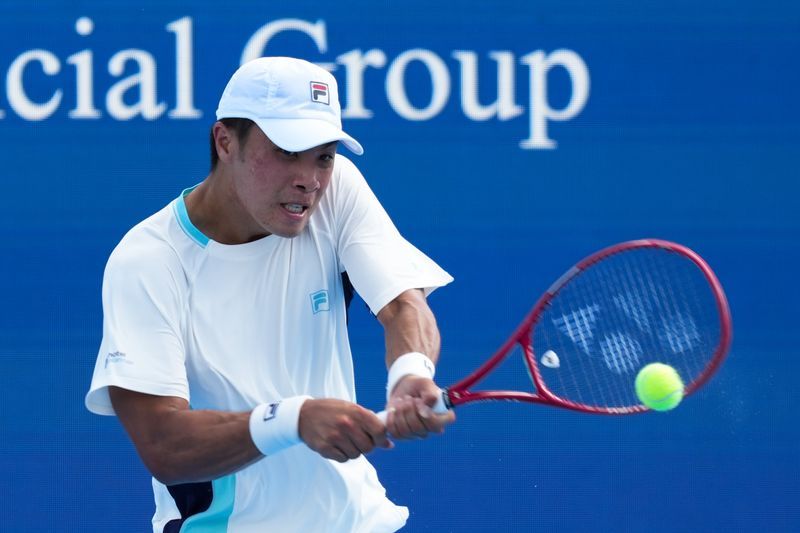
Brandon Nakashima has established himself as one of the most dangerous players on the North American hard-court circuit, demonstrating his capabilities once again at the Cincinnati Open on Friday with a dramatic three-set victory over sixth-seeded American rival Taylor Fritz. The 25-year-old's 7-6(9) 4-6 6-3 triumph delivered another compelling reminder of his resurgent form, propelling him into the semi-finals of the prestigious Masters 1000 event and maintaining his remarkable momentum heading towards the U.S. Open later this month.
Nakashima's achievement carries particular significance given his trajectory over consecutive weeks. By reaching the last four at Cincinnati, he has now accomplished the same feat at back-to-back Masters 1000 tournaments following his run in Montreal the previous week. This consecutive progression through elite tournament stages underscores a fundamental shift in his competitive standing within professional tennis, suggesting that his emergence as a formidable force represents something more than a fleeting hot streak. For Malaysian tennis enthusiasts and regional players monitoring the tour, Nakashima's ascent demonstrates how sustained hard-court specialization and mental resilience can transform a player's positioning within an increasingly competitive landscape.
The opening set epitomized the calibre of tennis both competitors brought to the court. Nakashima entered the match carrying a modest 1-4 head-to-head record against Fritz, a statistical backdrop that typically favours experience and familiarity. However, the American's recent elevation in confidence appeared to neutralize such historical disadvantages. With both players commanding their service games with precision, the set extended to a tiebreak—a format that often decides tight opening frames at the highest levels. The tiebreak itself unfolded as a miniature contest within the larger match, featuring multiple lead changes and strategic mini-breaks. Nakashima eventually prevailed when Fritz's ball landed just beyond the baseline at the critical moment, with Nakashima converting his fifth set point to seize the opener.
Fritz responded with characteristic aggression in the second set, recalibrating his approach through enhanced returning pressure that yielded an early break. The sixth seed's confidence visibly elevated following this breakthrough, and he consolidated with a powerful ace to close the set decisively at 6-4, forcing the encounter into a deciding third set where tension would inevitably escalate given the stakes involved.
The third set proved to be the defining passage where Nakashima's psychological fortitude truly separated him from his opponent. Fritz initially seized control by capitalizing on unforced errors to establish a 3-2 advantage, a position that promised momentum and potential victory. Yet Nakashima responded with the characteristic composure of a player experiencing an upward career trajectory. From 30-0 down, he recovered brilliantly to convert his second break point of the match and immediately equalize at 3-3. This particular moment functioned as a watershed within the match—Fritz's serving precision deteriorated noticeably while Nakashima's confidence continued ascending with each successful point.
The closing sequence witnessed Nakashima's complete dominance as he captured the final three games in succession. Fritz's error count accumulated visibly during this phase, and his confidence visibly eroded as his American rival served out the match with increasing assurance. This closing gambit proved decisive in a contest that might easily have tilted in the opposite direction had momentum shifted differently. Nakashima's capacity to convert these pressure moments reflects the mental architecture increasingly characteristic of players entering their prime competitive years.
Nakashima's victory represents his fourth top-10 scalp during the current season, a statistical achievement that gains enhanced significance when contextualized against his broader career trajectory. The 27th seed's emergence as a player capable of consistently challenging and defeating elite-ranked opponents suggests that the tour's competitive hierarchy may be experiencing subtle but meaningful shifts. For regional tennis development programs, Nakashima's path offers instructive lessons about the value of specialized court expertise and the importance of building confidence through structured tournament progression.
Looking ahead, Nakashima will confront either Italian 10th seed Lorenzo Musetti or fellow American Frances Tiafoe in the semi-finals. Both represent formidable opposition with their own legitimate aspirations for final advancement, yet Nakashima's current emotional momentum and tactical acuity position him as a genuine contender to reach the championship match. The Cincinnati semi-final will offer another opportunity to test himself against established players while the U.S. Open remains tantalisingly close on the tennis calendar.
For Southeast Asian observers of professional tennis, Nakashima's sustained performance surge carries instructive implications about player development and the importance of identifying young competitors during their breakthrough phases. His hard-court expertise particularly resonates given the regional tour's increasing integration with North American circuits and the rising profile of Asian players seeking to compete at similar elite levels. Nakashima's journey from fringe competitor to consistent tournament threat demonstrates that sustained improvement remains entirely achievable within professional tennis' demanding landscape.

