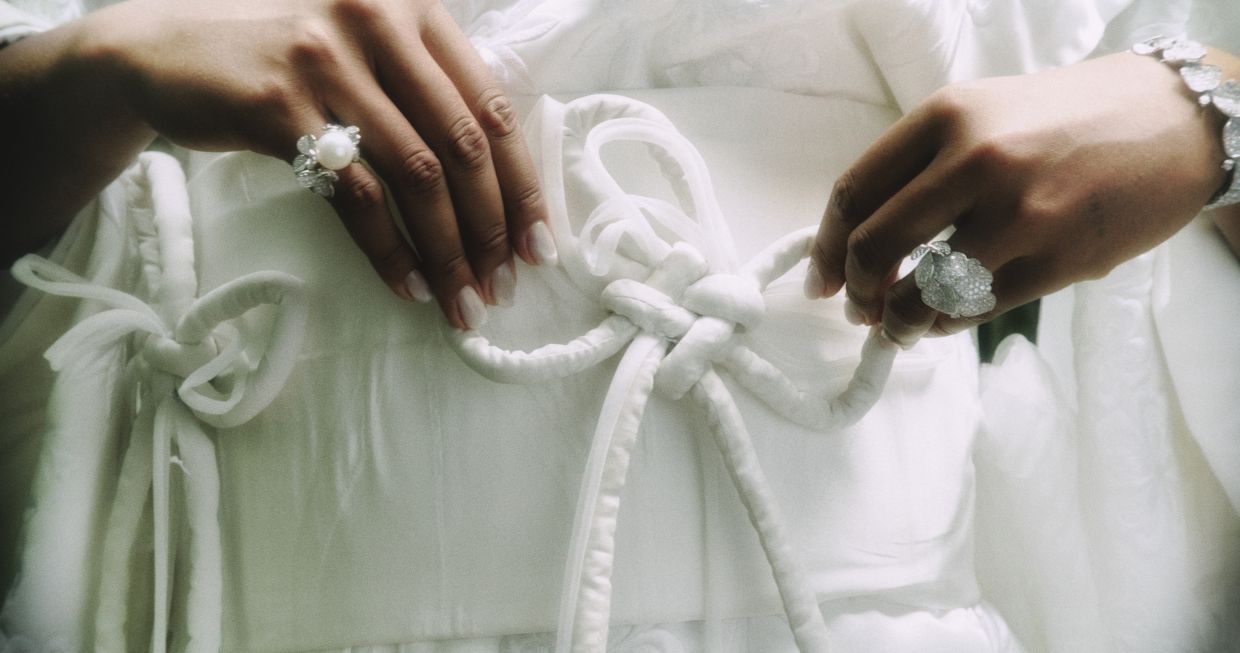
Naomi Osaka's appearance at Wimbledon this year represents far more than a fashion moment—it signals a deliberate reimagining of how elite athletes can command attention before competition even begins. The 14th-seeded former world number one made her court entrance in an all-white ensemble by Hana Yagi, a Tokyo-based independent designer, titled "Evolving Ceremony." Despite concerns about a foot injury that briefly threatened her participation, Osaka delivered what has become her signature move: a grand entrance that captures headlines and reshapes expectations around sports fashion.
The Wimbledon gown itself demonstrates extraordinary craftsmanship and conceptual depth. Hana Yagi drew inspiration from traditional Japanese dress codes, specifically modelling the piece on the kimono and the junihitoe—the formal 12-layer garment worn by noblewomen during the Heian period from 794 to 1185. Rather than creating something entirely new, Yagi employed seven different textiles salvaged from vintage kimonos, a traditional shiromuku wedding dress, and a deconstructed wedding gown. This approach to materials reflects a growing conversation in sports fashion about environmental responsibility and the reuse of luxury garments. The underlying Nike performance dress, adorned with Japanese kirigami-inspired floral appliques and micro-pleated details, further reinforced the cultural narrative Osaka was constructing.
This Wimbledon appearance forms the final chapter of what Osaka has established as a three-tournament arc of fashion storytelling. The sequence began at the Australian Open in January, where she emerged wearing a Robert Wun gown designed to evoke a jellyfish, complete with a butterfly hat that hinted at metamorphosis and her identity as a young mother. She then progressed to the French Open in a black corseted ballgown by Kevin Germanier, crafted as a tribute to the Eiffel Tower and assembled from upcycled Nike kits. These three looks, when examined collectively, reveal an intentional strategy far removed from simple aesthetic preference. Instead, Osaka is using her moments of maximum visibility to communicate distinct values: environmental sustainability, support for emerging talent, and conscious celebration of her Japanese identity.
The designer selection itself represents a deliberate choice to amplify underrepresented voices in fashion. Hana Yagi remains in her twenties and established her company in Tokyo after reaching finalist status in the International Talent Support competition held in Italy in 2019. By choosing Yagi, Osaka's stylist Marty Harper—who explicitly frames these collaborations as efforts to "give voices to new kids on the block"—has weaponised Osaka's visibility at one of tennis's most prestigious tournaments. Each designer collaboration extends Osaka's influence beyond her on-court performance, creating ripple effects throughout the fashion industry and positioning her as a curator of emerging talent.
The practical engineering required to execute these grand entrances far exceeds what casual observers might assume. Each tournament demands a custom couture piece that must be visibly striking from the furthest stadium seats, yet simultaneously removable within an extraordinarily tight timeframe. Harper revealed the compressed logistics: Osaka must be dressed in roughly three minutes and undressed in less than one minute before play begins. This constraint would paralyse most designers, but Yagi responded with meticulous problem-solving. She engineered the dress with nine detachable segments, each secured with Velcro, allowing the garment to be deconstructed and recombined in different configurations throughout the tournament as Osaka advances.
Additional practical considerations shape the final design. The dress features an adjustable train spanning nearly ten feet, a detail that might seem purely aesthetic but serves important functional purposes. Outer courts at Wimbledon position players so far from the lounge that a lengthy train could accumulate dirt or damage during the walk, necessitating variable train length depending on playing location. Yagi conceived the overall design philosophy as one of evolution, with the aesthetic transforming as Osaka progresses deeper into the tournament. "One of the key concepts was that the look would evolve as Naomi progresses," Yagi explained, noting that she experimented extensively to ensure the transformations would occur naturally rather than appearing forced.
The jewellery choices complete the carefully orchestrated narrative. Osaka wore pieces from Mikimoto, the legendary Japanese pearl house, grounding her entire appearance in a celebration of Japanese craftsmanship and heritage. The choices form a coherent statement: this is not a player reaching toward international fashion capitals but rather someone deliberately rooting her identity in her own cultural traditions while projecting them onto the global stage. Her public statement emphasised this balance: "Working with Hana allowed us to celebrate Japanese history and craftsmanship while creating something that feels entirely modern. I love that it feels both powerful and delicate at the same time."
For Malaysian and Southeast Asian audiences, Osaka's approach offers an instructive model of how regional talent and design houses can leverage global platforms. Her deliberate choice to highlight emerging Asian designers, sustainability practices, and cultural heritage resonates within a regional context increasingly focused on authenticity and sustainable fashion. While Western fashion houses continue to dominate tennis sponsorships, Osaka demonstrates that independent designers from Tokyo can compete at the highest levels of visibility and execution. This carries implications for how other athletes and cultural figures throughout Southeast Asia might approach their own public presentations and brand-building strategies.
The broader tennis world provides context for understanding why Osaka's fashion interventions carry such weight. Serena Williams established a precedent for using competition wear as personal expression rather than mere athletic uniform. Jannik Sinner, as a Gucci ambassador, represents the traditional model of luxury brand alignment. Osaka has charted a different path entirely—one that serves multiple constituencies simultaneously. She supports independent designers, advances environmental sustainability, celebrates cultural heritage, and constructs a distinctive personal brand that extends far beyond her tournament results. This multivalent approach distinguishes her strategic thinking about visibility and cultural influence.
The practical brilliance of Yagi's design solutions—the Velcro segmentation, the adjustable train, the engineered evolution—transforms what might otherwise be a vanity project into genuine problem-solving within severe constraints. These solutions emerged not from unlimited resources but from creative response to genuine operational limitations. The three-minute dressing window and sub-minute undressing requirement forced innovation rather than permitting compromise. Yagi's willingness to engage with these difficulties rather than dismiss them as impossible produced a garment that functions simultaneously as couture art, sustainable fashion statement, and practical competition wear.
Regardless of how Osaka performs within the tournament bracket itself, her fashion strategy has already secured victory in what might be termed the attention championship. Before a single serve is struck, before any match-point drama unfolds, the narrative has shifted to questions of design, heritage, sustainability, and emerging talent. This pre-match dominance extends Osaka's influence far beyond the tennis court, creating conversations that ripple through fashion media, sustainability discussions, and conversations about cultural representation in global sport. For athletes and public figures across Southeast Asia seeking to navigate the intersection of performance, cultural identity, and global visibility, Osaka's methodical, carefully considered approach to fashion and branding offers a blueprint for authentic engagement with both personal heritage and contemporary values.

