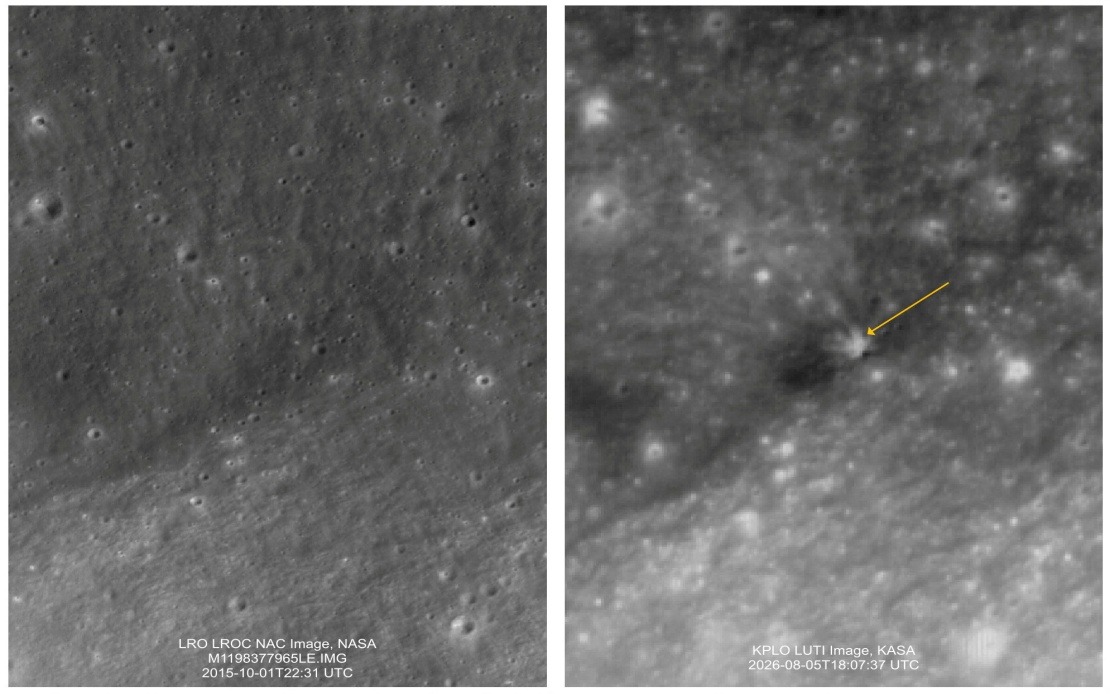
NASA has formally acknowledged that a substantial fragment from a spent SpaceX Falcon 9 rocket collided with the lunar surface in the early hours of August 5th, creating a crater on the Moon's face. The upper stage, weighing approximately four tonnes and measuring about the size of a house, struck at nearly 5,400 miles per hour, compressing 8,690 kilometres per hour into a violent and momentary impact. The admission came through NASA's own communications channels, with lunar scientist Kelsey Young providing reassurance to the public through a video statement released on the agency's X platform.
The collision itself was not the result of deliberate mission planning, Young clarified in her official address. Rather, the Falcon 9's upper stage, which had already completed its assigned tasks in space, encountered a predicament when its fuel reserves became depleted. Unable to perform the necessary manoeuvres to return toward Earth's atmosphere, the inert component maintained its trajectory toward the lunar body, ultimately reaching its unintended destination on the lunar surface. This sequence of events underscores how the challenges of orbital mechanics can lead to unexpected outcomes even for the world's most advanced space operators.
Despite the dramatic nature of a multi-tonne object striking another celestial body, NASA's position reflects a pragmatic view of space operations that many in the aerospace industry have come to accept. Young emphasised that the impact posed no hazard whatsoever to Earth or its inhabitants, a crucial distinction that prevents public alarm over routine space activities. The statement sought to contextualise an event that might otherwise sound catastrophic to outside observers as merely a consequence of standard disposal procedures within the constraints of space exploration.
Further perspective emerged from Young's explanation of how contemporary space missions manage end-of-life hardware. Rather than representing a failure or danger, deliberately directing spent rocket stages to impact the lunar surface has become an established practice within the industry. Mission operators frequently choose this approach for disposing of exhausted equipment, as it offers several operational advantages that make it preferable to alternative disposal methods. The strategy transforms a potential problem into a controlled and documented outcome.
The appeal of lunar impact disposal centres on its reliability and trackability as a waste management approach. Once a spacecraft or rocket component is on a trajectory toward the Moon, calculations become straightforward and the final disposition guaranteed. Unlike attempts to manoeuvre hardware into stable orbits or calculate complex atmospheric re-entry profiles, a lunar impact eliminates uncertainty about where the object will eventually end up. This predictability matters enormously in space operations, where surprises carry significant consequences and risks.
The Falcon 9 vehicle involved in this incident had launched on December 15, 2025, from Earth carrying a dual payload of considerable scientific importance. Firefly Aerospace's Blue Ghost lunar module and Japan's ispace Resilience lander both depended on the rocket's performance to reach their intended destination. The second stage successfully accomplished its primary objective of placing both spacecraft onto a trajectory toward the Moon, demonstrating that the mission itself was fundamentally successful despite what would follow.
The stage's inability to return to Earth stemmed from the physical realities of rocket fuel consumption and mission parameters. Having expended the propellant necessary to accelerate the lunar-bound payloads to the required velocity, the upper stage lacked sufficient reserves to perform any significant course correction or braking manoeuvre. In orbital mechanics, this constraint is fundamental and unavoidable—achieving the speeds needed to reach the Moon requires consuming nearly all available fuel. Once that threshold is crossed, the spent stage becomes merely an object following the laws of physics toward whatever destination its velocity and trajectory dictate.
From a Malaysian and Southeast Asian perspective, this incident illustrates the increasingly complex ecosystem of space activities unfolding above us. As commercial spaceflight companies like SpaceX expand their operations globally, and as regional nations pursue their own space exploration ambitions, understanding these orbital dynamics becomes relevant to policymakers and scientists across the region. Japan's participation through the ispace Resilience lander demonstrates how spacefaring activities now span across Asia, with Japanese companies working alongside American commercial operators.
The broader implication for Southeast Asia involves recognising that space is becoming an operational domain where multiple nations and commercial actors conduct simultaneous activities with global consequences. Malaysia's own space agency and satellite programs mean the nation has stakes in ensuring that international space operations maintain safety standards and transparent communication about activities like this one. The precedent that NASA and SpaceX have established through candid acknowledgment of the impact sets an important tone for accountability in an increasingly crowded orbital environment.
NASA's characterisation of the impact as acceptable and routine reflects how space agencies have adapted their thinking to accommodate commercial spaceflight and the inevitable byproducts of intensive launch schedules. Rather than viewing uncontrolled rocket fragments as inherently problematic, the approach recognises that some level of orbital and celestial debris is an inescapable consequence of modern space operations. The crucial distinction lies in whether such debris poses demonstrable risks to operating spacecraft, Earth-based infrastructure, or human safety—criteria that this particular impact clearly did not meet.
Looking forward, incidents like this one will likely become more common as launch rates increase and more companies enter the space transportation sector. The Moon itself, long viewed as a pristine domain, is gradually accumulating the detritus of our expanding space economy. While the impact creates no immediate hazard, the accumulation of such events raises longer-term questions about lunar surface preservation and whether future generations will regard our casual impact of rocket stages onto the Moon with the same equanimity we currently do. For now, NASA's position that this represents a predictable and technically sound disposal method appears to carry the day, but the calculus may shift as lunar activity intensifies.

