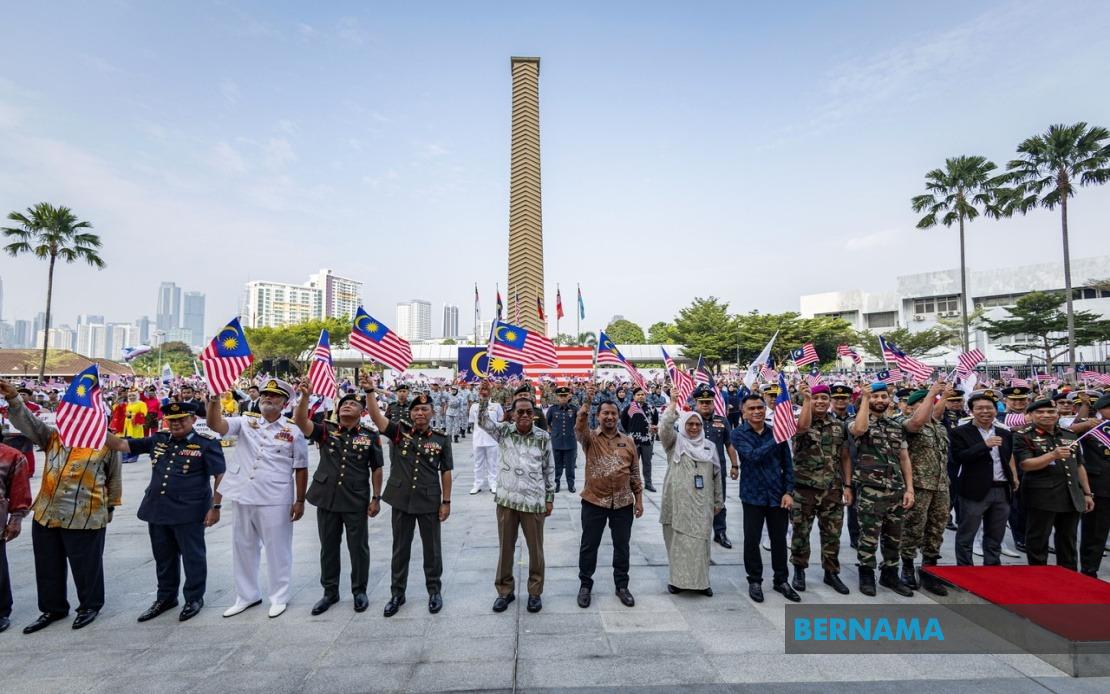
Defence Minister Datuk Seri Mohamed Khaled Nordin has urged Malaysians to view their National Day and Malaysia Day celebrations as occasions to deepen their patriotic commitment rather than platforms for airing grievances over contentious issues. Delivering remarks at the Defence Ministry's launch of the National Month and Fly the Jalur Gemilang campaign on Wednesday, Mohamed Khaled emphasised that the annual commemorations should be driven by genuine affection for the nation rather than by emotional reactions to specific policy disputes or social concerns.
The minister's comments appear directed at activist groups and civil society organisations that have called for boycotts or reduced participation in this year's celebrations. These campaigns have centred on Malaysia's handling of the Rohingya refugee situation, with critics arguing that the government's policies fall short of international humanitarian standards. Mohamed Khaled explicitly referenced this debate, expressing disagreement with the strategy of leveraging National Day observances as a means to protest against such matters.
His intervention reflects a broader tension within Malaysian public discourse about how national symbols and commemorative occasions should be utilised. While critics contend that patriotism encompasses the right to voice concerns about government policies and national direction, officials like Mohamed Khaled appear to view such displays as undermining national unity. The Defence Ministry's position suggests that using National Day to highlight grievances risks transforming what should be an inclusive, unifying moment into a divisive political statement.
Mohamed Khaled framed Malaysia's foundational character as resting upon pillars of mutual understanding and religious and ethnic harmony. By this reasoning, the preservation of national peace and sovereignty depends on all segments of society continuing to embrace these values. The minister's argument carries particular weight in the Malaysian context, where memories of communal tensions remain relevant to contemporary nation-building efforts. His invocation of these principles positions national unity as both a historical achievement and an ongoing responsibility requiring active commitment from citizens.
The call to fly the Jalur Gemilang with pride and gratitude represents another dimension of Mohamed Khaled's appeal. Rather than framing the national flag as a symbol available for various forms of civic expression, he presents it as an emblem specifically associated with appreciation for the nation and its founding principles. This framing implicitly suggests that using National Day or national symbols as vehicles for political criticism represents a departure from appropriate patriotic conduct.
Mohamed Khaled also highlighted the sacrifices of security personnel stationed at Malaysia's borders, integrating this recognition into his broader appeal for national solidarity. By connecting the flag-flying campaign to appreciation for military and security services, the Defence Ministry links ordinary citizen participation in National Day observances to concrete acknowledgment of those who defend the nation's integrity. This approach broadens the significance of the celebration beyond abstract patriotism to encompass gratitude for specific institutional contributions to national security.
The minister's remarks will likely resonate differently across Malaysia's diverse political and social landscape. Government supporters and those prioritising national cohesion will likely view his intervention as necessary guidance against instrumentalising patriotic occasions. Opposition voices and human rights advocates, conversely, may interpret such statements as attempts to suppress legitimate expression of dissent by invoking patriotism as a silencing mechanism. This fundamental disagreement about what patriotism permits reflects deeper questions about the relationship between national identity and political freedom in contemporary Malaysia.
For Southeast Asian observers, Mohamed Khaled's intervention highlights how different governments navigate tensions between unity-building and pluralism. While Malaysia's official ideology of harmony among diverse communities represents a considerable achievement, international scrutiny of issues like refugee policy indicates that external actors assess national performance against humanitarian criteria that may conflict with domestic political preferences. The Defence Minister's emphasis on the country as independent and sovereign subtly signals resistance to external influence on how Malaysia interprets its own patriotic obligations.
The timing of these remarks, released during the annual National Month campaign period, suggests institutional effort to shape public participation in August and September celebrations. By framing boycotts and politically motivated campaigns as incompatible with appropriate patriotic expression, the Defence Ministry attempt to establish normative boundaries around how the national occasion should be observed. Whether such messaging successfully discourages protest-oriented participation or instead generates counterarguments about the meaning of genuine patriotism remains to be seen as the celebration period unfolds.

