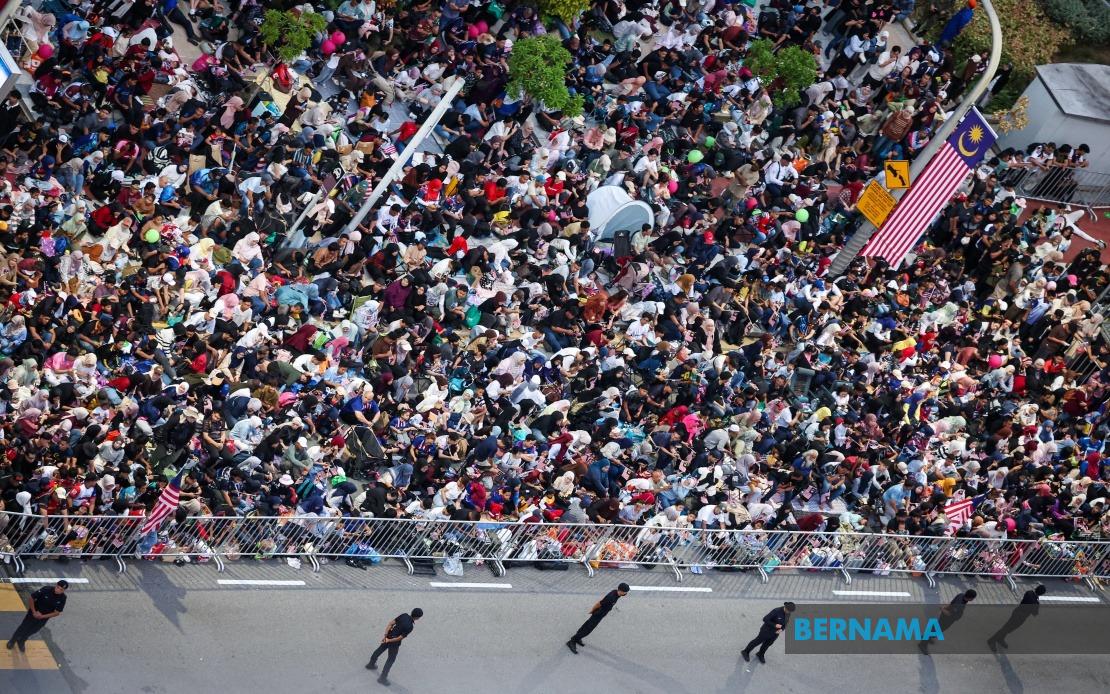
The anticipation surrounding Malaysia's 69th National Day celebration drew crowds to Dataran Putrajaya from the previous evening, with enthusiastic members of the public strategically positioning themselves well before the scheduled 8 am commencement of festivities. This year's ceremony, carrying the theme "Malaysia MADANI: Kesejahteraan Dinikmati", attracted visitors spanning multiple generations and backgrounds, each driven by their own motivations to experience the national commemoration up close and personally.
Among the early arrivals were young content creators whose professional ambitions shaped their pilgrimage to the capital's ceremonial grounds. Mock Wei Qi, a 23-year-old freelance photographer, along with his circle of friends, positioned themselves at the venue by 11 pm the previous evening, their objective clear and purposeful. For Wei Qi and his collaborators, the National Day spectacle represented more than a civic observance; it was an opportunity to demonstrate Malaysia's distinctive character through the medium of film and photography. Their mission to capture cinematically striking visuals that would communicate Malaysia's exceptional qualities to global audiences reflected how contemporary Malaysians engage with national occasions through creative expression and digital platforms.
The dedication demonstrated by Wei Qi's group exemplified how younger generations view major national events as platforms for artistic experimentation and cultural storytelling. By arriving hours before dawn, they positioned themselves not merely as spectators but as active participants in documenting and interpreting the nation's celebration for wider consumption. This approach speaks to the evolving relationship between public events and digital content creation, particularly among professionals seeking to establish their creative portfolios through high-profile national occasions.
Family units represented another substantial demographic within the early-bird contingent. A couple identifying themselves as As and Adib brought their children to Dataran Putrajaya by 5 pm the previous day, driven by a desire to rectify their experience from the preceding year's celebration. Their earlier arrival reflected a pragmatic lesson learned from previous attendance, where late timing had relegated them to peripheral vantage points. This year's strategy prioritised proximity to the main events, allowing their children to engage meaningfully with Malaysia's most significant patriotic observance and providing the family with unobstructed viewing opportunities that would enhance their collective memory of the occasion.
The calculation behind As and Adib's planning demonstrates how Malaysians strategically navigate major public events, weighing logistics and timing to maximise their experience. For families, attending the National Day celebration carries significance beyond mere entertainment; it functions as a pedagogical experience through which children develop consciousness of national identity and understand their role within the broader Malaysian community. The willingness to arrive hours early and potentially endure overnight stays underscores the seriousness with which Malaysian families treat these civic occasions.
Another family unit, headed by Ahmad Azri Onn aged 55, adopted a deliberately recreational approach to the overnight encampment. Arriving at approximately 5.30 pm with his wife and three children spanning ages ten to fifteen, Ahmad Azri reimagined the waiting period preceding the celebration as a family camping adventure rather than an inconvenience. The transformation of what might ordinarily be perceived as tedious anticipation into a shared experiential activity reflected his pedagogical philosophy regarding national occasions. By framing the early arrival and overnight vigil as an entertaining episode rather than a sacrifice, Ahmad Azri facilitated his children's engagement with the National Day ceremony while creating alternative family memories during their school holiday period.
The atmospheric conditions during the overnight gathering, including light drizzle that fell the previous evening, failed to dampen the enthusiasm of assembled crowds. Ahmad Azri noted that his family found the precipitation actually beneficial, as it provided relief from the typical heat associated with Dataran Putrajaya during early morning hours. This observation illustrates how participants adapted pragmatically to environmental circumstances, with weather becoming an element that enhanced rather than diminished their camping experience. The comfort of his children, secured through careful planning and positive attitude adjustment, ensured that the waiting period contributed positively to their overall engagement with the national celebration.
By morning, Dataran Putrajaya had transformed into a densely populated venue teeming with visitors positioning themselves for optimal viewing. The accumulation of these early arrivals created momentum throughout the day, with successive waves of later attendees discovering increasingly limited availability for desirable vantage points. This dynamic underscored an established pattern within Malaysian civic culture, whereby significant national events attract competitive behaviour regarding spatial positioning, reflecting the cultural weight assigned to witnessing major celebrations firsthand rather than through broadcast media.
The diversity of participants illustrated the broad cross-sectional appeal of Malaysia's National Day observance. Professional content creators sought to harness the event's visual spectacle for their commercial and artistic purposes, families endeavoured to construct shared national consciousness among younger generations, and older adults sought to participate in and witness the ceremonial affirmation of collective identity. These varied motivations coexisted within the same physical space, creating a rich tapestry of national engagement that extended beyond the actual ceremony itself into the preceding hours of anticipation and preparation.
The phenomenon of early arrivals and overnight camping reflects deeper dimensions of how Malaysians construct and maintain national identity through participatory engagement with state-sanctioned occasions. For a diverse and geographically dispersed population, the National Day celebration at Dataran Putrajaya serves as a symbolic gathering point where citizenship is publicly performed and renewed. The willingness of thousands to sacrifice sleep and endure discomfort to secure advantageous viewing positions suggests that attendance at this event transcends conventional entertainment consumption, instead functioning as an assertion of belonging and investment in the national community.

