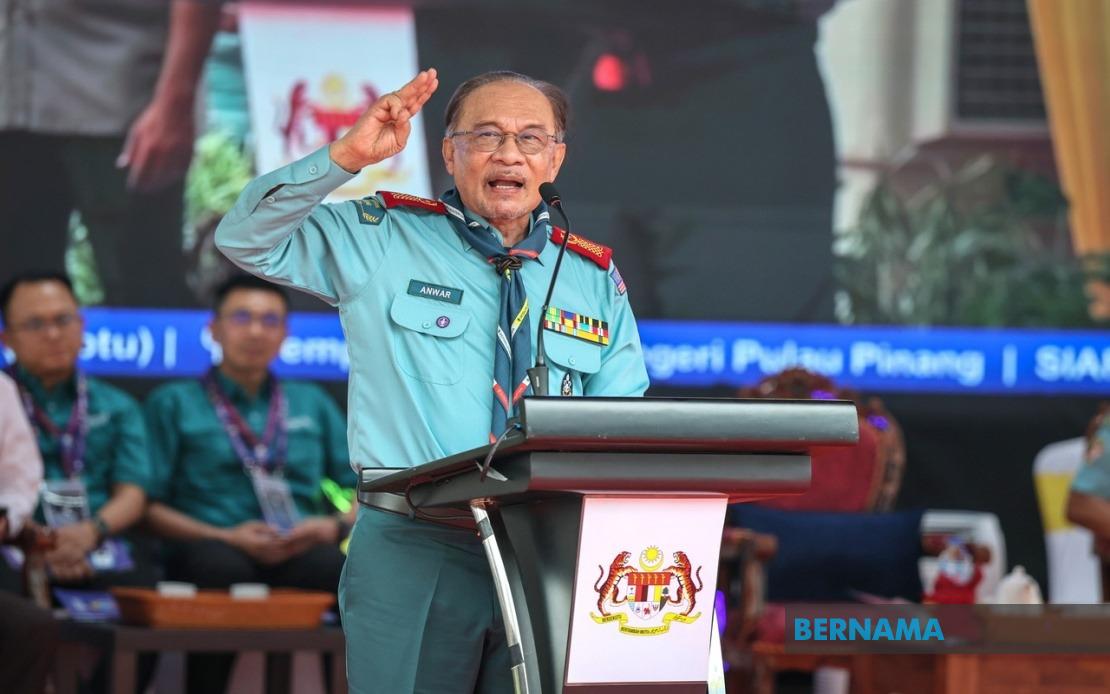
Datuk Seri Anwar Ibrahim has articulated a vision of national development that transcends the conventional metrics of economic growth and technological prowess. Speaking at the 15th Malaysian Scouts Jamboree in Penang, the Prime Minister positioned moral education and generational discipline as equally vital pillars for Malaysia's future trajectory. His remarks underscore a growing concern among policymakers that rapid modernisation, while economically beneficial, must be tempered by investment in character formation and ethical grounding among young Malaysians.
Anwar's intervention reflects a philosophical stance that distinguishes his administration's approach to youth development. Rather than viewing education as primarily instrumental—a pathway to economic productivity—he framed it as foundational to creating citizens capable of serving not just themselves but their communities and nation. The Prime Minister articulated this worldview bluntly, questioning the utility of technological advancement if accompanied by the erosion of values, discipline, and familial responsibility. This reframing carries particular resonance in Southeast Asia, where rapid digitalisation and globalisation have prompted similar anxieties among political leaders about cultural coherence and social cohesion.
The timing of these remarks at MYJAM15, which brought together more than 5,450 scouts from eleven countries including South Korea, Indonesia, Singapore, and Sri Lanka, was deliberately symbolic. The jamboree provided Anwar an international platform to articulate Malaysian values and underscore the nation's commitment to character-building alongside skills development. The gathering's international dimension—featuring participants from across the region and beyond—allowed the Prime Minister to position Malaysia's youth leadership model as a competitive advantage in a region grappling with similar questions about balancing modernisation with cultural preservation.
Anwar specifically highlighted the tension between technological advancement and cultural rootedness. He cautioned that as the younger generation navigates artificial intelligence and rapid information technology developments, they must not become unmoored from the values and traditions that constitute their cultural foundation. This represents a middle-ground position: rejecting both wholesale rejection of technology and uncritical embrace of it without consideration for social consequences. For Malaysian policymakers, this framing acknowledges that retreating from technological change is neither feasible nor desirable, but that such change must be managed through strong ethical frameworks.
The emphasis on unity in diversity within his address carries particular significance for Malaysia's multicultural context. Anwar stressed that the younger generation, positioned as future custodians of national leadership, must understand and embody this principle. In a country where communal harmony remains fragile and subject to periodic strain, cultivating leaders who genuinely appreciate and respect diversity becomes an explicit strategic objective. The Prime Minister's invocation of this theme suggests recognition that economic growth and technological prowess, without corresponding development of intercommunal understanding, could actually exacerbate social tensions rather than alleviate them.
The location of MYJAM15 in Penang carries historical resonance that Anwar subtly leveraged. The jamboree marks the first time the event has returned to the state in six decades, since Teluk Bahang hosted it in 1966. This milestone connects contemporary youth development efforts to Malaysia's post-independence trajectory, implicitly suggesting continuity between the nation-building efforts of the immediate post-colonial period and current governance challenges. The symbolism of returning to Penang—a state historically significant to Malaysian independence and development—reinforces the narrative that character formation among youth remains as central to national progress now as it was during the formative independence era.
Anwar's articulation of education's purpose deserves particular attention given Malaysia's ongoing struggles with educational quality and relevance. He positioned schooling, tertiary institutions, and universities as vehicles not merely for knowledge acquisition but for cultivating morally upright individuals prepared for service. This represents a challenge to purely instrumentalist educational models that emphasise marketable skills above all else. For Malaysia, where concerns about graduate employability and skills gaps persist, Anwar's framing suggests that addressing these issues requires not just curriculum revision but fundamental reconceptualisation of education's social mission.
The Prime Minister's call for nurturing patriotic spirit ahead of the 2026 National Day celebrations connected generational development to national occasions and civic ritual. By tying scouts' commitment to service and values to broader patriotic sentiment, Anwar positioned youth organisations as incubators of national loyalty and collective identity. This reflects a broader pattern in Malaysian governance where youth engagement is viewed as essential to maintaining national cohesion and forward momentum. In a region where generational divides increasingly shape political preferences and social attitudes, cultivating patriotic sentiment among scouts may represent an attempt to anchor younger Malaysians to nation-building narratives.
The international composition of MYJAM15 provides regional context for Anwar's remarks. The presence of scouts from neighbouring Indonesia, Singapore, and Sri Lanka, alongside those from South Korea, positions Malaysia within a regional conversation about development models and generational leadership. The jamboree becomes not just a domestic youth event but a platform for Malaysia to demonstrate its approach to balancing modernisation with values preservation. For neighbouring countries facing similar questions, Malaysia's emphasis on moral education alongside economic progress offers both a model and implicit critique of alternative approaches that deprioritise character development.
Anwar's emphasis on parental and familial responsibility within his education framework deserves consideration alongside contemporary Malaysian family structures. As urbanisation and economic pressures reshape traditional family arrangements, his call for instilling responsibility towards families reflects recognition that education cannot operate in isolation from family dynamics. This acknowledgment that moral development occurs within relational contexts—family, community, nation—positions schools and youth organisations as supplements to rather than replacements for family influence, a particularly important distinction in Malaysian society where extended family relationships remain significant.
The broader implications of Anwar's positioning extend beyond youth policy to fundamental questions about Malaysia's development trajectory. By insisting that progress encompasses moral and disciplinary dimensions alongside economic metrics, he challenges narrow utilitarian conceptions of national advancement. For Malaysia, where per capita income has risen substantially but social cohesion and public trust have shown volatility, this framing suggests recognition that economic development without corresponding social development may prove inadequate to meeting national aspirations. The Prime Minister's willingness to articulate this position publicly at a major national youth event signals that character and values formation remain central to his administration's development philosophy.
Moving forward, the challenge lies in translating these articulated principles into concrete policy mechanisms and resource allocation. Youth organisations like the Malaysian Scouts serve as crucial implementation vehicles, but scaling these approaches across the broader education system and society requires sustained political commitment and funding. Anwar's remarks establish a rhetorical foundation and policy direction, but realising a generation genuinely grounded in both knowledge and moral discipline demands systemic changes extending beyond inspirational speeches at jamborees. The 2026 National Day timeline he referenced may serve as a natural checkpoint for assessing progress on these developmental objectives.

