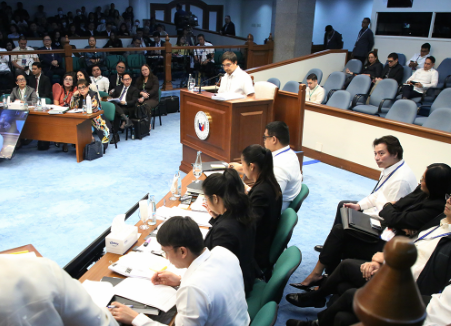
The impeachment trial of Vice President Sara Duterte intensified on Tuesday when National Bureau of Investigation regional director Jeremy Lotoc delivered testimony asserting that the country's second-highest official possessed both the will and the means to translate her publicly stated assassination threats into lethal action. The charge, emerging on the fifth day of proceedings before the Senate impeachment court, represents a critical prosecution argument as prosecutors build their case that Duterte's inflammatory remarks constitute a betrayal of public trust—an impeachable offence under the Philippine Constitution.
Lotoc, who previously headed the NBI's Cybercrime Division during the investigation into Duterte's incendiary statements, positioned himself as a key link between the bureau's investigative findings and the courtroom narrative prosecutors are constructing. The former Cybercrime chief asserted that investigators had thoroughly examined Duterte's remarks and concluded they satisfied all legal elements constituting grave threats. His testimony sought to establish that the Vice President's comments transcended mere rhetoric or political bombast, instead representing a calculated expression of murderous intent backed by genuine capability.
When pressed by Senate President Sherwin Gatchalian to elaborate on whether Duterte possessed the practical ability to execute her threats, Lotoc offered a succinct affirmation: "Definitely." He then anchored this assessment not solely to her official position but to her broader political pedigree. Recognizing that holding the vice presidency alone might not necessarily confer assassination capability, Lotoc pivoted to Duterte's family background—specifically her father's tenure as Philippine president—as evidence that she occupied a position within the country's political ecosystem with sufficient influence and access to potentially orchestrate violence against the nation's top leadership.
Central to the prosecution's strategy has been establishing that Duterte did not merely voice idle threats but rather contracted someone to execute her revenge fantasies should she herself face harm. Lotoc grounded the NBI's conviction on this point in Duterte's own public utterances, particularly her November 23, 2024 online press conference and a subsequent November 26 interview where she repeatedly asserted having spoken with someone about exacting vengeance if she were killed. The investigator stated flatly: "We believe the Vice President was not kidding when she made those remarks." He emphasized that investigators interpreted her language not as hyperbole but as a genuine acknowledgment that she had engaged in conversations with unidentified persons regarding potential assassination.
However, the investigation's foundation reveals a notable weakness that the defence subsequently attempted to exploit. When asked directly whether the NBI possessed independent evidence identifying the alleged hit man or even confirming such a person's existence, Lotoc acknowledged the bureau had none. The investigator conceded that the NBI's entire conclusion rested exclusively on Duterte's own statements and admissions, without corroborating documentation, witness testimony, or circumstantial evidence establishing contact with any would-be assassin. This admission opens substantial analytical space for scrutinizing whether the prosecution's case relies too heavily on extracting incriminating conclusions from the Vice President's own rhetoric without extrinsic confirmation.
The inability to independently verify the existence of any contracted assassin or gather evidence beyond Duterte's words became even more pronounced when Lotoc disclosed that the Cybercrime Division had sought to personally interrogate the Vice President to clarify whether she had genuinely engaged in such discussions. Duterte, however, never appeared before investigators to submit to questioning. Instead, she responded through written denial—a stark refusal to engage with the investigative process that Lotoc characterized as insufficient to negate the offence. The investigator argued that her mere written denial, without in-person clarification or additional context, could not extinguish the fact that she had made the utterances or that she had allegedly spoken with someone about assassination.
This evidentiary gap assumes particular importance within Southeast Asian and Malaysian legal contexts, where judges traditionally scrutinize whether circumstantial cases satisfy the exacting standards required for serious constitutional charges. The reliance on a defendant's public statements without independent corroboration, combined with the subject's refusal to be questioned, creates tension between establishing genuine criminal intent and constructing narratives from inflammatory political rhetoric. Malaysian observers familiar with sedition and public order prosecutions will recognize the methodological parallels—and the interpretive challenges—inherent in building grave threats cases primarily from statements made in public forums.
During redirect examination, private prosecutor Amado Virgil Ligutan strategically pivoted away from questions about whether Duterte had contracted an assassin, instead emphasizing an uncontested fact: Duterte has never denied making the controversial statements themselves. Rather, she has denied only the specific allegation that she hired someone to kill the President, his wife, and former Speaker Martin Romualdez. Lotoc reinforced this distinction, noting that Duterte's November 26 interview actually repeated and reiterated her earlier remarks rather than retracting them, thereby suggesting she stood by her statements and had not dismissed them as misspoken or taken out of context.
The investigation also examined a parallel claim Duterte has raised in her defence: allegations of a so-called "Operation Romanov" directed against her by the Marcos administration. When questioned by Senator Raffy Tulfo, Lotoc testified that NBI investigators traced the term's origin to Davao City Mayor Sebastian "Baste" Duterte, the Vice President's brother, during a January 2024 rally, and determined it referenced threats against President Marcos and his family rather than against the Vice President herself. Furthermore, the vlogger Princess Maui, who invoked Operation Romanov during Duterte's November 23 online briefing, failed to substantiate her claims when the NBI requested she appear for questioning. Consequently, investigators deemed her information unreliable and found no validated threat against Duterte herself.
The prosecution's presentation strategy reveals an attempt to establish a clear asymmetry: while Duterte claims she faces threats justifying her defensive remarks, investigators found no credible evidence supporting such threats while simultaneously cataloguing her own assassination statements as grave criminal matters. This framing aligns with prosecutors' broader narrative that Duterte's conduct demonstrates unfitness for the presidency, given that as constitutional successor to the chief executive, she should exemplify stability and respect for constitutional order rather than public expressions of murderous intent against the sitting president and his family.
Defence counsel subsequently challenged Lotoc's testimony, concentrating on typographical and clerical errors within NBI documentation—an approach prosecution adviser Robert Ace Barbers characterized as misdirected, arguing the defence sought to undermine credibility through technical defects rather than confronting the substance of the investigator's conclusions. This tactical distinction matters considerably, as it determines whether the trial focuses on the reliability of investigative procedures and documentary precision or on the fundamental evidentiary foundations supporting the grave threats allegations.
For Malaysian and broader Southeast Asian readers, this trial illustrates the constitutional and political complexities surrounding impeachment proceedings when the defendant occupies the vice presidency. Unlike criminal prosecution conducted through ordinary courts, impeachment operates within a political sphere where senator-judges simultaneously serve as both adjudicators and elected officials answerable to their constituencies. The case also demonstrates how nations grapple with criminalizing political speech and threats, particularly when such speech emanates from high government officials—a perennial tension between protecting democratic discourse and deterring violence against state leaders.

