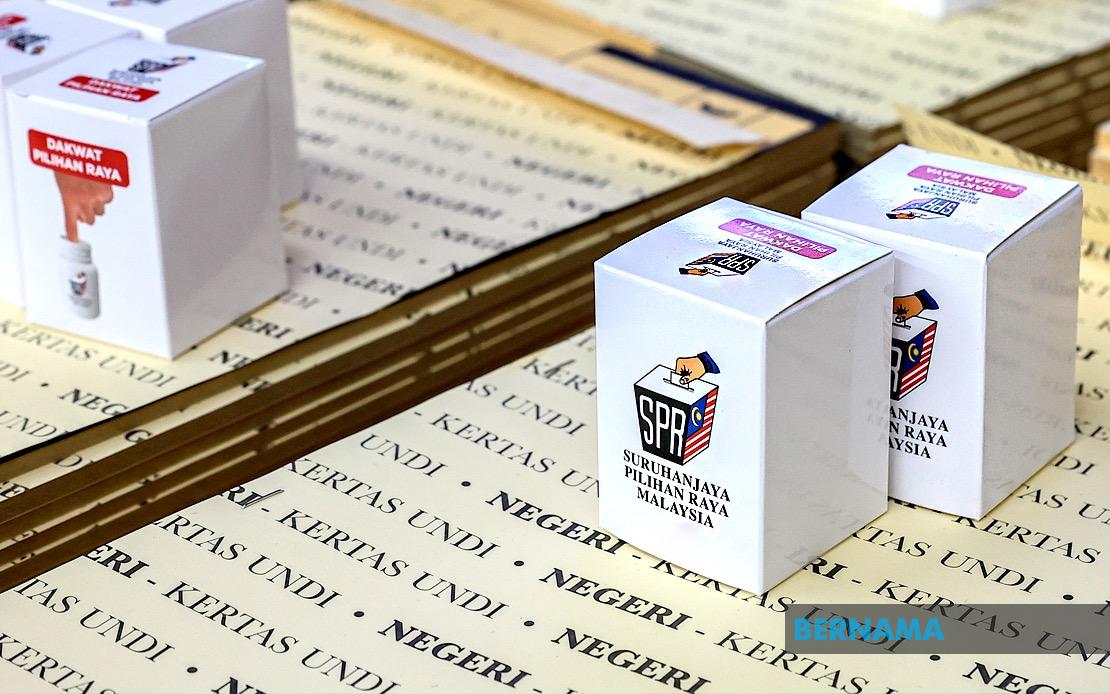
Almost 25,000 members of the uniformed services and their spouses in Johor will exercise their voting rights tomorrow through the state's early polling process, setting the stage for the 16th Johor State Election proper, scheduled for Saturday, July 11. The early voting arrangement, spanning 64 designated centres across the state, reflects standard electoral practice that allows security forces and their families to participate without disrupting operational duties on election day. This preliminary voting phase represents a crucial logistical component of the state-wide electoral machinery, demonstrating the complexity involved in managing democratic participation across a diverse population.
The 24,751 registered early voters comprise two distinct groups: 12,041 military personnel alongside their spouses, and 12,710 police officers and their families. This division reflects the institutional structures through which the Election Commission organises early voting opportunities for security sector workers. The allocation underscores how electoral management requires tailored approaches for different communities, particularly those with operational commitments that could conflict with standard polling day participation. The numerical distribution between military and police participants reveals the relative deployment of these forces across Johor's administrative landscape.
Physical voting arrangements demonstrate meticulous organisational preparation. Police personnel and their dependents will access 53 dedicated early polling centres, whilst military voters utilise 11 separate facilities. Both sets of venues will operate on identical schedules, opening uniformly at 8 am to accommodate large-scale simultaneous voting. The infrastructure reflects the electoral commission's commitment to preventing congestion and ensuring orderly participation. Within the police contingent, 12,067 individuals intend to vote in person at these designated locations, whilst 643 opt for postal voting—a provision that acknowledges the operational demands facing certain security personnel who may be stationed in remote areas or on special duty.
Security arrangements surrounding early voting necessitate substantial personnel deployment. Johor's police force will station 3,565 officers and civilian support staff across all early polling venues and associated areas. This complement comprises 647 commissioned officers, 2,806 rank-and-file personnel, and 112 civilian administrative staff. Their responsibilities extend well beyond the polling centres themselves, encompassing perimeter security, escort protocols for ballot boxes transitioning to storage or counting facilities, traffic management around voting venues, and preventative law enforcement operations throughout affected districts. This comprehensive approach reflects authorities' determination to maintain electoral integrity and public confidence in the voting process.
Operational planning extends to environmental and logistical variables. The Malaysian Meteorological Department has issued forecasts indicating morning precipitation across Batu Pahat, Muar, Pontian, and Tangkak districts, whilst anticipating fair conditions elsewhere in Johor. Election administrators must factor such weather patterns into preparations, ensuring voting venues remain accessible despite potentially challenging conditions. The early polling centres themselves operate on staggered closure schedules, reflecting variable voter registrations across constituencies. Smaller facilities serving only six to 28 registered early voters—including the Buloh Kasap Police Station in Segamat, Tenang Police Station in Labis, and Bandar Penawar Police Station—will close at midday. Conversely, high-volume centres will remain operational until 6 pm, with closure times calibrated to match local demand patterns and geographic distribution.
Capacity disparities across early polling venues reveal the uneven geographic spread of eligible military and police voters throughout Johor. The Federal Reserve Unit Hall Number 2 at Johor Police Headquarters emerges as the single largest early voting site, accommodating 1,338 voters contesting the Stulang state constituency. This concentration suggests significant police deployment or family housing concentrated in the state capital region. The secondary-largest facility—the KEMAS Preschool at the Sixth General Operations Force Battalion in Bakri—serves 927 voters for the Bukit Naning constituency, indicating substantial military presence in that area. These configurations demonstrate how electoral infrastructure must be sized dynamically according to local force compositions and family demographics.
The early voting exercise represents merely the preliminary phase of Johor's broader electoral process. The full 16th state election will unfold on July 11, involving 172 candidates competing across 56 legislative seats. This substantial candidacy indicates robust multi-party participation and competitive electoral dynamics across the state. For Malaysian observers, the Johor election carries significance beyond the state itself, often serving as a bellwether for national political trends and coalition strategies. Johor's voters will determine not only their state government but will send signals regarding public sentiment toward governing formations, economic management, and developmental priorities that resonate across the federation.
The operational machinery mobilised for early voting demonstrates the institutional sophistication required to conduct elections in contemporary Malaysia. Security force participation adds complexity absent from general civilian voting, necessitating parallel infrastructure, expanded security perimeters, and coordination between electoral officials and military-police command structures. The 24,751 early voters represent a manageable but significant subset requiring individualised verification, ballot security, and procedural compliance. Their votes will be counted alongside approximately 4 million Johor voters participating during the main polling day, collectively determining the state's political direction for the coming electoral term.
For Johor's citizens and Malaysia's broader democratic process, early voting represents an inclusive mechanism acknowledging that certain professional obligations legitimately conflict with standard voting hours. By accommodating security personnel and their families, the electoral system preserves their fundamental franchise rights whilst maintaining operational preparedness. Tomorrow's early voting will test these systems' execution and set the procedural tone for the larger electoral exercise to follow. The smooth administration of early voting serves as both practical requirement and symbolic commitment to inclusive democratic participation across diverse communities within Johor's population.

