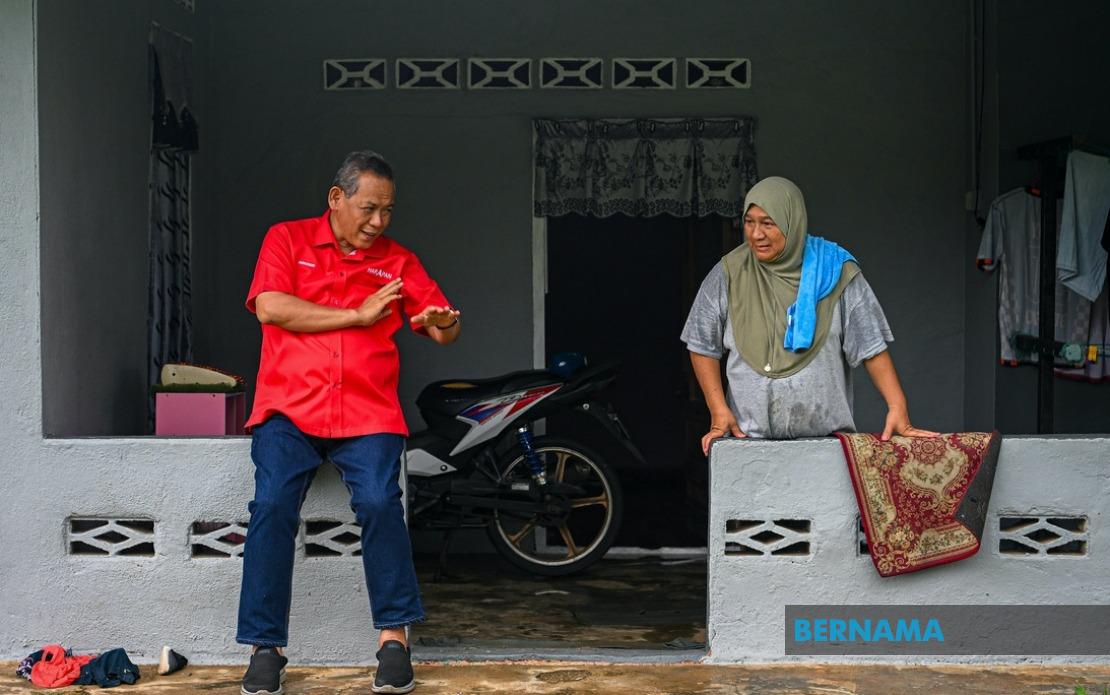
Pakatan Harapan enters the Negeri Sembilan state election with a strategy built squarely on the administrative reputation of incumbent Menteri Besar Datuk Seri Aminuddin Harun, whose absence of major scandal and steady stewardship across nearly two terms has become the coalition's chief selling point to voters. The PH campaign apparatus believes that in an era of heightened public scepticism toward politicians, Aminuddin's relatively unblemished tenure offers a tangible answer to voter concerns about governance quality and financial integrity at the state level.
Campaign officials convey that the opening phase of grassroots engagement has yielded encouraging signs, with feedback from party workers and community meetings suggesting that Aminuddin's leadership continues to strike a chord among voters who value predictability and administrative competence. The coalition's election director, Datuk Seri Amirudin Shari, who also serves as Selangor Menteri Besar, emphasised that conversations across the state have revealed minimal discontent with the current administration, a sharp contrast to opposition narratives elsewhere in Malaysia that have capitalised on public frustration.
For PH, the absence of major corruption allegations or governance failures represents a crucial defensive advantage in Negeri Sembilan. Unlike several other state governments that have grappled with high-profile scandals in recent years, the Negeri Sembilan administration under Aminuddin has maintained a relatively clean public image. This track record becomes especially valuable as the coalition seeks to shield itself from broader criticisms about political accountability, allowing PH to frame the election as a choice between proven stability and uncertainty under alternatives.
Beyond Aminuddin's personal credibility, PH is mobilising its grassroots machinery—described by campaign officials as well-organised and strategically positioned—to translate positive sentiment into concrete electoral support. The coalition's confidence rests on the assumption that effective ground-level organisation can bridge the gap between public sentiment and voting behaviour, particularly in contests where traditional strongholds might be challenged. This emphasis on grassroots work reflects PH's recognition that elections are increasingly won through community-level mobilisation rather than top-down messaging alone.
Prime Minister Datuk Seri Anwar Ibrahim's national leadership is also positioned as an asset to PH's state-level campaign. Officials point to the experience in Johor, where Anwar's personal popularity and the federal government's economic performance measurably benefited state candidates, suggesting that a similar dynamic could bolster PH's prospects in Negeri Sembilan. The coalition believes that the national government's economic policies and development initiatives provide tangible evidence that PH can deliver material improvements to voters' lives, reinforcing the case for continuity at the state level.
The PH manifesto, to be unveiled as campaigning intensifies, will blend existing government initiatives with fresh policy proposals aimed at addressing contemporary concerns around economic growth and household prosperity. This balanced approach allows the coalition to claim credit for ongoing development projects while simultaneously offering new commitments that signal responsiveness to evolving voter priorities. The strategy acknowledges that incumbents must demonstrate both achievement and dynamism to defend their mandate credibly.
Negeri Sembilan's electoral mathematics present a mixed picture that informs PH's urgency. In the 2023 state election, PH secured 17 of 36 seats, providing a comfortable governing majority but leaving room for significant gains or losses depending on voter sentiment shifts. Barisan Nasional captured 14 seats, remaining a formidable challenge, whilst Perikatan Nasional's five seats demonstrate the fragmentation of opposition support. This distribution means PH can potentially improve its position, but faces organised competition that could exploit any perceived weakening in public confidence.
The electoral process is beginning in earnest as 889,490 registered voters prepare to cast ballots across the state, a substantial electorate that encompasses not only ordinary civilians but also military personnel and police officers voting early. This diverse voter base means PH must craft messaging that resonates across different demographic and professional segments, from urban professionals to rural communities to uniformed services personnel. The early voting schedule, with military and police ballots cast on July 28 before the general election on August 1, creates a potential information environment where early results could influence late deciders.
For Malaysian political observers, the Negeri Sembilan contest represents a critical test of whether PH's emphasis on administrative cleanliness and governance stability can sustain electoral momentum in a state where the coalition has consolidated control but faces persistent opposition. The state's significance extends beyond its own boundaries; outcomes here offer diagnostic insight into whether Anwar Ibrahim's national government retains sufficient political capital to deliver results in state elections, or whether dissatisfaction with federal policies is beginning to erode local support for his coalition partners. Should PH perform strongly, it would validate the coalition's campaign framework and strengthen Anwar's hand in managing internal party dynamics. A weaker result would suggest vulnerabilities that opposition movements could exploit in future contests.
The emphasis on Aminuddin's record also carries implications for how PH intends to compete nationally. By prioritising clean governance and administrative stability over grand ideological promises, the coalition signals a pragmatic shift toward performance-based politics, reflecting lessons from earlier campaigns where ambitious manifestos failed to translate into durable voter support. This recalibration suggests PH believes Malaysian voters increasingly value demonstrated competence and integrity over revolutionary visions of change, a calculation that could reshape competitive dynamics across the peninsula as state and federal elections approach.
For the broader Southeast Asian region, Malaysia's Negeri Sembilan contest offers a window into how ruling coalitions navigate the tension between consolidating incumbency advantages and responding to voter demands for renewal. The PH strategy of banking on administrative track records while simultaneously unveiling new policies reflects the delicate balancing act that governing coalitions across the region must perform to retain public confidence in an era of heightened political volatility and rapid social change.

