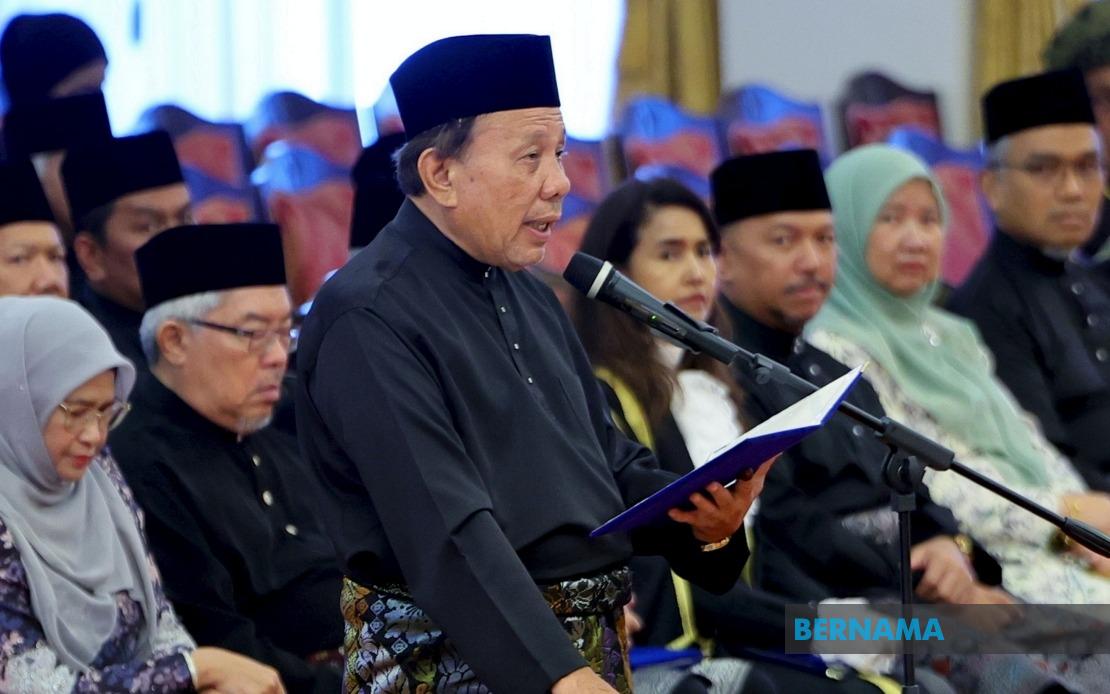
Datuk Ismail Lasim commenced his tenure as Negeri Sembilan's Menteri Besar with a solemn pledge to uphold the democratic mandate entrusted to him by voters in the state's 16th election. Speaking during his swearing-in ceremony at Istana Besar Seri Menanti before Yang Dipertuan Besar Tuanku Muhriz Tuanku Munawir, Ismail underscored that public confidence represents far more than symbolic recognition—it constitutes a binding obligation to govern with integrity, responsiveness and effectiveness. His inauguration marks a transition in state leadership that carries implications extending beyond Negeri Sembilan's boundaries, as the state's governance trajectory often influences broader Malaysian political dynamics and intergovernmental cooperation within the central region.
Central to Ismail's vision is a commitment to evidence-based, inclusive policymaking that genuinely reflects constituent concerns rather than narrow partisan interests. He emphasised that his administration would operate transparently, establishing clear channels for public dialogue and demonstrating receptiveness to constructive feedback from communities, civil society and opposition voices alike. This pledge gains significance within Malaysia's current political climate, where public scepticism regarding governmental accountability remains pronounced across multiple demographic segments. By prioritising institutional transparency and regular public accountability mechanisms, Ismail's administration could establish a replicable model for managing citizen expectations and rebuilding confidence in state institutions—a challenge confronting governments throughout Southeast Asia.
Ismail's articulation of development philosophy reflects a deliberate recalibration of priorities beyond conventional metrics of economic expansion and infrastructure investment. Rather than measuring progress solely through gross domestic product growth rates or construction projects, he advocated for holistic assessment encompassing social cohesion, institutional robustness, public health outcomes and educational advancement. This reframing aligns with evolving international development discourse emphasising human-centred governance and sustainable prosperity. For Negeri Sembilan specifically, this philosophy suggests future government initiatives will emphasise rural-urban equity, ensuring that development dividends reach peripheral communities historically marginalised in resource allocation discussions.
The preservation of Adat Perpatih—Negeri Sembilan's distinctive customary legal system—emerged as another cornerstone of Ismail's stated governance framework. This matrilineal, consensus-based tradition represents a rare institutional inheritance within Malaysia's predominantly patriarchal state structures. By committing to safeguard and transmit these customary principles to subsequent generations, Ismail positioned cultural continuity as integral to governance legitimacy rather than peripheral heritage preservation. Such commitment carries implications for how the state navigates contemporary policy challenges, potentially encouraging consensus-driven decision-making processes that incorporate traditional wisdom alongside modern administrative practices.
Economic revitalisation formed another substantive component of Ismail's inaugural vision, with particular emphasis on attracting quality investment, generating employment opportunities and elevating living standards across socioeconomic strata. The pledge to strengthen Negeri Sembilan's economic foundation while simultaneously improving healthcare access, educational quality and agricultural productivity suggests recognition that sustainable prosperity requires multi-sectoral development rather than singular industry concentration. For Malaysian investors and regional observers, such statements signal potential policy stability and strategic planning extending across multiple economic domains. The emphasis on quality rather than merely volumetric investment attraction also suggests selective sector focus that might particularly benefit value-added manufacturing, advanced services and knowledge-based industries.
Ismail's commitment to harmonious relations between state institutions—encompassing the royal establishment, federal government, civil service, private sector and community leadership—addresses a persistent governance challenge across Malaysian states. Effective intergovernmental coordination remains frequently impeded by partisan divisions, jurisdictional ambiguities and personality conflicts between leaders of different tiers. By explicitly pledging to strengthen institutional relationships, Ismail acknowledged that state-level effectiveness depends substantially upon productive federal-state engagement and cooperative civil service culture. For Negeri Sembilan's development trajectory, such institutional cohesion directly influences infrastructure project execution, regulatory consistency and investor confidence in medium-to-long-term governance stability.
The invocation of constitutional monarchy principles and parliamentary democracy reflected not mere ceremonial observance but substantive commitments to institutional hierarchy and democratic processes. Ismail's pledge to receive and implement royal guidance while respecting parliamentary oversight structures positioned the new administration within Malaysia's constitutional framework, thereby foreclosing authoritarian drift and establishing clear parameters for executive discretion. This rhetorical anchoring to constitutional principles carries significance given contemporary global concerns regarding democratic erosion and executive overreach in various jurisdictions. Malaysian states, as subnational democratic laboratories, demonstrate varying commitments to constitutional constraints, making Ismail's explicit dedication to these principles noteworthy.
The expressed appreciation for departing Menteri Besar Datuk Seri Aminuddin Harun's contributions and development foundation indicates Ismail's intention to pursue governmental continuity rather than disruptive change. This transitional stance suggests pragmatic recognition that abrupt administrative reversal disrupts institutional functioning and potentially undermines ongoing development initiatives. By acknowledging his predecessor's achievements while positioning himself as custodian of accumulated development momentum, Ismail sought to reassure civil servants, investors and communities regarding administrative consistency. Such transitional messaging proves particularly important in Malaysian politics, where alternating administrations sometimes engage in wholesale reversal of preceding policies, thereby creating uncertainty and inefficiency.
The civil service receives particular attention in Ismail's governance philosophy, with explicit pledges to maintain institutional integrity, professional standards and strong ethical orientation among state bureaucrats. This emphasis acknowledges that administrative capacity directly constrains governmental effectiveness regardless of leadership quality or policy ambitions. By committing to support and empower civil servants, Ismail addressed a persistent Malaysian governance challenge—namely, ensuring that talented administrators remain motivated and protected from partisan pressure. The state's developmental success ultimately depends upon sustained professional competence and institutional memory resident within bureaucratic structures, rendering civil service health integral to governance outcomes.
Ismail's framing of progress as encompassing both urban and rural advancement carries particular resonance for Negeri Sembilan, whose geography encompasses both developed Kuala Lumpur-adjacent areas and rural hinterland communities. Inclusive development rhetoric, while commonplace in Malaysian political discourse, carries genuine implementation challenges requiring sustained investment, targeted policies and resource reallocation toward historically underserved regions. The specific articulation of rural-urban equity concerns suggests awareness that development patterns have not uniformly benefited all communities, necessitating corrective governmental action. For Malaysian policymakers across other states, such explicit commitment to inclusive development provides a replicable framework for addressing historical regional disparities.
The inaugural oath represents Ismail's formal commencement of a mandate whose duration and success remain contingent upon sustained delivery of pledged governance improvements. Malaysian voters and observers will assess whether these articulated commitments translate into concrete institutional reforms, policy innovations and measurable improvements in public service quality and developmental outcomes. The Negeri Sembilan administration's performance trajectory will illuminate broader questions regarding Malaysian governance evolution, institutional effectiveness and public sector capacity for responsive, transparent administration. Subsequent months will reveal whether Ismail's administration translates rhetorical commitments into substantive institutional transformation or whether governance performance reverts to conventional patterns of incrementalism and selective accountability.

