Negeri Sembilan has a new leader following yesterday's state election. Datuk Ismail Lasim, who secured victory in the Juasseh constituency, was formally sworn in as Menteri Besar on August 2, taking his oath before the Yang di-Pertuan Besar of Negeri Sembilan, Tuanku Muhriz Tuanku Munawir, at Istana Besar Seri Menanti. The ceremony marked a significant moment in the state's political transition, with the newly elected representative immediately embarking on a deeply personal observance that reflected his values and priorities as he stepped into one of the state's highest offices.
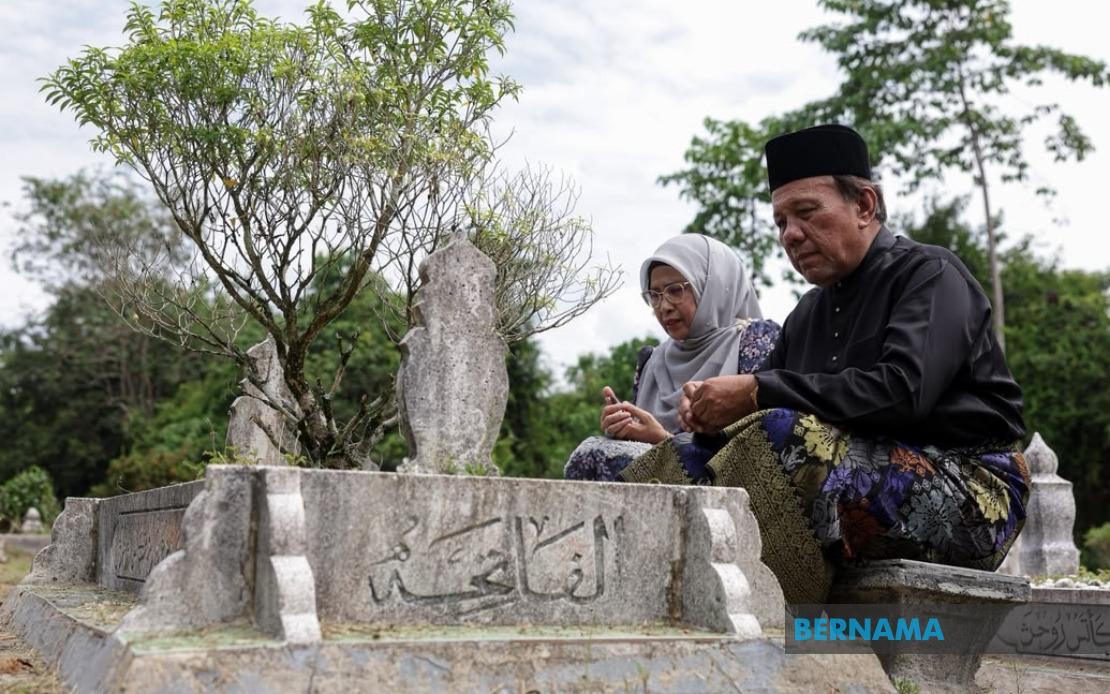
Within hours of receiving his oath of office, Ismail made his way to the Tebing Tinggi Muslim cemetery in Kuala Pilah, where he visited the graves of his parents in the company of his wife, Datin Noraishah Othman. The visit, conducted while he was still dressed in formal traditional Malay attire, demonstrated the significance he placed on honouring his family heritage even as he embarked on his duties as the state's chief executive. The gesture underscored a personal commitment to acknowledging those who shaped him before stepping fully into his public responsibilities.
Ismail's father, the late Lasim Yaman, had passed away on March 5, 2020, at the remarkable age of 97 years old. His mother, the late Bedah Othman, preceded her husband in death, having died on September 16, 2014. The passing of both parents meant that Ismail's elevation to the position of Menteri Besar occurred in the absence of family members who might otherwise have witnessed this milestone in his political career. His pilgrimage to their resting place served as a private acknowledgement of their influence on his life and principles.
The electoral outcome that paved the way for Ismail's appointment reflected a decisive mandate from Negeri Sembilan voters. In the 16th state election held just one day before the swearing-in ceremony, the results demonstrated strong support for the two main coalitions competing for control of the state assembly. Barisan Nasional emerged as the dominant force, claiming 18 of the state seats up for election, while Perikatan Nasional secured seven seats. This distribution of seats granted both coalitions together a comfortable two-thirds majority in the state legislature, providing a stable foundation for governance during the new administration's term.
The combination of these two political alliances in forming the state government represented a significant development in Negeri Sembilan's political landscape. Such coalitions determine not only who holds executive power but also shape the legislative agenda and policy direction for the coming years. The decisive majority secured by the joint coalition meant that the government would have the numerical strength to pass legislation and implement its programmes without dependence on independent assemblymen or unexpected defections.
Ismail's election victory in Juasseh, a state constituency that has figured prominently in recent Negeri Sembilan politics, positioned him to lead the state during a period when Malaysia itself is navigating evolving political alignments. His background and the circumstances of his taking office—marked by the personal ritual of visiting his parents' graves—suggest a leader conscious of tradition and family values, qualities that resonate with many Malaysians, particularly those in the more traditionally-minded rural and semi-rural constituencies that form part of Negeri Sembilan's electoral base.
The timing of Ismail's cemetery visit carried additional symbolic weight in the context of Malaysian political culture. In a nation where Islamic principles and filial piety hold deep cultural significance, his act of honouring his deceased parents immediately upon assuming office demonstrated a personal philosophy that transcends secular political ambition. This moment of private reflection, undertaken within hours of formal investiture, provided a counterpoint to the ceremonial grandeur of the swearing-in and suggested that personal integrity and family respect would inform his approach to leadership.
Negeri Sembilan, one of Malaysia's smaller and less densely populated states, occupies an important position in the nation's federal structure. The state has historically served as a testing ground for various political configurations and has produced several prominent national figures. The peaceful transition of power following the recent election, culminating in Ismail's installation as Menteri Besar, demonstrated the maturity of the state's democratic institutions and the acceptance by all parties of the electoral verdict.
For Southeast Asian observers watching Malaysian state-level politics, the Negeri Sembilan election results and subsequent government formation illustrated the resilience of Malaysia's electoral system and the continued viability of coalition-building as a governing strategy. The fact that two distinct political groupings could work together to form a state government demonstrated pragmatism in Malaysian politics, where ideological differences sometimes yield to practical considerations of governance and service delivery to constituents.
Ismail's elevation to the position of Menteri Besar comes at a juncture when Malaysian states are increasingly asserting their roles in addressing local development priorities, from infrastructure expansion to business regulation. As Negeri Sembilan's chief executive, he will oversee state-level implementation of federal policies while advocating for the state's specific needs and interests within the broader Malaysian political framework. His early gesture of honouring his parents suggested that he approaches this responsibility with a sense of duty and accountability informed by family values and personal integrity.

