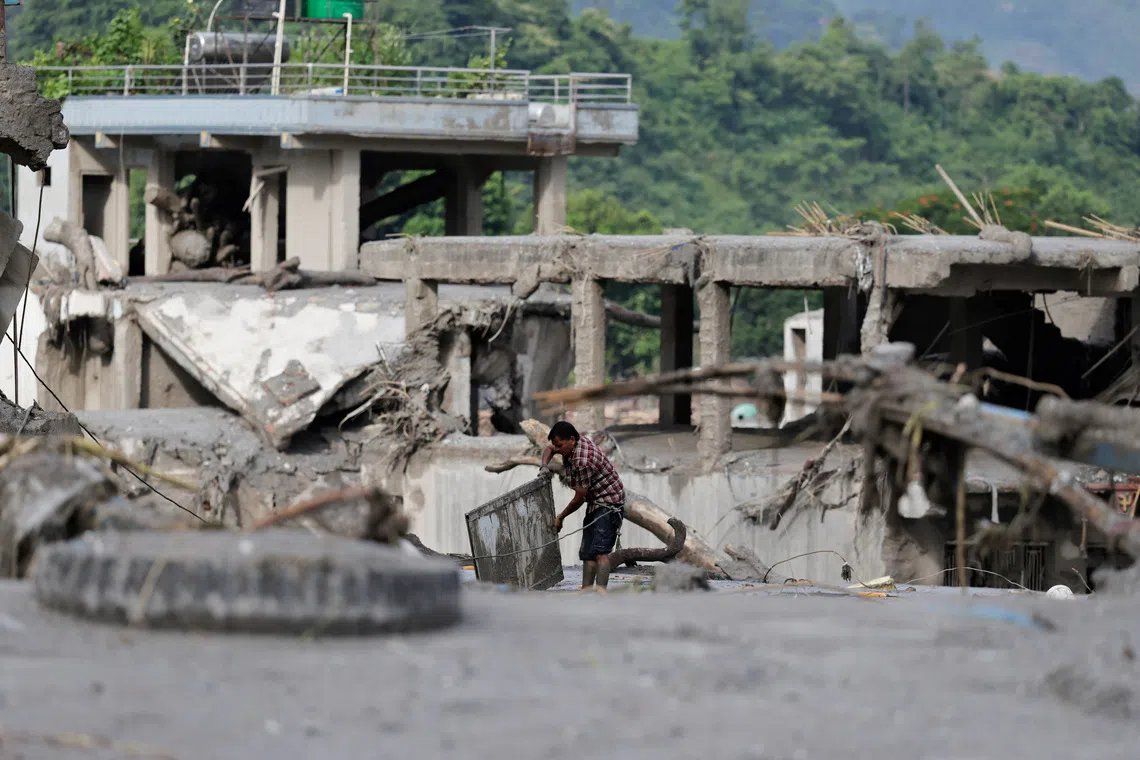
The catastrophic flooding that swept through the Himalayan border region of Nepal and Tibet on Wednesday has triggered a fresh crisis: two massive lakes formed by the same disaster now threaten to unleash secondary devastation. Both governments sounded alarms on Thursday as meteorologists and water specialists warned that the dammed bodies of water could burst their natural barriers within days, potentially causing another wave of destruction through already-ravaged valleys. The compounding threat highlights the unpredictable cascading dangers of mountain disasters, where initial destruction often sets the stage for subsequent calamities that can prove equally lethal.
The primary catastrophe stemmed from a glacier collapse high in the Himalayan peaks that sent torrents of rock, ice, and pulverized debris cascading into river systems below. The torrent obliterated communities along its path, claiming at least 362 lives and leaving more than 1,000 people unaccounted for. Search and rescue teams continue their grim work across debris-choked valleys and steep hillsides, racing against time and deteriorating weather to locate survivors. Yet even as these operations press forward, the danger landscape is fundamentally shifting from flood debris to something potentially more predictable but equally destructive: the water accumulated behind natural dams.
The mechanism behind the secondary threat is straightforward but alarming. The initial glacier collapse pushed vast quantities of rock and debris into river channels, effectively damming them. Water from rainfall and continued snowmelt has accumulated behind these natural barriers on both the Nepalese and Chinese sides of the frontier. Nepal's disaster management authority issued formal guidance on Thursday specifically addressing the lake that has formed at the flood site itself. The agency's statement emphasized that the accumulating water behind the debris blockage posed a growing hazard and could burst without warning, transforming the already-devastated river valleys into channels of destruction once again.
China's water resources ministry painted an even more concrete picture of the looming danger on its territory. Officials calculated that approximately three million cubic meters of water—equivalent to roughly 1,200 Olympic-sized swimming pools—would flow into an already-existing dammed lake over the subsequent 72 hours. This influx threatens to breach the dam's capacity, potentially releasing a massive volume of water with destructive force. Chinese hydrologists predicted the critical moment would arrive around September 1, giving authorities and populations downstream a narrow window for preparation and evacuation. The sheer volume involved—three million cubic meters—underscores the immense scale of water management challenges in high-altitude environments where human infrastructure can prove fragile against natural forces.
Metereological forecasts have only amplified the concern. Chinese state media reported that rainfall expected throughout the week ahead would worsen the situation by adding more water to already-stressed systems. Zhu Jinfeng, a senior researcher at the water resources ministry's hydrology department, expressed the escalating crisis in stark terms during an interview with national broadcaster CCTV. He noted that water volumes continue rising at an accelerating rate, proportionally increasing the risk of catastrophic overflow. The combination of existing water accumulation, predicted inflow, and anticipated rainfall creates what water specialists term a compounded hazard scenario—one where multiple risk factors converge to create dangers exceeding the sum of their parts.
The warnings prompted immediate tactical responses from rescue operations on the ground. Teams working to recover survivors and locate missing persons began withdrawing from lower-elevation areas and relocating toward higher terrain. Pawan Koirala, leading a rescue contingent of 13 personnel, exemplified this cautious repositioning. He explained the reasoning behind the pullback with candid simplicity: their mission centered on saving lives, not risking them by remaining in potential flood zones. This practical response illustrates how frontline responders balance the moral imperative to search for survivors against the operational reality that rescue teams themselves can become victims if secondary disasters strike.
The situation reveals broader vulnerabilities in high-mountain regions where climate change, glacial retreat, and the concentration of populations in valley bottoms create compounding risks. The 2013 Uttarakhand floods in neighboring India and the 2021 Chamoli glacier disaster—which similarly involved glacier collapse and subsequent flooding—demonstrate that such cascading disasters have become recurring phenomena. For Malaysia and other Southeast Asian nations, the situation offers cautionary lessons about climate adaptation in regions with significant mountainous terrain and river systems originating in high-altitude zones. Transboundary water disasters demand coordinated early warning systems and regional cooperation mechanisms that can function across political boundaries.
Nepal and China's joint acknowledgment of the threat, despite occasional tensions over their shared frontier, demonstrates that existential hazards can transcend geopolitical considerations. Both nations have activated disaster response protocols and are coordinating information about water levels and forecasted movements. This cooperation reflects recognition that no border can contain the physical forces of water and gravity in mountain environments. The urgency of the warnings also suggests that preliminary assessments may have underestimated initial damage, requiring revised contingency planning for multiple scenarios of secondary flooding with varying intensities and timing.
For the affected populations in Nepal's border districts and Tibet's lower valleys, the immediate future remains fraught with uncertainty. Communities that survived Wednesday's initial devastation now face the prospect of renewed inundation, complicating both rescue operations and longer-term reconstruction. The psychological toll compounds the physical danger—survivors processing trauma while confronting fresh threats represent a humanitarian dimension often overlooked in technical disaster assessments. Officials in both countries have urged residents to remain vigilant, avoid river banks and low-lying areas, and maintain readiness for rapid evacuation should the natural dams fail or water authorities decide controlled releases are necessary to prevent catastrophic breaches.

