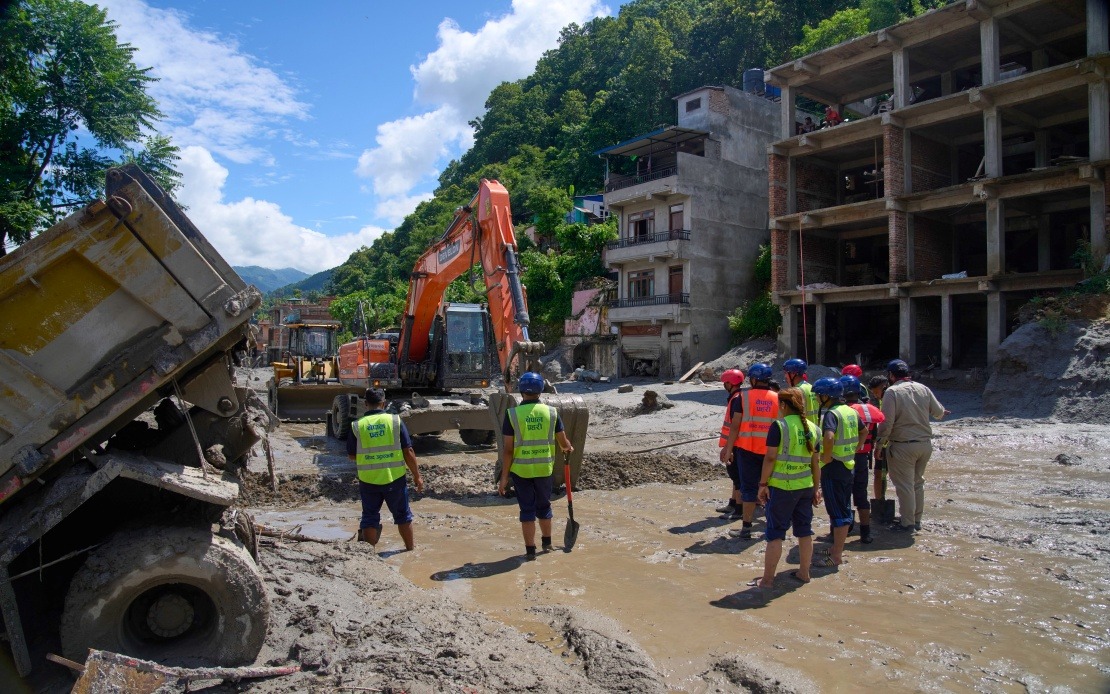
Nepal's Foreign Ministry has activated an Emergency Response Team dedicated to coordinating the search for foreign nationals reported missing in the catastrophic flooding that struck the Rasuwa district on Wednesday morning. The specialized unit represents the government's effort to centralize information management and streamline rescue coordination across multiple agencies responding to one of the nation's most severe natural disasters in recent years.
The Emergency Response Team functions as a unified command center tasked with several critical responsibilities in the immediate aftermath of the disaster. Among its primary functions are verifying information regarding affected foreign nationals, liaising directly with active search and rescue operations, and providing dedicated consular support to international citizens caught in the calamity. By consolidating these functions under a single coordinating mechanism, Nepal's Foreign Ministry aims to eliminate information gaps and accelerate response times for families seeking updates on missing relatives.
The scope of the coordination challenge is substantial. Nepal's authorities have confirmed that at least 359 lives were lost by Thursday evening, with rescue operations ongoing. Among the survivors documented to date, 31 have been successfully extracted from affected areas. However, the scale of uncertainty remains alarming: more than 800 individuals remain unaccounted for, encompassing hundreds of international tourists whose nationalities and precise locations remain uncertain. The majority of the missing are reported to be from India and Nepal, reflecting both regional tourism patterns and the proximity of these populations to the disaster zone.
For Malaysian readers and authorities, the situation carries direct relevance. Malaysian Foreign Minister Datuk Seri Mohamad Hasan indicated that while Malaysians may be among those affected, the Nepali government has yet to provide a confirmed figure of missing Malaysian nationals. This uncertainty underscores the complexity facing foreign ministries attempting to account for citizens caught in rapidly evolving humanitarian emergencies across international borders.
The Emergency Response Team's operational structure emphasizes information gathering and verification as foundational tasks. Officials will compile comprehensive data on all foreign nationals affected by the flooding, cross-reference this information with reports from families and diplomatic missions, and establish a verified database for distribution to concerned parties. This systematic approach becomes essential when hundreds of people from multiple countries require identification and tracking across a disaster zone spanning a mountainous region with challenging terrain and communications infrastructure.
Coordination with external stakeholders forms another pillar of the team's mandate. The Foreign Ministry has established direct communication channels with diplomatic missions stationed in Kathmandu, international humanitarian organizations present in Nepal, and the families of missing persons worldwide. Through these networks, verified updates can flow rapidly to concerned parties, reducing the information vacuum that typically compounds the distress of disaster victims' relatives.
To mobilize public participation in the search effort, Nepal's Foreign Ministry has publicized multiple contact channels for reporting information about missing or affected foreign nationals. Those with knowledge of affected individuals can reach the Emergency Response Team via phone or WhatsApp at +977-9744441227 or +977-9744441228, or submit information electronically through [email protected]. This multi-channel approach recognizes that critical information may emerge from diverse sources, including survivors in contact with family members abroad, local residents who encountered missing individuals, and other tourists who witnessed the disaster.
The Bhotekoshi River flooding represents a stark reminder of the environmental hazards facing Nepal's tourism sector, which attracts thousands of international visitors annually to its mountain regions, trekking routes, and natural attractions. The disaster's impact on foreign nationals highlights how natural catastrophes in remote regions can rapidly become international incidents requiring coordinated diplomatic and humanitarian response. For Southeast Asian nations with significant tourism flows to Nepal, including Malaysia, the incident underscores the importance of maintaining updated consular capacity and emergency communication protocols.
The activation of the Emergency Response Team also reflects lessons learned from previous disasters affecting foreign nationals in Nepal and throughout the region. By establishing formal coordination structures and communication protocols before crises reach their peak, governments can reduce response delays and improve information accuracy when families and media outlets are seeking answers. This proactive framework becomes particularly valuable in scenarios where terrain, weather, and infrastructure damage complicate access to affected areas.
For Malaysian authorities and citizens, the unfolding situation in Rasuwa demonstrates the unpredictability of international travel and the importance of maintaining consular support systems. The Malaysian Foreign Ministry's ongoing liaison with Nepali counterparts to confirm the status of any affected Malaysians reflects standard diplomatic protocol, though the continued uncertainty regarding exact numbers suggests the scale of the challenge facing coordinating authorities.
Looking forward, the Emergency Response Team's effectiveness will be measured by its ability to resolve the status of the more than 800 currently unaccounted individuals. As search operations continue and information emerges from remote areas, the team's information management systems will be tested by the volume and complexity of data requiring processing. The coming days and weeks will determine how successfully Nepal's institutional response translates into concrete outcomes for families awaiting news of their relatives.

