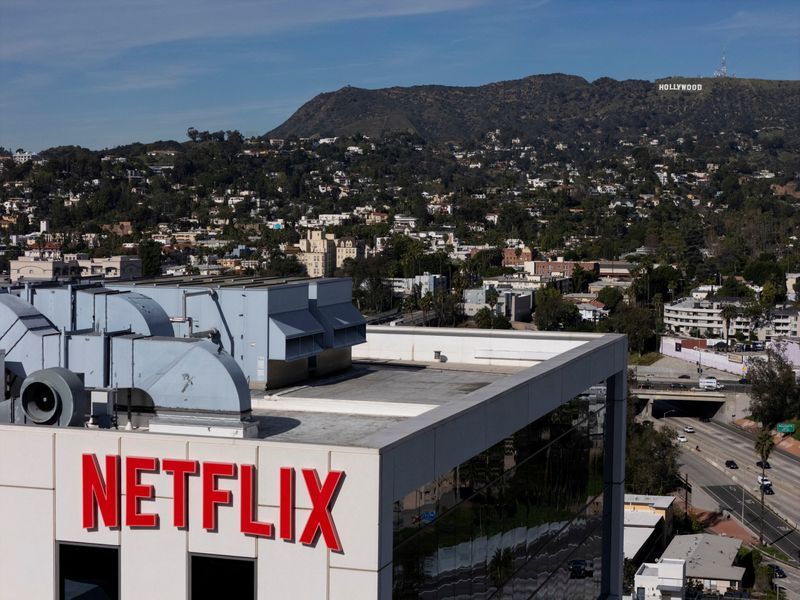
Netflix enters a pivotal reporting period this week as the entertainment behemoth grapples with mounting investor concerns about its ability to sustain growth in an increasingly crowded digital landscape. The company's market value has contracted by more than one-fifth since the start of the year, reflecting widespread scepticism about whether management's strategic initiatives can deliver the expansion rates that once defined the business. When Netflix announces its second-quarter financial performance on Thursday, analysts will scrutinize not just the numbers but the company's roadmap for the years ahead, particularly as the tailwinds from earlier policy decisions begin to diminish.
The financial metrics expected to emerge from the earnings call reveal an unmistakable deceleration. Netflix is projected to report revenue growth of 13.6 percent to reach $12.59 billion, marking its most sluggish expansion in more than four quarters. This slowdown stands in stark contrast to the double-digit growth trajectories that historically characterised the streaming pioneer, signalling that the industry's maturation phase has arrived. Adjusted earnings per share are anticipated to land at 79 cents, according to consensus forecasts compiled by LSEG, though the modest profitability figures mask deeper anxieties about whether the company can leverage its massive subscriber base into sustained financial growth.
The advertising division represents Netflix's most critical lever for reigniting expansion momentum. The platform projects advertising revenue of approximately $705.8 million this quarter, yet even this figure masks underlying disappointment with the ad business's performance trajectory. Emarketer analyst Ross Benes recently acknowledged that his firm and others have revised their advertising forecasts downward, as the segment has failed to gather the commercial traction that optimists envisioned when Netflix first introduced the ad-supported tier. The discrepancy between initial expectations and actual performance highlights a fundamental challenge: persuading traditional advertisers accustomed to broadcast and cable formats to embrace Netflix's premium inventory, which demands higher price points but offers smaller aggregate audiences than traditional mass-market channels.
Underlying the advertising challenge lies a more troubling engagement pattern that Netflix must address. Recent reporting has documented declining audience loyalty across the platform's catalogue, with popular original productions such as "The Night Agent" and "Beef" experiencing significant viewership drops between their inaugural and subsequent seasons. In some cases, these shows have lost roughly half their audience after the first season concluded, a metric that directly threatens the content strategy underpinning Netflix's competitive advantage. This attrition suggests that viewers increasingly treat Netflix as a transactional service rather than a destination requiring ongoing subscription commitment, a perceptual shift that fundamentally undermines the advertising model's viability.
To counteract engagement challenges and create new avenues for advertiser integration, Netflix has begun exploring unconventional content categories, most notably live events. The company has reportedly emerged as a potential bidder for the exclusive United States broadcasting rights to both the 2030 and 2034 FIFA World Cup tournaments, a move that would represent a dramatic expansion beyond its traditional filmed-entertainment focus. Sporting events offer distinct advantages compared to scripted drama: they generate genuine live audiences rather than recorded viewership, they command premium advertising rates, and they create recurring annual revenue opportunities rather than one-time content investments. Such ventures also signal management's recognition that traditional episodic content alone may prove insufficient to justify premium subscription pricing.
Simultaneously, Netflix has entered discussions regarding the potential acquisition of Letterboxd, a social media platform dedicated to film enthusiasts and cinephile communities. This acquisition would grant Netflix direct access to engaged entertainment-focused users whilst establishing infrastructure for subscriber-generated content and discussion, elements largely absent from Netflix's current ecosystem. The Letterboxd acquisition would represent a relatively modest outlay compared to Netflix's previous major content investments, yet it could generate outsized strategic value by increasing daily active user engagement and strengthening the platform's community functions.
The broader strategic challenge Netflix faces was succinctly characterised by analyst Paolo Pescatore of PP Foresight, who observed that the company has transitioned from disruptive insurgent to established incumbent. This transition fundamentally alters the growth calculus: whilst early-stage Netflix could expand by capturing market share from traditional media and converting cord-cutters to streaming, the incumbent Netflix confronts the considerably more difficult task of expanding within a saturated market where subscriber growth depends primarily on price increases and market consolidation. Sustaining momentum from a much larger revenue base requires disproportionately larger absolute increments, a mathematical reality that constrains achievable growth rates regardless of management execution.
Regional implications for Southeast Asian markets remain significant despite Netflix's global maturation. The company's shift toward advertising-supported tiers and live events carries particular relevance in developing economies where price sensitivity remains pronounced. Advertising integration offers a pathway for Netflix to serve price-conscious consumers whilst maintaining revenue per user, potentially extending market penetration into lower-income segments. Additionally, live sports acquisition strategies may require Netflix to negotiate broadcasting arrangements with regional sporting bodies and local regulators, introducing both opportunities for market expansion and complications in executing global content strategies.
Analysts remain divided regarding Netflix's likely response to growth pressures. Some expect the company to pursue additional transformative acquisitions, potentially capitalising on market volatility to acquire complementary entertainment properties at attractive valuations. Others anticipate Netflix will favour smaller, targeted acquisitions focused on specific capabilities or user communities, an approach that would impose lower financial risk whilst testing strategic hypotheses before committing substantial capital. The company's recent pattern of smaller deals and partnerships suggests management leans toward this latter orientation, particularly given that major acquisitions would introduce integration complexities and distract executives from addressing fundamental engagement challenges within the existing platform.
Investor expectations heading into this earnings report centre fundamentally on management's credibility in articulating a plausible pathway to sustained growth. The near-term financial projections themselves matter less than the conviction with which Netflix leadership can explain how advertising maturation, live events expansion, and international market development will collectively deliver acceptable returns to shareholders. Without persuasive answers to these strategic questions, market sentiment regarding Netflix's valuation is unlikely to stabilise regardless of whether the company meets quarterly consensus estimates. The coming quarter represents not merely a financial reporting obligation but rather a critical juncture in Netflix's evolution from growth stock to mature cash-generation franchise.

