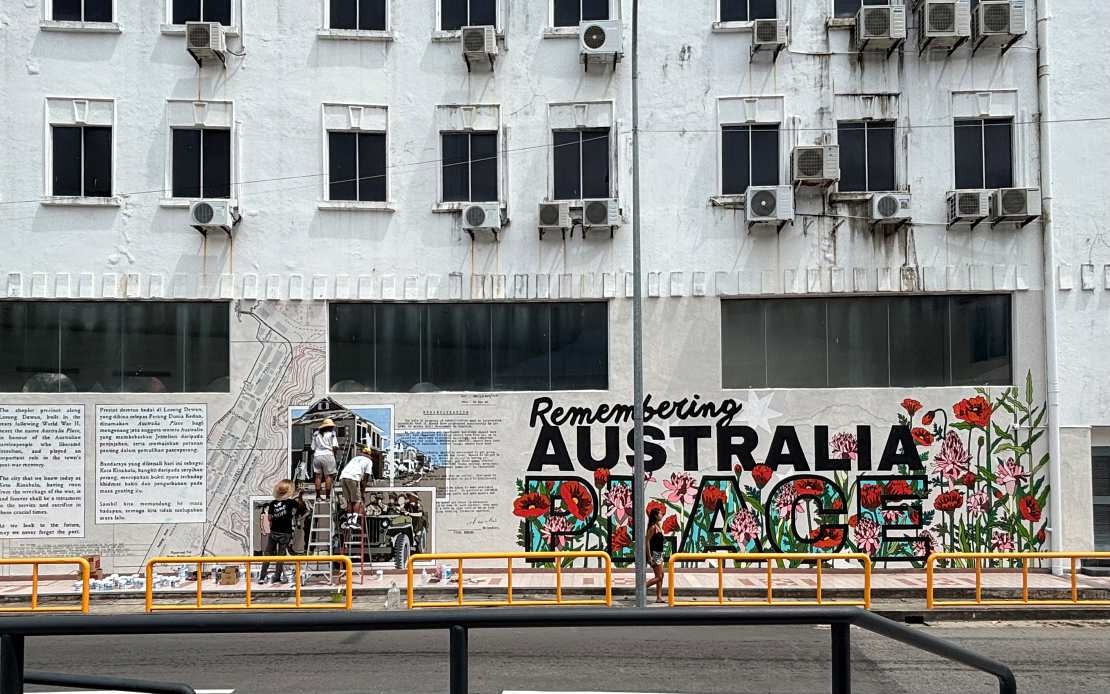
A newly unveiled mural in central Kota Kinabalu is breathing fresh colour and purpose into a location long recognised by locals simply as 'Australia Place', transforming a physical space into a visible testament to decades of deepening ties between Sabah and Australia. The artwork, formally titled 'Remembering Australia Place', adorns the Wisma Intiutama building and was officially launched on Friday, strategically timed to coincide with Sandakan Day, an annual observance that bridges the shared wartime experiences that first bound the two peoples together in modern times.
The mural initiative reflects a deliberate effort by diplomatic and cultural actors to deepen public awareness of bilateral connections that extend far beyond formal government channels. Australian High Commissioner to Malaysia Danielle Heinecke, who presided over the unveiling ceremony, articulated this deeper vision, emphasising that the artwork represents an archive of human relationships and institutional partnerships accumulated across generations. Her statement underscored how Australians and Sabahans have repeatedly chosen to work together, build institutions together, and share cultural knowledge, creating networks of friendship that now form the bedrock of contemporary bilateral relations.
The creative vision behind the mural originated with Pillars of Sabah, a locally-based community arts organisation that approached the commission as an opportunity to use visual storytelling as a medium for historical reflection. Rather than relying on conventional documentary approaches, the artists employed symbolic imagery to capture abstract values—friendship, resilience, cooperation, and interconnection—that they identified as defining the Australia-Sabah relationship. This artistic methodology acknowledges that bilateral relationships are ultimately sustained not by treaties or trade statistics, but by the lived experiences and emotional investments of ordinary citizens who build connections across borders.
The personal story of Jared Abdul Rahman, Pillars of Sabah's co-founder, exemplifies the very human dimension that the mural attempts to memorialise. Rahman's biography itself constitutes a microcosm of Australia-Malaysia engagement: his Sabahan father pursued higher education in Australia through the Colombo Plan scholarship programme, a landmark initiative that brought thousands of students from Commonwealth nations to Australian universities during the post-war period. His mother, Tasmanian-born, represented the Australian side of this cross-cultural encounter. Their meeting and subsequent family represents the kind of people-to-people linkage that, multiplied across thousands of individuals, creates the deeper tissue of bilateral relationship that survives political fluctuations and economic cycles.
Rahman's involvement in designing and executing the mural granted him a platform to consciously weave his hybrid heritage into a public artwork that speaks to his community in Kota Kinabalu. The project extended beyond the artist's individual creative expression, deliberately incorporating engagement with younger generations, particularly students and educators from Sekolah Menengah Kebangsaan Sanzac, who participated in the mural's creation. This intergenerational collaboration carries pedagogical significance, introducing schoolchildren to historical narratives about Australia-Malaysia cooperation at a formative stage, potentially cultivating long-term awareness and affinity that may translate into future academic, professional, or cultural exchange.
The timing of the mural's unveiling on the eve of Sandakan Day is laden with historical and symbolic meaning. Sandakan Day commemorates one of the Pacific War's most devastating chapters: the Sandakan Death Marches of 1944-45, during which Allied prisoners of war endured brutal forced relocations that claimed 2,434 lives. The observance honours not only the suffering of these prisoners but also the courage of local Sabahans who, at considerable personal risk, provided assistance to captive soldiers and facilitated escape attempts. This historical episode, though tragic, established an early foundation for Australia-Sabah relations rooted in shared sacrifice and mutual respect.
For Malaysian readers and policymakers, the mural represents a practical example of how cultural diplomacy and community-level engagement can reinforce and visualise official bilateral partnerships. Kota Kinabalu, as Sabah's capital and largest urban centre, functions as a cultural and political nexus, making it an ideal location for such symbolic gestures. The 'Australia Place' location carries its own embedded history—the informal nomenclature itself testifies to Australians' longstanding presence and integration within Kota Kinabalu's social fabric, suggesting that the mural formalises and celebrates what residents already understood intuitively.
The attendance of Mayor Datuk Seri Sabin Samitah alongside the Australian High Commissioner, together with parliamentarians, community leaders, and alumni of Australian universities, underscored official sanction and endorsement of the initiative. The inclusion of Australian university alumni is particularly significant, as this cohort represents individuals whose formative educational experiences occurred in Australia, creating personal investments in the relationship and often translating into professional networks, ongoing cultural affinity, and channels for continued exchange of knowledge and ideas.
From a regional Southeast Asian perspective, the Australia-Sabah relationship occupies a distinctive niche. Australia's engagement with the region historically extended beyond major economic powers like Indonesia and Thailand, encompassing smaller state economies and regions. Sabah's geographical proximity to the Philippines and Brunei, combined with its strategic location along major maritime routes, has rendered it a consistent focus of Australian diplomatic and cultural attention. The mural acknowledges this particularised history while positioning Sabah not as a peripheral recipient of Australian goodwill, but as an equal partner in a reciprocal relationship.
The artwork also emerges within a broader contemporary context of heightened interest in Australia-Southeast Asia relations across multiple domains. As Australia navigates its regional strategic position amid evolving geopolitical dynamics, cultural initiatives such as the 'Remembering Australia Place' mural serve as tangible reminders of deep, long-established connections that transcend immediate political considerations. These cultural anchors help sustain relationship continuity and provide platforms for dialogue when official channels face constraints or complications.
Looking forward, the mural's presence in a high-traffic urban location in Kota Kinabalu positions it as an ongoing educational resource and conversation starter. Visitors encountering the artwork for years to come will have an opportunity to reflect on Australia-Malaysia ties, potentially sparking interest in bilateral history, cultural exchange opportunities, or professional partnerships. The permanent installation thus extends the diplomatic impact of the unveiling ceremony itself, creating a lasting institutional memory encoded in visual form within the urban landscape.
The involvement of Pillars of Sabah in the project also models a community-centred approach to cultural diplomacy, wherein local artistic voices mediate the representation of bilateral relationships rather than outsourcing such narratives to international actors. This approach honours local agency and ensures that the Australia-Sabah partnership is articulated through a lens grounded in Sabahan experiences, values, and aesthetic sensibilities. For Malaysian cultural practitioners and policymakers observing this initiative, it demonstrates the potential for arts-based approaches to strengthen bilateral relationships while simultaneously generating opportunities for local creative professionals.

