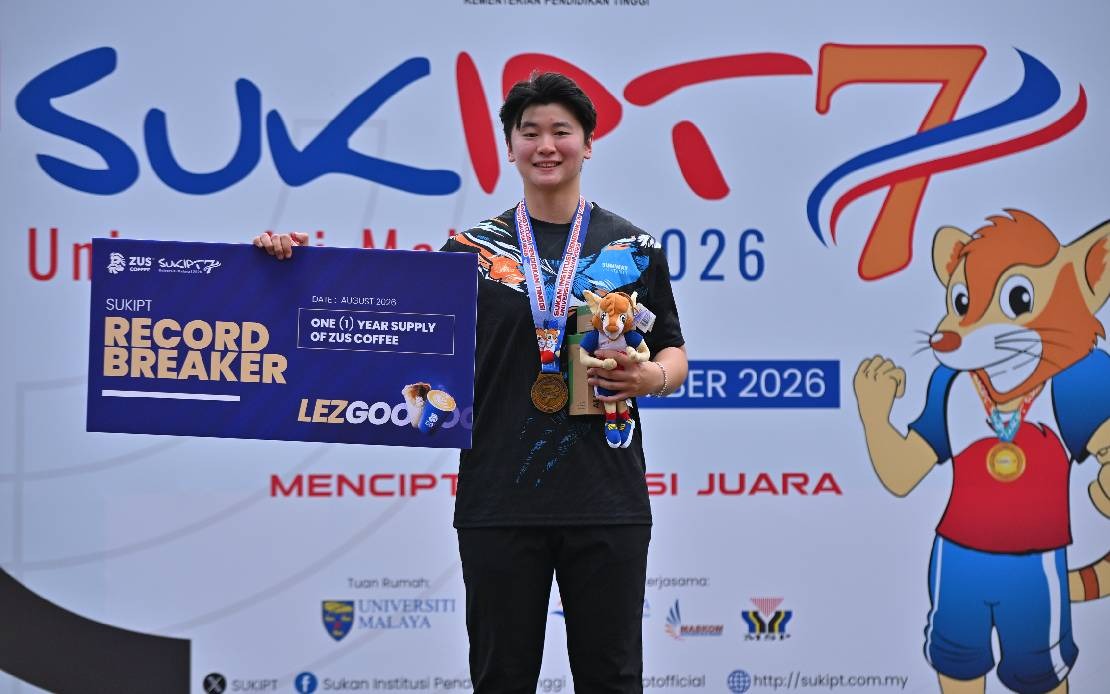
Javelin champion Ng Jing Xuan marked Malaysia's National Day celebration with a standout athletic performance, establishing a fresh meet record at the 2026 Higher Education Institutions Sports Games (SUKIPT) held at UM Arena on the Universiti Malaya campus in Kuala Lumpur on August 31. The 22-year-old athlete's accomplishment carried particular significance for Sunway University, the institution she represents, as she etched her name into the sporting annals of one of Southeast Asia's premier university competitions.
The winning throw measured 46.92 metres, decisively clearing the previous record of 44.41 metres that had stood since the 2016 competition. That earlier benchmark belonged to Nur Fatin Adibah Suharman from Universiti Malaysia Perlis (UniMAP), making Jing Xuan's breakthrough a substantial improvement over a decade-old standard. Such records gain particular prominence within Malaysian university sport, as SUKIPT serves as a testing ground for emerging talent and occasionally reveals individuals capable of competing at continental and global levels.
Yet beneath the surface of gold-medal success lay a more complex emotional landscape for the accomplished thrower. Jing Xuan acknowledged that disappointment tempered her satisfaction, stemming from an unmet objective that transcended the immediate competitive context. Her personal national record stands at 52.17 metres—a significantly higher benchmark that she had genuinely targeted during her preparation cycle. The gap between her championship performance and her best-ever distance represents the challenging reality many elite athletes navigate, where consistent top-tier execution remains elusive despite rigorous training regimens.
The athlete reflected candidly on her mindset after crossing the finish line, explaining that her fundamental approach to SUKIPT competition centred on maximising performance within the parameters of each specific event. However, the presence of a national record ambition elevated the stakes psychologically. "Actually, for SUKIPT this time, my target was just like usual - to do my best. It's just that I had a target for the national record, but today luck wasn't on my side to get it. However, I managed to set a SUKIPT record. So I am still grateful to have broken the SUKIPT record," she conveyed during post-event remarks at the venue.
Jing Xuan's preparation timeline provides instructive context for understanding her competitive readiness during August. Following her participation in the Asian U23 Athletics Championships, she dedicated approximately one month to intensive training specifically oriented towards SUKIPT competition. This concentrated preparation period represents standard practice for athletes balancing multiple international and domestic calendar obligations. Despite this focused training block, the throws during actual competition sessions felt constrained, a phenomenon she attributed partially to external logistical adjustments beyond her control.
A scheduling modification imposed shortly before competition significantly disrupted her competitive rhythm and mental preparation. The women's javelin final shifted from an afternoon timeslot to a morning session, necessitating adjustment to her warm-up protocols, psychological pacing, and throwing conditions. Such seemingly minor administrative changes can materially impact athletic performance, particularly in field events where consistency and precise technical execution depend upon established routines. Jing Xuan interpreted this involuntary schedule shift as a contributing factor to what she characterised as sluggish throwing mechanics during her attempts.
Beyond the immediate SUKIPT context, Jing Xuan's remarks emphasised her capacity to absorb setbacks and maintain competitive focus. Even when competitive outcomes fall short of ambitious targets, elite athletes must rapidly recalibrate mentally and redirect energy towards forthcoming obligations. In this instance, she expressed determination to channel the National Day spirit of collective purpose towards preparation for two consequential competitions on Malaysia's sporting calendar. The ASEAN University Games scheduled for December represents one significant milestone, followed by the Southeast Asian Games slated for 2025, where she intends to deliver medal-winning performances for her nation.
The competitive field at SUKIPT reflected the strength of university-level javelin talent circulating through Malaysian higher education institutions. Farisha Athirah Wai of Universiti Pendidikan Sultan Idris (UPSI) secured the silver medal with a throw reaching 36.21 metres, a performance that demonstrated respectable technical competency but remained considerably distant from Jing Xuan's championship standard. Bronze honours went to Tai Yu Tian representing Universiti Putra Malaysia (UPM), whose 32.74-metre effort placed her substantially further back in the competitive hierarchy. The separation in distances highlights Jing Xuan's competitive dominance within the university sector, though her international aspirations demand continuous progression beyond these domestic benchmarks.
The significance of Jing Xuan's achievement extends beyond individual athletic accomplishment to encompass broader implications for Malaysian track and field development. University sports competitions function as critical pathways for talent identification and athlete development within the Malaysian sporting ecosystem. When competitors establish meet records during such competitions, they signal emerging capability that may translate into future international representation. The SUKIPT platform thus serves dual purposes: providing meaningful competitive experience for participating athletes while simultaneously offering national sporting bodies visibility into emerging talent pools.
Looking forward, Jing Xuan's trajectory over the coming months will merit close attention from Malaysian athletics administrators and regional observers. Her stated ambitions regarding the ASEAN University Games and Southeast Asian Games represent typical progression for athletes of her calibre, yet actualising these goals demands sustained technical refinement and psychological resilience. The gap between her personal best and her SUKIPT achievement indicates considerable room for improvement, suggesting that future performances—particularly should she successfully close that gap—could position her prominently within the broader Southeast Asian athletic landscape.
The National Day context of this achievement adds a patriotic dimension to Jing Xuan's individual success, transforming a personal sporting accomplishment into a modest contribution to national sporting pride. As Malaysia continues developing its athletic infrastructure and talent pipelines, performances like hers from university-level competitors underscore the continuing vitality of grassroots and intermediate-level competition. The SUKIPT platform thus validates its importance within Malaysian sports development architecture, producing not merely records but athletes capable of eventually competing for national glory on continental and global stages.

