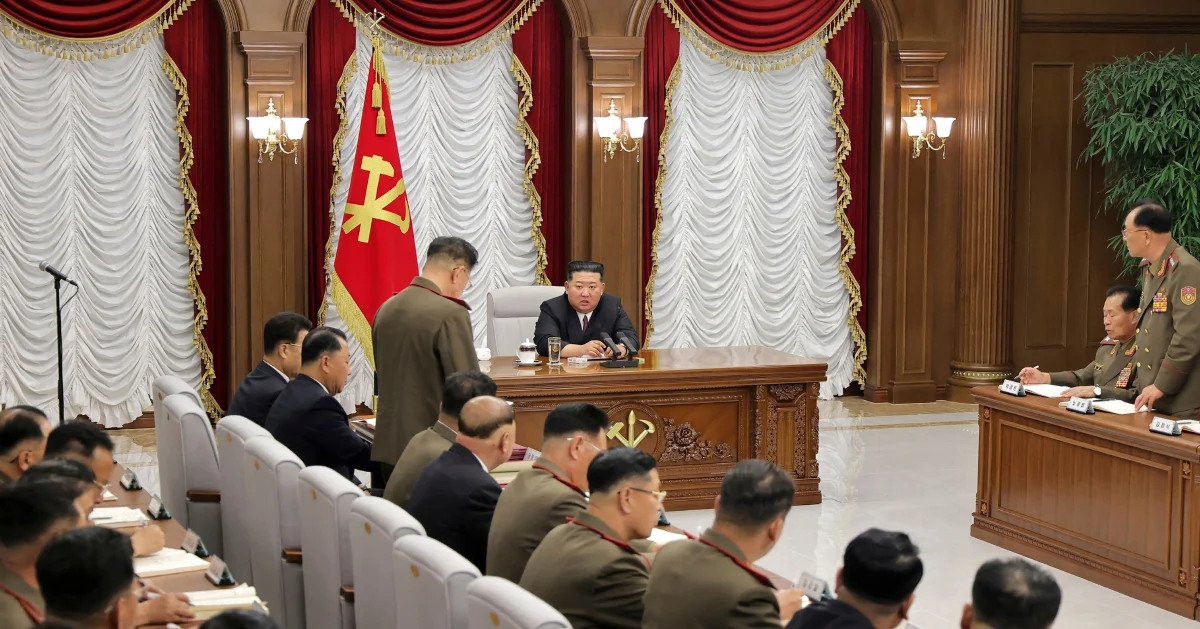
North Korea's leader Kim Jong Un has taken the unusual step of publicly attacking a high-ranking military officer for corruption, ordering his removal from the ruling Workers' Party of Korea. According to state-controlled media reporting over the weekend, the dismissed official had engaged in bribery and other illicit financial dealings, conduct that Kim Jong Un characterized as a fundamental violation of the regime's political principles. The rare public censure represents a notable departure from North Korea's typical practice of conducting such purges quietly, suggesting either a genuine shift toward greater transparency or a calculated display of leadership resolve.
The specific allegations against the unnamed official centred on the acceptance of bribes and personal enrichment schemes while holding a position of significant military authority. In North Korea's tightly controlled system, such accusations typically indicate factional struggles within the elite or attempts by the leadership to consolidate control. The decision to broadcast the condemnation through state media rather than handling the matter discretely suggests that Kim Jong Un wished to send a broader message to other officials about the consequences of financial misconduct. Whether this reflects genuine anti-corruption efforts or merely performative governance remains unclear to outside observers.
The timing of this announcement carries potential significance for understanding internal dynamics within North Korea's power structure. Military officials have historically occupied a crucial position in the regime's hierarchy, controlling access to resources and wielding considerable influence over security matters. Any disruption within this elite circle could indicate broader restructuring of the leadership's power balance or perhaps efforts to consolidate younger, more loyal figures into influential positions. The public nature of the denunciation may also serve to preempt potential resistance from other military figures who might harbour sympathies toward the dismissed official.
For Southeast Asian observers, this development offers a window into how authoritarian regimes manage internal discipline and the extent to which they will sacrifice individual officials to maintain systemic legitimacy. The North Korean case demonstrates that even in highly centralized states, the appearance of accountability can serve important propaganda functions. Neighbouring countries like Thailand and Cambodia have occasionally employed similar tactics, using high-profile anti-corruption campaigns to project governmental competence while sidelining political rivals or consolidating power among favoured factions.
The Workers' Party of Korea, from which the military official was expelled, serves as the nominal governing body of North Korea, though real power resides in Kim Jong Un's hands. Party expulsion represents a severe punishment in the North Korean context, effectively severing the individual from political legitimacy and access to state resources. Such action typically precedes further consequences, though the exact fate of dismissed officials remains opaque to international observers. Historical patterns suggest that expelled party members face isolation, potential reassignment to labour camps, or in extreme cases, execution, though contemporary practices remain difficult to verify.
Corruption in North Korea exists within a peculiar context shaped by chronic economic dysfunction and widespread poverty. While ordinary citizens struggle with food insecurity and limited access to goods, regime elites maintain privileged lifestyles through access to restricted markets and foreign currency. The existence of widespread corruption within the system implies that bribery and illicit enrichment have become normalized survival mechanisms even for those in positions of power. When leaders publicly condemn such practices, the disconnect between rhetoric and reality becomes particularly stark.
The military's role in North Korea's economy has expanded considerably over recent decades, with armed forces controlling numerous enterprises and generating revenue streams independent of the formal state budget. This arrangement creates incentives for military leaders to engage in profitable black-market activities and corrupt practices. Any crackdown on such behaviour within military ranks could potentially disrupt these parallel revenue sources, which partly fund the armed forces and sustain North Korea's weapons development programmes. Consequently, anti-corruption campaigns targeting military officials carry economic implications beyond simple personnel management.
International observers struggle to assess whether North Korea's leadership genuinely seeks to address systemic corruption or whether such announcements serve primarily propaganda functions. The regime's track record demonstrates selective enforcement of rules, with punishment often correlating more closely with political power dynamics than with consistent application of principles. The dramatic public denunciation may reflect either authentic concerns about governance or a tactical move to enhance Kim Jong Un's image as a decisive leader capable of maintaining party discipline. Without independent verification or transparency mechanisms, definitive interpretation remains impossible.
Regional implications of North Korean internal developments deserve consideration, particularly regarding the regime's stability and decision-making coherence. Military officials purged from the party might harbour resentments that could theoretically manifest as security risks, though institutional constraints and surveillance mechanisms make organised resistance virtually impossible. More significantly for regional security, any disruption within the military command structure could create temporary uncertainty regarding who holds actual decision-making authority during sensitive diplomatic or military situations, potentially affecting how the regime responds to external pressures or opportunities.
The incident underscores how authoritarian systems employ accountability narratives strategically to maintain legitimacy, both domestically and internationally. North Korea's willingness to publicise this expulsion might reflect calculations about how such announcements could influence perceptions among allies like China or within the broader context of negotiations regarding sanctions and diplomatic relations. Whether genuine anti-corruption efforts will follow or whether this remains an isolated gesture toward accountability will become apparent through subsequent developments and patterns in how the regime handles similar allegations among other elite officials.

