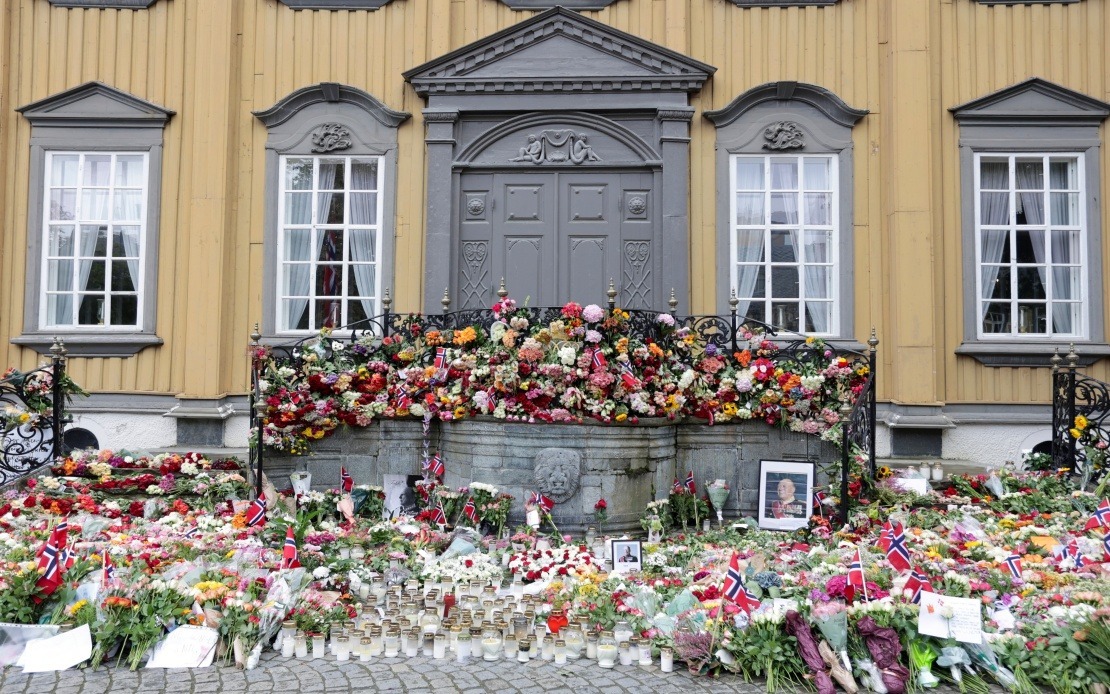
The death of King Harald V has prompted an outpouring of national grief across Norway, with memorial services taking place simultaneously at churches and cathedrals throughout the kingdom on Sunday. The 89-year-old monarch, who passed away on Friday, was remembered by tens of thousands of citizens who gathered at religious institutions to pay their respects and reflect on his long reign. The Norwegian Royal House has formally announced that the state funeral will be conducted on September 9, providing a focal point for the nation's mourning period and allowing dignitaries and ordinary citizens alike to bid farewell to their sovereign.
The spontaneous displays of public mourning have extended far beyond formal church services, with the Royal Palace in Oslo becoming an impromptu memorial site. Flowers, candles, and personal cards have accumulated outside the palace as ordinary Norwegians sought to express their sorrow and gratitude for Harald V's decades of service to the kingdom. These visible demonstrations of collective grief underscored the deep affection held by the Norwegian people for their late monarch, reflecting his significant role in the nation's modern history and cultural identity.
Following the constitutional framework that governs Norwegian succession, the transition of power occurred immediately upon Harald V's death, with no interregnum or period of uncertainty. His son, now 53 years old, automatically inherited the throne and has taken the regnal name Haakon VIII, continuing a tradition of Norwegian monarchs bearing this historic title. The seamless transfer of sovereignty demonstrates the stability of Norway's constitutional monarchy system, where the line of succession is clearly defined and legally established, ensuring continuity of governance during periods of dynastic change.
The ascension of Haakon VIII marks a significant generational shift in Norwegian leadership. While Harald V witnessed and guided the nation through much of the post-World War II era and the transformations of the late twentieth and early twenty-first centuries, his successor represents a new chapter in the kingdom's history. The new king inherits not only the ceremonial duties and symbolic significance of the Norwegian Crown but also the responsibilities of representing the nation on the international stage during a period of considerable geopolitical complexity in Northern Europe.
For Malaysian and Southeast Asian observers, the events in Norway offer insights into how established monarchies manage transitions and maintain institutional stability during periods of dynastic change. Unlike some monarchical systems, Norway's constitutional framework leaves little room for dispute or ambiguity in matters of succession, providing a model of institutional clarity and legal precision. The respectful manner in which the Norwegian nation has conducted itself during this period of mourning demonstrates the deep cultural integration of monarchical institutions within Norwegian society, where the Crown serves as a unifying symbol transcending political divisions.
The timing of Harald V's passing and the rapid succession process also reflect broader trends within European monarchies, where aging sovereigns have increasingly led to planned or imminent transitions of power. Several other European nations have experienced similar dynastic changes in recent years, prompting discussions about the contemporary relevance and evolution of royal institutions in modern democracies. Norway's handling of these circumstances provides a case study in institutional resilience and the continuing cultural significance of monarchy in Scandinavian societies.
The funeral arrangements scheduled for September 9 will likely draw international delegations and representatives from various nations, positioning the event as not merely a Norwegian national observance but also an occasion for diplomatic engagement and international protocol. The formalities surrounding such state funerals often require extensive coordination between government agencies, security services, and international partners, reflecting the complex logistical demands of contemporary royal ceremonies in an interconnected world.
Haakon VIII's assumption of the throne occurs during a period when European monarchies face evolving expectations regarding their role in society. Modern sovereigns are increasingly expected to engage with contemporary social issues, demonstrate environmental consciousness, and maintain accessible relationships with their citizens through digital media. The new king will need to navigate these expectations while maintaining the dignified ceremonial functions that have long defined the Norwegian monarchy, striking a balance between tradition and modernity that has become essential for royal institutions seeking to retain public support and relevance.
The transition also carries implications for the continuity of Norwegian foreign policy and Nordic cooperation frameworks. As a prominent member of NATO and a key player in Arctic governance, Norway's leadership under its new monarch will shape the kingdom's approach to regional security challenges, climate change, and economic cooperation with other Nordic and European partners. The funeral and succession ceremonies thus assume geopolitical significance extending well beyond traditional expressions of national mourning.
The widespread participation of ordinary Norwegians in the memorial services demonstrates the enduring connection between the Crown and civil society in a mature democracy. Rather than viewing the monarchy as an antiquated institution, Norwegians appear to regard it as an integral component of their national identity and constitutional framework. This perspective contrasts with republican sentiment in some democracies and underscores the varied ways in which different societies define their governance structures and national symbols.

