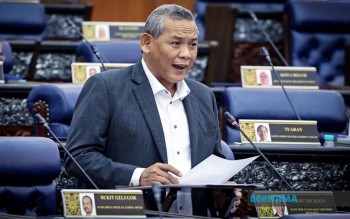
Port Dickson Member of Parliament Datuk Seri Aminuddin Harun has cautioned against blanket assumptions that all investment losses at Lembaga Tabung Haji stem from misconduct, arguing instead that fair analysis must differentiate between ordinary market risks and actual failures in institutional governance. Speaking during a parliamentary debate on the Royal Commission of Inquiry report into Tabung Haji, the former Negeri Sembilan menteri besar emphasised that investment management inherently involves exposure to market volatility, and that losses arising from such exposure should be treated distinctly from those caused by negligence, conflicts of interest, or deficient governance practices.
This distinction proves critical for understanding the nuances of Tabung Haji's financial performance. The institution, which manages savings for Malaysian pilgrims undertaking the hajj, operates within complex global financial markets where even prudent investment strategies can produce negative returns during economic downturns or market corrections. By separating genuine misconduct from unavoidable market fluctuations, policymakers can identify where institutional reform genuinely matters rather than attributing all underperformance to wrongdoing. Aminuddin's framing suggests that the RCI's scope, while examining the 2014-2020 period, may not have fully disentangled these categories in ways that allow for proportionate responses.
The RCI report itself, released publicly on July 29 and comprising 211 pages of findings on institutional weaknesses, recommended forensic audits of 14 investments that experienced significant declines. This targeted approach aligns with Aminuddin's argument that scrutiny should be focused and evidence-based rather than assuming systemic fraud. Of the 25 recommendations contained in the report, 75 per cent had already been implemented by Tabung Haji as of late July, suggesting the institution has moved to address identified governance gaps. The RCI process began in 2021, with member appointments made in January 2022, and the final report was presented to the Yang di-Pertuan Agong in August 2022.
Aminuddin directed particular attention to the appointment process for board members and senior management, proposing that selection criteria be substantially upgraded beyond current practice. He advocated that positions should be allocated based on demonstrable expertise and relevant investment experience rather than serving as sinecures for politically connected individuals. This represents a fundamental critique of how Malaysian public institutions have traditionally filled leadership roles, where appointments often reflected factional allegiances or rewards for political loyalty rather than professional qualifications. Such practices undermine institutional effectiveness and create environments where conflicts of interest flourish.
The former state chief called for a systematic overhaul of institutional culture at Tabung Haji, explicitly warning against treating board appointments as favours or mechanisms for building political influence. He stressed that these positions constitute professional trusts demanding rigorous selection and oversight. This cultural transformation requires deliberate effort, as institutional habits formed over decades do not change through rhetorical commitment alone. Aminuddin's framing positions merit-based governance not merely as administrative best practice but as essential to protecting the savings of millions of Malaysian Muslims.
Furthering this agenda, Aminuddin proposed that all prospective board candidates undergo comprehensive screening encompassing integrity assessment, investment experience, Islamic finance knowledge, risk management expertise, accounting and auditing competency, legal understanding, corporate governance familiarity, and hajj management experience. Such multidisciplinary criteria would ensure that board composition reflects the genuine complexity of managing an institution handling billions of ringgit in pilgrim savings. Candidates would additionally be required to formally declare conflicts of interest, creating transparency mechanisms absent from previous appointments. This represents a substantial elevation of accountability standards compared to historical practice.
Aminuddin also endorsed an RCI recommendation to amend the Tabung Haji Act, specifically to prohibit serving politicians from appointment as chairman or board members of Tabung Haji or its subsidiary entities. This prohibition addresses a fundamental governance principle: active politicians overseeing large financial institutions creates structural conflicts between political and fiduciary obligations. Removing active politicians from decision-making roles would reduce pressure to deploy pilgrim savings for politically motivated purposes and insulate investment decisions from electoral cycle considerations. Such legislative changes, while procedurally straightforward, represent meaningful shifts in governance philosophy.
Parallel concerns emerged from other parliamentarians during the same sitting. Datuk Mohd Isam Mohd Isa, representing Tampin and serving on the Public Accounts Committee, expressed frustration that the RCI's temporal scope ended in 2020, leaving a significant gap until 2025. Mohd Isam argued that substantial institutional developments occurred after 2020, meaning that critical governance questions and operational weaknesses during 2021-2025 remain unexamined by the formal inquiry. He called for establishment of a new RCI specifically examining this later period, arguing that the current inquiry's limited timeframe prevented comprehensive understanding of evolving institutional challenges.
Mohd Isam additionally proposed that Tabung Haji matters be referred to the Public Accounts Committee for extended scrutiny covering 2022-2026. The PAC possesses ongoing investigative powers and can conduct detailed examinations extending beyond a single commission's timeframe. This approach would provide continuous parliamentary oversight of institutional performance and governance implementation rather than relying on isolated inquiries. Such mechanisms prove particularly valuable for monitoring how Tabung Haji implements the RCI's recommendations and whether genuine cultural transformation occurs or merely procedural adjustments are undertaken.
The governance challenges facing Tabung Haji reflect broader institutional weaknesses affecting Malaysian public entities. Investment losses, governance failures, and conflicts of interest have plagued numerous state-linked enterprises and government agencies, suggesting systemic rather than isolated problems. Reforms targeting Tabung Haji specifically must therefore connect to wider civil service and institutional governance improvements if they are to prove durable. Aminuddin's emphasis on merit-based appointment and professional credentials speaks to this broader imperative for institutional quality across the Malaysian public sector.
For Malaysian pilgrims, these governance discussions carry direct significance. Tabung Haji's financial health determines whether savings remain secure and whether the institution can sustainably finance hajj operations for future generations of depositors. Poor governance and investment mismanagement threaten the institution's ability to fulfil its core mandate of facilitating affordable pilgrimage for ordinary Malaysians. The distinction Aminuddin draws between market losses and misconduct therefore has real consequences for millions of account holders who depend on the institution's financial stability.
Moving forward, implementation of both the RCI recommendations and the additional governance measures proposed in parliament will prove critical. The fact that 75 per cent of initial recommendations were already implemented suggests institutional responsiveness, yet deeper cultural transformation remains necessary. Political will for such change must transcend rhetorical commitment, as entrenched interests typically resist merit-based appointment systems and transparency mechanisms. Sustained parliamentary oversight, combined with strengthened accountability frameworks and genuine prioritisation of professional expertise over political connection, offers the most realistic pathway toward institutional renewal.

