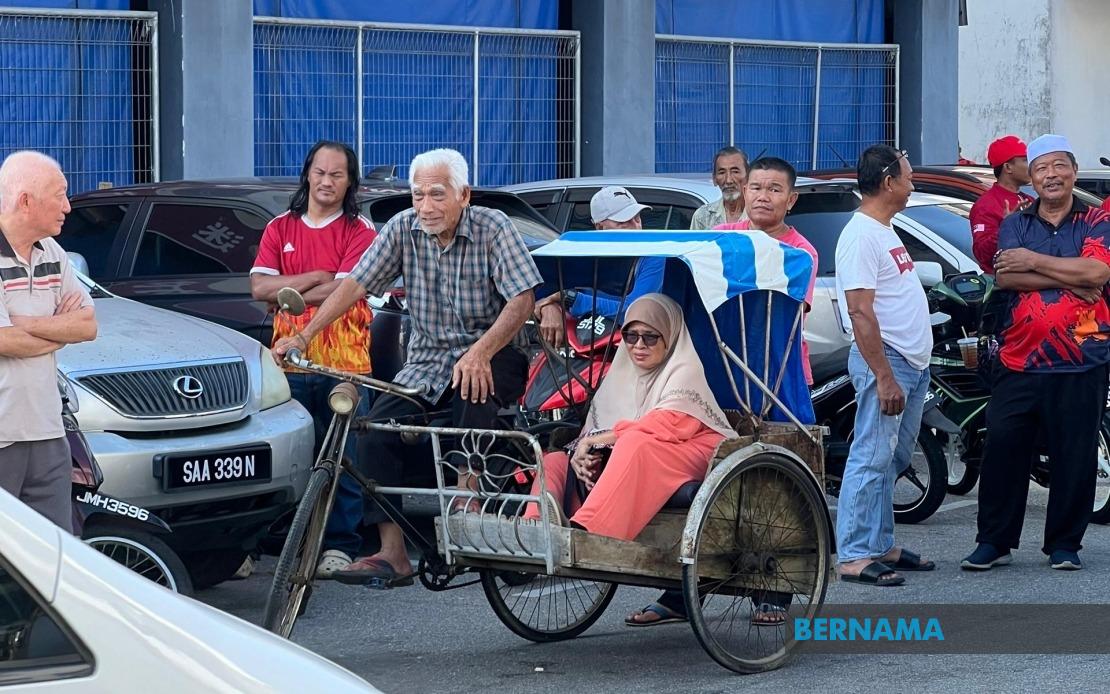
Abdul Razak Pelangga, an 86-year-old resident of Batu Pahat in Johor, demonstrated remarkable determination on a sweltering July afternoon when he chose to pedal his trishaw nearly a kilometre from his home in Kampung Parit Bugis to a local coffee shop to witness Prime Minister Datuk Seri Anwar Ibrahim. The decision to undertake the physically demanding journey in oppressive heat, rather than rely on motorised transport readily available to him, underscores the deep personal connection many Malaysians feel towards their political leaders and the sacrifices some are willing to make for fleeting moments of proximity to them.
Abdul Razak, accompanied by his wife Jamilah Samsudin, 64, had learned the previous day that the Prime Minister would be stopping at Kedai Kopi Hailam Sri Medan in Senggarang as part of his campaign activities in the lead-up to Johor's state election. Rather than arriving by car or motorcycle—modes of transport that would have offered greater comfort and convenience—the octogenarian selected his trishaw, reasoning that the traditional three-wheeled vehicle would spare him the frustration of hunting for a parking space in what would certainly be a congested area during the Prime Minister's visit.
The personal history that motivated Abdul Razak's journey adds a layer of emotional resonance to the story. Serving as the Imam of Masjid Raudhatul Jannah Parit Bugis, he had encountered Anwar Ibrahim years earlier during a congregational prayer session at his mosque, long before the latter ascended to the country's highest political office. That encounter had left a favourable impression on both men, and Abdul Razak had since shared the memory with his wife, describing Anwar's approachable demeanour and the friendly exchange that followed their meeting. The prospect of bringing his spouse to see the Prime Minister in person thus represented an opportunity to make a shared memory that had previously existed only in conversation and television broadcasts.
When the Prime Minister finally arrived at the coffee shop, Abdul Razak and his wife were unable to secure a close face-to-face interaction with him, given the substantial crowd that had gathered for the occasion. Nevertheless, the elderly couple expressed satisfaction at having observed Anwar from a reasonably proximate distance, a privilege that proved more meaningful to them than mere television viewership. The occasion formed part of the PMX Meet-and-Greet Programme, a series of engagements designed to allow the Prime Minister to connect with constituents in Senggarang during his campaigning efforts for the Johor state election. Anwar spent approximately fifty minutes at the establishment, during which time he mingled with residents and participated in the carefully orchestrated public relations exercise.
Accompanying the Prime Minister on the visit was Datuk Fahmi Fadzil, the Communications Minister and Communications Director of Pakatan Harapan, whose presence reflected the coalition's strategic focus on maximising media coverage and public engagement during the state election campaign. The staging of such meet-and-greet events serves multiple purposes within Malaysia's political landscape: they generate grassroots enthusiasm, create opportunities for local media coverage, and demonstrate that senior political figures remain accessible and attuned to the concerns of ordinary citizens in provincial areas.
Beyond the narrative of an elderly man's devotion to witnessing his country's leader, Abdul Razak's story carries particular significance given the convergence of personal and civic milestones in his life. He revealed that the date of the Johor state election polling—July 11—happens to coincide with his 87th birthday, transforming what might otherwise be a routine exercise of electoral duty into an occasion of profound personal meaning. Having participated in numerous elections throughout his long life, Abdul Razak expressed that this particular voting opportunity felt distinctly special, imbued with the symbolic weight of marking a birthday by fulfilling his democratic responsibilities.
The timing of the election itself merits consideration within the broader context of Malaysian politics. Johor, one of the peninsula's most politically significant states and a traditional stronghold of considerable importance, was undergoing a state-level electoral exercise that would determine representation and governance for the forthcoming term. Early voting was scheduled for July 7, with the main polling day set for July 11, providing voters with options regarding when to cast their ballots. For voters like Abdul Razak, the opportunity to participate in elections remains a valued privilege, particularly for those who have witnessed Malaysia's democratic evolution over multiple decades.
Abdul Razak's choice to employ the trishaw, a form of transport increasingly rare in modern Malaysia as motorised vehicles have proliferated, carries subtle cultural and social commentary. The decision to rely on this traditional mode of conveyance suggests a deliberate embrace of heritage and authenticity, a conscious rejection of convenience in favour of maintaining connection to older practices and values. In an era of rapid modernisation and mechanisation, such choices stand out as acts of quiet resistance and affirmation of continuity. For residents of smaller towns and rural areas like Batu Pahat, the trishaw remains a visible symbol of their community's character and history.
The broader significance of incidents such as this lies in what they reveal about citizen engagement with political processes in Malaysia. The willingness of an octogenarian to undertake physical exertion to glimpse his Prime Minister demonstrates that political interest and investment persist across age groups and extends beyond what digital-age observers might anticipate. The story also highlights the enduring appeal of personal, face-to-face political engagement, even in an age of extensive media coverage and virtual connectivity. For many Malaysians, particularly older generations, the opportunity to see political leaders in person carries symbolic weight that transcends the brief duration of the encounter itself.
The anecdote of Abdul Razak and his wife ultimately serves as a human-interest counterpoint to the formal machinery of electoral campaigns and state-level political manoeuvring. While campaign strategists focus on vote banks, policy platforms, and electoral mathematics, individuals like Abdul Razak approach elections and political engagement through the lens of personal relationship, historical memory, and civic pride. His journey by trishaw, undertaken despite physical demands and climatic challenges, exemplifies the diverse motivations that drive political participation among Malaysian voters across different demographics and regions.

