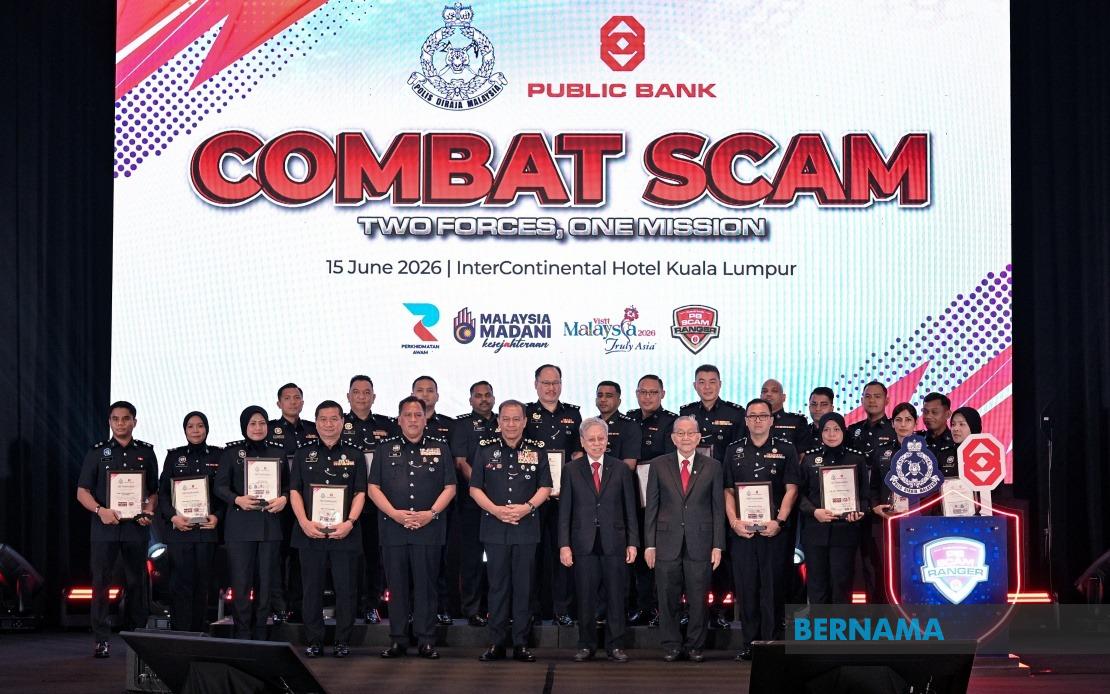
Malaysia's cybercrime landscape has deteriorated significantly, with losses from online scams nearly doubling to RM2.97 billion in 2025 compared to RM1.57 billion the previous year. Inspector-General of Police Tan Sri Mohd Khalid Ismail disclosed these figures at the launch of the 'Combat Scam: Two Teams, One Goal' campaign in Kuala Lumpur on June 15, painting a grim picture of a nation increasingly vulnerable to digital fraud schemes that show no signs of abating.
The magnitude of the increase—RM1.40 billion more in losses within a single year—underscores how rapidly fraud syndicates are scaling their operations and refining their criminal methodologies. The number of reported cases jumped dramatically as well, with 66,204 online fraud incidents recorded throughout 2025, representing an 87 percent surge from the 35,368 cases documented in 2024. This explosive growth suggests that the problem is not merely becoming more severe in terms of financial impact, but is also affecting far greater numbers of Malaysians across different socioeconomic backgrounds and digital literacy levels.
Non-existent investment scams emerged as the most profitable category for criminal networks, generating RM1.47 billion in losses alone. These schemes, which typically lure victims with promises of unrealistic returns through fake cryptocurrency platforms, forex trading systems, or fraudulent business opportunities, have become increasingly sophisticated in their presentation and marketing. The prevalence of investment-related fraud reflects how scammers have adapted their tactics to exploit growing public interest in wealth creation and financial independence, particularly among younger Malaysians seeking alternative income streams.
Phone-based scams continue to dominate the fraud landscape, with 28,388 cases reported in 2025, making them the single most prevalent attack vector. These schemes range from impersonating banking officials requesting personal information to coordinated vishing operations where perpetrators pose as law enforcement or telecommunications representatives. The continued effectiveness of phone scams suggests that despite heightened awareness campaigns, many Malaysians remain vulnerable to social engineering tactics that exploit trust in authority figures and urgency-based manipulation.
The Inspector-General emphasized that these are not mere statistical abstractions but represent thousands of individuals whose financial security and future prospects have been irreparably damaged. Victims frequently experience devastating consequences beyond immediate monetary loss, including psychological trauma, damaged family relationships, and in severe cases, suicide. The ripple effects extend through communities and the broader economy, as victims often cease productive activity and become dependent on social assistance or family support.
Mohd Khalid attributed the escalating threat to the sophistication of modern criminal networks that continuously exploit technological advancement and evolving digital communication platforms. Scammers leverage encrypted messaging applications, deepfake technology, artificial intelligence for voice cloning, and advanced social media targeting algorithms to identify and manipulate vulnerable individuals. This technological arms race means that traditional prevention methods frequently lag behind the criminals' capabilities, creating a persistent vulnerability window that criminal syndicates aggressively exploit.
Recognizing the severity of the challenge, the police chief stressed that prevention, education, and cultivating widespread digital security awareness have become urgent national priorities. The police force has committed to strengthening these efforts continuously, acknowledging that law enforcement alone cannot solve a problem that requires societal-level behavioral change and resilience building. This represents a strategic shift toward acknowledging that cybersecurity is not merely a technical or policing issue but a fundamental aspect of digital citizenship that demands comprehensive, multi-stakeholder engagement.
A notable development in this regard is the PB Scam Rangers Programme, a collaborative initiative between the Bukit Aman Commercial Crime Investigation Department and Public Bank Berhad. This partnership represents a progressive approach wherein the financial sector actively partners with law enforcement to enhance public understanding of both financial literacy and cybersecurity best practices. By leveraging the bank's extensive reach and trusted position within communities, the programme aims to create multiple touchpoints where the public can access education about common scam methodologies and protective measures.
The strategic vision underpinning this approach recognizes that building a scam-resistant society requires cultivating broader awareness, knowledge, and psychological resilience against manipulation tactics. Rather than treating each scam case as an isolated incident requiring law enforcement intervention, the new campaign framework treats cybercrime prevention as a preventive public health issue requiring community-wide immunity development. This shift acknowledges that as scammers become more sophisticated, potential victims must similarly develop more sophisticated defensive capabilities.
For Malaysian readers and regional observers, these statistics carry particular significance given Southeast Asia's rapid digital transformation and the region's emerging prominence as both a market for legitimate digital services and an increasingly attractive target for transnational cybercrime syndicates. The 87 percent surge in cases within a single year suggests that cybercriminals are achieving acceleration in their recruitment, training, and deployment of fraudsters across jurisdictions. This regional dimension means that Malaysian victims are not only targeted by domestic scammers but by coordinated international criminal networks operating across the Association of Southeast Asian Nations, where law enforcement coordination remains inconsistent and legal frameworks vary significantly.
The financial implications also warrant attention from policymakers and institutional stakeholders. The RM2.97 billion in losses represents real economic damage that reduces consumer spending, diverts household resources from productive investment, and creates negative multiplier effects throughout the economy. Additionally, these figures likely underestimate actual losses, as many victims never report incidents due to shame, fear of legal consequences, or uncertainty about where to seek assistance, meaning the true economic burden is substantially higher than official statistics suggest.
Moving forward, the effectiveness of the police and banking sector partnership will depend on sustained commitment, adequate resource allocation, and genuine integration across multiple institutions including telecommunications providers, social media platforms, and educational establishments. Without coordinated action across these domains, including harder interventions like disrupting the financial infrastructure that enables scammers to launder proceeds, awareness campaigns alone will remain insufficient to reverse the escalating trend that has positioned Malaysia as an increasingly vulnerable jurisdiction for online fraud.