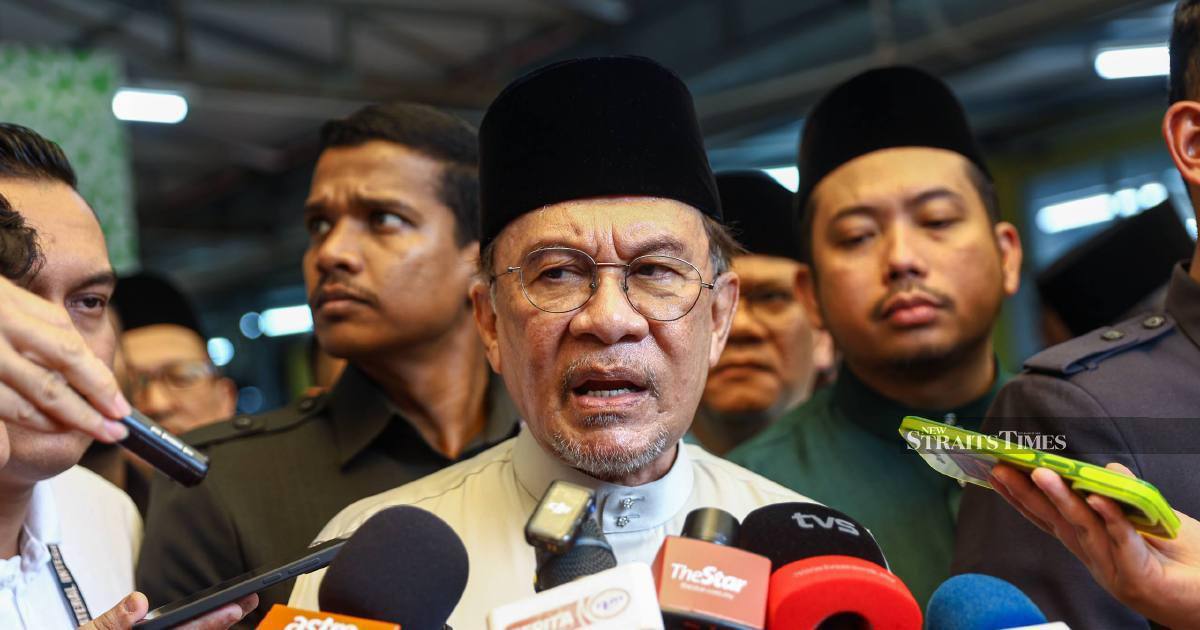
Prime Minister Datuk Seri Anwar Ibrahim has drawn a clear constitutional boundary around the appointment of Tan Sri Azam Baki to the National Financial Crime Centre (NFCC) advisory board, declaring that only Sultan Ibrahim, King of Malaysia, holds the authority to remove him from the position. The statement marks an important clarification regarding the institutional checks and separation of powers in matters concerning senior government appointments, particularly those involving statutory bodies and constitutional offices.
The pronouncement carries significant weight in the Malaysian governance context, where the distinction between executive prerogative and royal authority remains a matter of constitutional convention and interpretation. By explicitly vesting removal authority in the Agong rather than the Prime Minister's office or any other executive body, Anwar has effectively insulated the appointment from direct political intervention or cabinet-level pressure. This delineation of power reflects the constitutional position of the monarchy as the ultimate arbiter in matters of state appointment and removal, particularly for positions of considerable institutional importance.
The NFCC advisory board oversees Malaysia's financial crime prevention mechanisms, making it a sensitive institution at the intersection of law enforcement, financial regulation, and national security. Azam Baki's presence on this board carries particular significance given his prominent role within Malaysian law enforcement circles and his track record in anti-corruption initiatives. The appointment itself has been a subject of public and political scrutiny, necessitating the Prime Minister's clarification on the proper constitutional procedures for any potential future modifications.
Anwar's statement effectively channels any concerns about the appointment through the proper constitutional framework rather than through parliamentary debate or executive pressure. This approach demonstrates adherence to constitutional principles that reserve certain powers to the throne, even in an era of increasingly assertive parliamentary democracy. By making this declaration public, the Prime Minister has also signaled his administration's commitment to respecting institutional boundaries and avoiding the appearance of arbitrary executive power in matters touching on senior appointments.
The timing of this clarification suggests there has been sufficient public discourse or political questioning regarding Azam Baki's continued tenure on the board to warrant official comment from the highest level of government. Such statements are typically released when ambiguity threatens institutional confidence or when political actors have raised formal questions about the legitimacy or appropriateness of an appointment. Anwar's intervention serves to settle the matter procedurally, even if the underlying concerns about the appointment itself remain contested.
Malaysian constitutional law has long established that the Agong functions as the fountain of honour and possesses the ultimate authority to appoint and remove holders of significant state positions. This principle extends beyond ceremonial roles to substantive positions within statutory bodies and government institutions. By directing potential challengers toward the throne rather than the executive branch, Anwar has essentially placed the matter beyond the reach of parliamentary maneuver or cabinet reshuffling. The implication is clear: those unhappy with Azam Baki's appointment must pursue avenues that engage with the constitutional monarchy rather than target the Prime Minister or his administration.
The statement also reflects contemporary Malaysian politics, where coalition dynamics and parliamentary mathematics create pressure for executive action on personnel matters that might otherwise lie outside ministerial portfolios. Anwar's clarification effectively resists such pressure by invoking constitutional constraints. This approach provides political cover for his administration while respecting the formal role of the Agong in matters of state appointments, thereby maintaining both executive stability and constitutional propriety.
For Southeast Asian observers, Malaysia's approach to separating powers between executive and monarchical authority presents an interesting case study in hybrid governance systems. The region features several constitutional monarchies with varying approaches to the distribution of appointment and removal powers. Malaysia's framework, as reiterated by Anwar, grants the throne substantial real power beyond ceremonial functions, distinguishing it from some purely constitutional monarchies where the sovereign acts on executive advice alone.
The practical implications of Anwar's statement extend to broader questions about institutional accountability and the appropriate channels for challenging government appointments. While the Prime Minister has clarified the constitutional position, the substantive debate about Azam Baki's suitability for the NFCC role may continue within parliamentary proceedings, civil society forums, and media discussions. However, any formal moves toward removal must now explicitly acknowledge they require royal intervention rather than executive action. This creates a higher institutional threshold for challenging the appointment, potentially insulating it from rapid political change while still leaving a constitutional pathway for concerned parties.
Anwar's careful articulation of constitutional boundaries also demonstrates the continuing relevance of formal legal frameworks in Malaysian governance despite the highly politicized nature of contemporary Malaysian public life. By grounding his position in constitutional principle rather than policy preference or political calculation, the Prime Minister has attempted to elevate the discussion above partisan argument. Whether this invocation of constitutional propriety will satisfy critics of the appointment remains uncertain, but it has clearly established the official government position regarding the powers of different branches of state authority over the matter.

