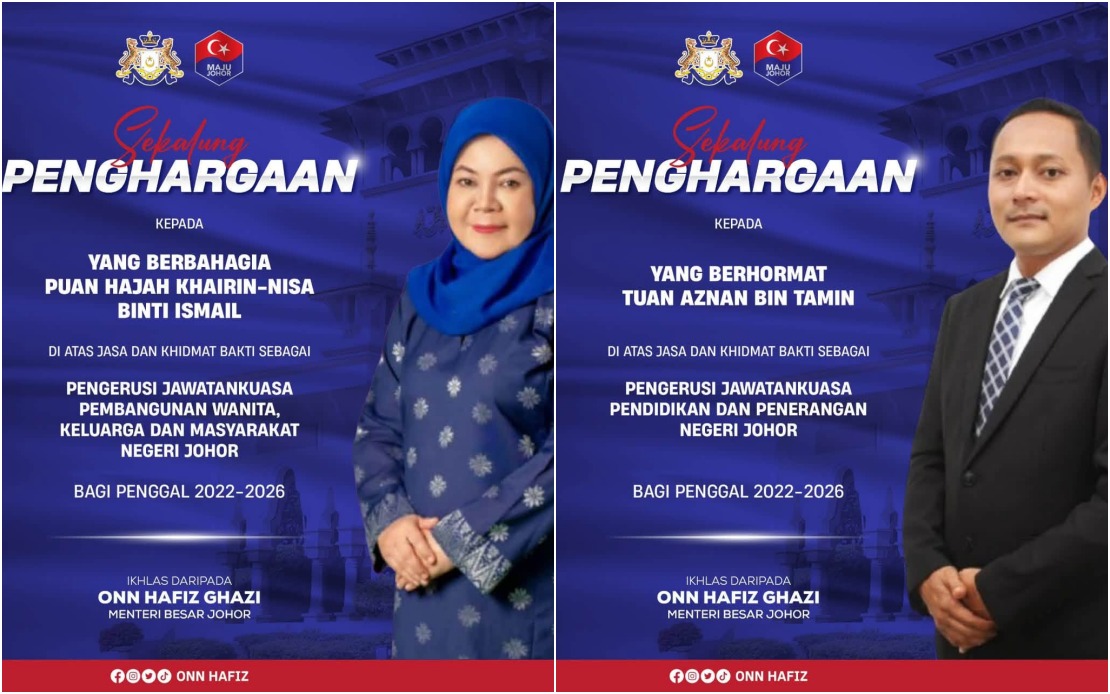
Johor's leadership hierarchy has undergone a significant restructuring designed to balance continuity with fresh administrative momentum, a move that Menteri Besar Datuk Onn Hafiz Ghazi framed as essential to advancing the state's developmental trajectory. The reshuffled State Executive Council, sworn in at Istana Bukit Serene before Tunku Mahkota Ismail, reflects a deliberate strategy to retain experienced hands whilst injecting new perspectives into state governance during the current political term.
In acknowledging the departure of four council members, Onn Hafiz took pains to emphasise that personnel changes represented standard administrative practice rather than any diminishment of their tenure's accomplishments. The four former exco members—Datuk Zahari Sarip, K. Raven Kumar, Aznan Tamin and Khairin-Nisa Ismail—have been publicly credited for their service during the 2022-2026 term, with the Menteri Besar insisting their contributions formed the foundation for state achievements throughout their period of office. This measured acknowledgment serves to maintain political goodwill whilst signalling that the administration's focus has shifted toward new priorities.
The composition of the new executive council reflects a pragmatic approach to governance. Six assemblymen retained their existing portfolios, suggesting confidence in their ongoing performance and policy direction, whilst four new representatives were brought into the administration. This ratio indicates neither wholesale change nor stagnation, but rather targeted renewal aimed at addressing evolving administrative demands and demographic representation within Johor's political structure. The appointment of new members also creates opportunities for previously sidelined assemblymen to contribute at the executive level, a consideration important in maintaining factional balance within the ruling coalition.
Onn Hafiz articulated the philosophical underpinning of the reshuffle through a statement on his Facebook page, positioning the changes as necessary components of ensuring governmental continuity whilst simultaneously refreshing administrative capacity. He underscored that positional shifts do not erase institutional memory or negate previous accomplishments, a reassurance likely intended for both departing members and stakeholders concerned about policy discontinuity. The framing reflects a recognition that effective governance requires acknowledging past contributions whilst maintaining forward momentum—a delicate balance in Malaysian state politics where factional sensitivities frequently influence appointments.
The Menteri Besar's emphasis on collective effort over individual position carries particular significance within Malaysia's constitutional framework. Johor's governance structure, like other states, operates on principles of collective responsibility whereby the Exco functions as a unified body rather than a collection of independent fiefdoms. Onn Hafiz's statement that responsibility for Johor transcends any single position reinforces this principle, suggesting that the reshuffle should not be interpreted as diminishing individual members but rather as redistributing roles to optimise administrative efficiency. This messaging becomes increasingly important when reshuffles involve high-profile figures or reflect internal political recalibrations.
For Malaysian observers tracking state-level governance dynamics, the Johor reshuffle provides a window into contemporary patterns of leadership management. The decision to retain six members whilst replacing four reflects confidence in existing policy trajectories whilst permitting course corrections or renewed emphasis in specific portfolios. This approach differs markedly from wholesale administrative overhauls, suggesting institutional stability and continuity of developmental agendas during a period when many Malaysian states grapple with economic recovery and attracting investments. Johor's economic prominence as a manufacturing and logistics hub makes its administrative decisions particularly consequential for regional development strategies.
The formal ceremony at the royal palace, attended by the Regent, invested the reshuffle with ceremonial legitimacy and constitutional propriety. Tunku Mahkota Ismail's participation in the appointment letter presentation and oath-taking underscores the constitutional dimensions of state governance, reminding stakeholders that executive authority ultimately derives from and remains subject to monarchical oversight. This constitutional formality distinguishes Malaysia's system from purely parliamentary democracies and reflects the constitutional role of state rulers in validating executive appointments—a mechanism that has periodically resurfaced in contemporary political debates surrounding executive authority.
The broader context for understanding this reshuffle involves Johor's position within Malaysia's federal structure and its international trade relationships. As a state hosting critical infrastructure, Special Economic Zones, and significant foreign investment, Johor's executive decisions directly influence Malaysia's competitiveness and economic trajectory. The composition of the Exco therefore extends beyond local political considerations to encompass implications for investment policy, regulatory frameworks, and sectoral development strategies. The retention of experienced members suggests continuity in managing these complex interfaces, whilst new appointments may indicate expanding administrative focus into emerging policy domains.
Onn Hafiz's public acknowledgment of departing members' sacrifices and contributions represents more than ceremonial courtesy—it constitutes an important political statement regarding institutional memory and the value ascribed to service within Malaysia's state bureaucracies. In a political environment where departing officials sometimes encounter diminished standing or factional marginalisation, explicit public appreciation provides a measure of dignity and recognition. This approach may also facilitate smoother transitions and reduce the likelihood of departing members obstructing successor initiatives through parliamentary or factional resistance—a consideration that has shaped Malaysian political outcomes in previous instances.
The implications of this reshuffle extend to Southeast Asia's broader governance patterns, where state-level administrative appointments increasingly reflect global pressures for economic competitiveness, sustainability concerns, and digital transformation. The balance between continuity and renewal that Johor has pursued through this restructuring represents a strategic choice to maintain institutional coherence whilst positioning the state to respond to evolving challenges. Whether this particular configuration proves sufficient to maintain Johor's developmental momentum throughout the remainder of the political term will depend on how effectively the new and retained council members navigate economic headwinds, infrastructure demands, and changing investor preferences that characterise contemporary regional competition for capital and talent.

