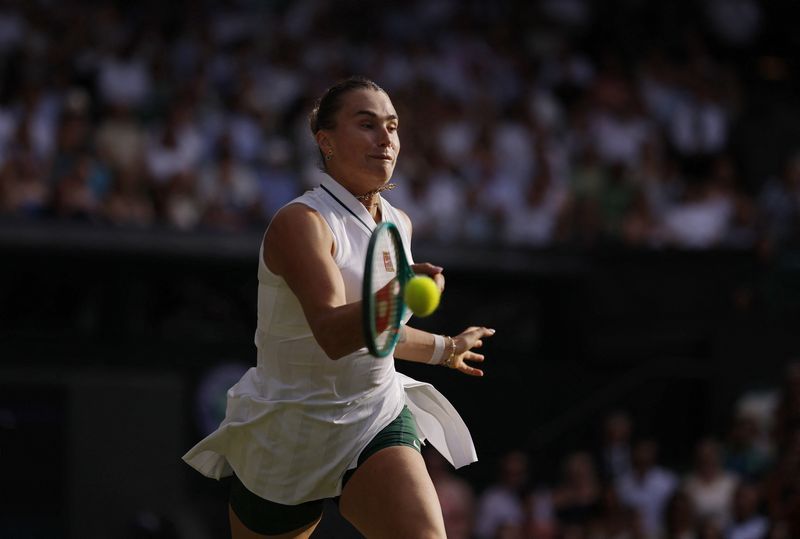
Naomi Osaka's triumphant return to professional tennis reached a new peak on Sunday when she dispatched top-seeded Aryna Sabalenka from Wimbledon's Centre Court in straight sets, claiming a 6-2 7-6(2) victory that fundamentally reshaped the women's championship landscape. The 14th seed's inspired display not only secured her first quarter-final appearance at the grass-court major but also marked her most impressive win since resuming competitive play following the birth of her daughter, Shai, early in 2024.
The fourth-round collision between two players who combined for eight Grand Slam titles promised drama befitting its status as the day's headline match, yet Osaka's controlled brilliance quickly diffused any tension. Sabalenka, seeking to advance beyond the semi-final stage after three consecutive near-misses at the tournament, found herself thoroughly outplayed during the opening set, which consumed just 32 minutes. The Belarusian's formidable power game, which has defined her dominance on hard courts globally, consistently misfired against Osaka's composed returning and precise groundstrokes, leaving the world number one visibly frustrated.
Though Sabalenka mounted a more competitive challenge in the second set, delivering the type of extended rally that the crowd had anticipated, Osaka's demeanour remained unshakeable. The decisive moment arrived in the tiebreak, where Osaka clinically snapped Sabalenka's remarkable streak of 21 consecutive Grand Slam tiebreak victories—a statistic underscoring her opponent's recent dominance. Sabalenka's frustration boiled over when she lost the match point, directing her anger towards a ball that she struck with such force it disappeared entirely from the stadium.
Oska's breakthrough carries enormous implications for the women's draw at a venue where grass-court tennis traditionally rewards precision and adaptability over power. With defending champion Iga Swiatek and second seed Elena Rybakina both eliminated in the third round on Saturday, the removal of the top seed by a returning mother represents a seismic shift in the tournament's complexity. This consolidation of upsets has effectively dismantled the favourites' pathway and created genuine uncertainty regarding who will ultimately hoist the trophy.
The Japanese player, who has become equally renowned for her fashion-forward Japanese-inspired walk-on attire, proved that her sartorial confidence extends fully to her on-court performance. From the opening service games, Osaka seized control through aggressive and well-timed return play that repeatedly disrupted Sabalenka's serving rhythm. Breaking her opponent twice in the initial set established psychological dominance that Sabalenka could never fully overcome, despite attempting various self-motivation techniques including rapping her racket against her head.
Historically, both players have built their Grand Slam credentials primarily on hard courts, where their aggressive baseline games flourish. Collectively, they have claimed eight titles on that surface alone, yet Wimbledon's grass presents an entirely different examination of their technical capabilities. Interestingly, their professional paths have diverged considerably despite being born merely seven months apart. Osaka accumulated all four of her major titles before Sabalenka captured her maiden Grand Slam, illustrating how differently their careers have unfolded despite their generation's proximity.
The two players had faced each other on the Slam stage only once previously, eight years earlier, when Osaka prevailed en route to her U.S. Open triumph. That distant encounter seemed almost irrelevant to their contemporary matchup, as Osaka's game has evolved substantially through her maternity absence. Rather than diminishing her competitive edge, her time away appears to have provided perspective and renewed hunger that manifested visibly throughout the fortnight thus far.
Sabalenka's post-match comments suggested a player emotionally drained by the unexpected defeat. The 28-year-old arrived at her press conference minutes after departing the court, immediately expressing her intention to distance herself from professional tennis briefly. Her candid desire to forget about tennis entirely highlighted the psychological toll of losing to an unseeded opponent at a tournament where she had harboured serious championship ambitions.
Oaska's quarter-final assignment against Czech 10th seed Karolina Muchova presents a manageable test that could propel the Japanese champion into the semi-finals. The momentum generated through her Centre Court victory, combined with the psychological advantage of eliminating the world's top-ranked player, positions her as a genuine contender moving forward. Her re-emergence has generated palpable enthusiasm among supporters and media, particularly given her compelling personal narrative of balancing motherhood with professional excellence at sport's highest echelon.
For Malaysian and regional audiences, Osaka's success resonates beyond mere sporting achievement. Her willingness to step away from professional demands and return stronger exemplifies broader conversations surrounding athlete welfare and work-life integration. Furthermore, her consistent identification with Japanese cultural expression through fashion demonstrates how athletes increasingly leverage their global platforms to celebrate heritage authenticity.
The eliminated Sabalenka, despite her considerable achievements and world ranking, now faces uncomfortable questions about her grass-court compatibility and mental resilience during high-pressure moments. Three consecutive Wimbledon semi-final runs had obscured persistent questions about converting those near-misses into ultimate success, and this fourth-round departure will intensify scrutiny about whether the surface's demands inherently limit her championship prospects there.

