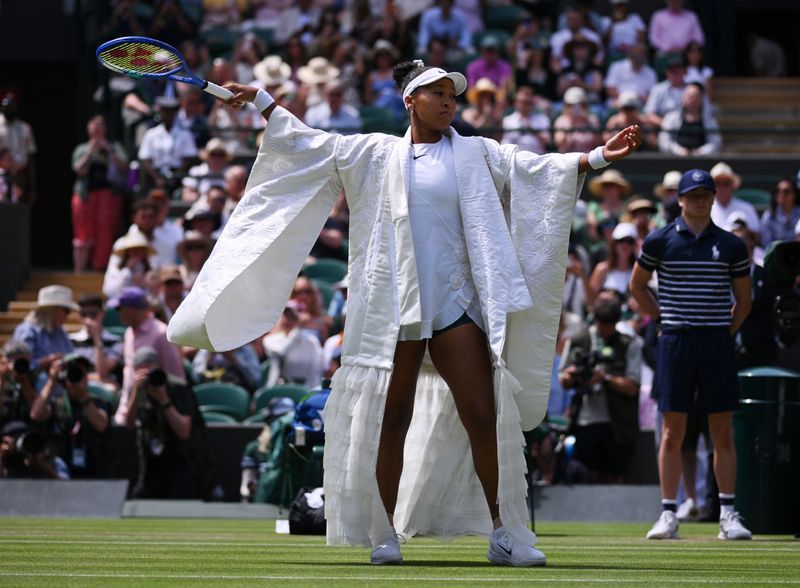
Naomi Osaka's trajectory through the opening rounds at Wimbledon has increasingly vindicated those who see her as more than a fashion phenomenon. The four-time Grand Slam champion from Japan dispatched unseeded Russian-born Daria Kasatkina with a emphatic 6-1 6-3 scoreline on Friday, reaching the last 16 at the All England Club for the first time in her career. The victory marks a significant milestone for Osaka, whose previous efforts at tennis's most tradition-steeped venue have yielded relatively modest results.
While international media has fixated on Osaka's sartorial choices throughout the first week—including her flower-patterned kimono-inspired ensemble that echoed her signature "Kill Bill" walk-on aesthetic—the 14th seed has been methodically building momentum through sheer tennis excellence. Her ability to balance the entertainment value of her court appearance with a steadily improving performance has created a compelling narrative that extends far beyond the typical fashion-versus-sport discourse that often surrounds female athletes at major tournaments.
Against Kasatkina, Osaka demonstrated the controlled aggression that has defined her four Grand Slam titles. She forced the break immediately in the opening set's second game, unleashing a backhand winner before consolidating with a punishing deep forehand that extended her advantage to two breaks. This was no flash of brilliance followed by inconsistency; rather, it represented the kind of sustained pressure that swept her through the opening set in commanding fashion under brilliant sunshine on Court One.
The second set proved slightly more testing for Osaka, though her resilience ultimately prevailed. She squandered an early advantage and found herself in a tighter contest, but rather than allowing doubt to creep in, she summoned the competitive fire that has characterized her major championship victories. Two match points materialised, and she converted the second with characteristic style, securing her passage into the round of 16 where considerably sterner challenges await.
For Malaysian and Southeast Asian tennis followers, Osaka's resurgence at Grand Slams carries particular significance. The region has historically produced few players capable of competing at the highest levels of women's tennis, making Osaka's success as an Asian player with Japanese heritage a source of considerable inspiration. Her demonstrated ability to thrive under the pressure of the All England Club's unique environment—the pristine grass, the historical expectations, the global spotlight—suggests she has genuinely mastered one of tennis's most challenging surfaces.
Osaka's post-match commentary reflected both relief and genuine satisfaction. She notably mentioned never having previously won on Court One, suggesting that each match at Wimbledon carries particular meaning for her. Her appreciation for the crowd's support, delivered with evident sincerity, underscored her growing comfort in this venue. The contrast between her earlier struggles at the championship and her current form speaks to the value of persistence and incremental improvement, lessons that resonate across elite sport.
Her grass-court preparation before Wimbledon proved instructive in this regard. Her participation at Bad Homburg, where she reached her first professional grass-court final before an injury forced withdrawal, clearly built confidence and match experience on this specialised surface. The tournament organizers at Wimbledon would be keenly aware that top players increasingly treat their calendar strategically, using smaller events to build momentum toward the majors. Osaka's willingness to contest multiple grass-court tournaments before Wimbledon proper suggests a player treating the surface with appropriate respect.
The fourth round promises a formidable opponent. Osaka faces either world number one Aryna Sabalenka or former French Open champion Jelena Ostapenko, both players capable of generating the kind of power and precision that could test even a player of Osaka's calibre. Sabalenka's dominance on hard courts has translated convincingly to grass, while Ostapenko's French Open victory demonstrated her capacity to perform under pressure at the sport's highest level. Neither represents a favourable draw, yet Osaka's calm demeanor and measured approach—taking matches one point at a time, as she described her mindset—suggests she approaches such challenges without fear.
Osaka's journey through this fortnight encapsulates a broader shift in professional tennis, where personal branding and athletic excellence need no longer exist in tension. She has convincingly demonstrated that a player can embrace fashion, engage with popular culture, and entertain audiences beyond the court boundaries while simultaneously maintaining the focus and intensity required to compete at the highest levels. This integration rather than compartmentalization of different aspects of identity may represent the future of how athletes, particularly women in high-profile sports, navigate public expectation and personal expression.
For readers across Malaysia and Southeast Asia, Osaka's presence at Wimbledon's second week represents an opportunity to witness one of the sport's premier talents performing at the venue most demanding of consistency and precision. Her previous struggles at the All England Club render her current progress genuinely significant rather than predetermined. Should she continue advancing, she would challenge assumptions about which surfaces and which players typically flourish in the tournament's latter stages.

