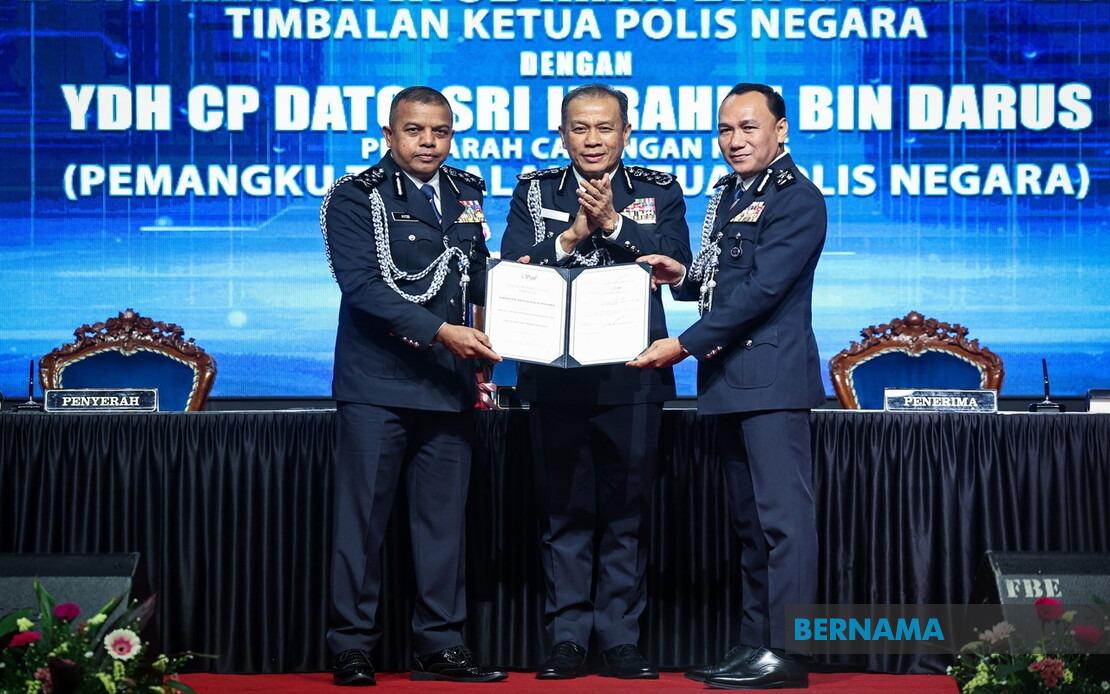
At a ceremonial handover of duty held in Kuala Lumpur on July 26, the Inspector-General of Police formally acknowledged the retirement of Tan Sri Ayob Khan Mydin Pitchay, who has spent more than three decades serving in the Royal Malaysian Police. Tan Sri Mohd Khalid Ismail used the occasion to reflect on Ayob Khan's tenure as the 29th Deputy Inspector-General of Police, describing his leadership as exemplary and rooted in an unwavering commitment to both institutional principles and the broader framework of the rule of law.
During his remarks, IGP Mohd Khalid characterised Ayob Khan as a leader whose presence extended far beyond administrative responsibilities. Rather than functioning merely as a senior official coordinating operations, Ayob Khan demonstrated the qualities of a trusted ally who remained steadfast during turbulent periods within the force. The IGP's language suggested deep respect for an individual who had proven capable of navigating complex institutional challenges while maintaining ethical standards—a quality increasingly valued as Malaysian law enforcement agencies face mounting public scrutiny regarding accountability and governance.
Ayob Khan's professional trajectory spanned a remarkable range of sensitive and strategically important portfolios within the police hierarchy. A graduate of Universiti Kebangsaan Malaysia, he rose through the ranks to lead the Special Branch, a division charged with counterintelligence and security operations. He subsequently served as commander of the Johor Contingent, managing policing across one of Malaysia's largest and economically significant states. His credentials in tackling narcotics crimes were established through his tenure as director of the Narcotics Criminal Investigation Department, an agency confronting Malaysia's persistent drug trafficking challenges. Most notably, before his appointment as Deputy Inspector-General in June 2023, Ayob Khan directed the Bukit Aman Criminal Investigation Department, the apex body overseeing criminal investigations nationwide.
The breadth of Ayob Khan's experience underscores a deliberate career path that exposed him to the full spectrum of modern policing challenges—from counterterrorism operations and internal security matters to organised crime suppression and criminal investigation protocols. This diversity of background positioned him uniquely to understand systemic vulnerabilities and institutional pressures across the police force. The IGP's explicit mention of Ayob Khan's determination in combating militant elements particularly resonates in a regional context where terrorist and extremist networks continue to pose genuine security threats to Malaysia and neighbouring countries.
Integrity emerged as a defining theme in the IGP's eulogy for the departing deputy. In an era when questions about police conduct, corruption, and accountability feature prominently in Malaysian civic discourse, the emphasis placed on Ayob Khan's principled approach to leadership carries significance beyond ceremonial politeness. The IGP suggested that his subordinates should regard Ayob Khan's commitment to integrity as a professional exemplar—a standard against which the broader police culture should be measured. This framing acknowledges that institutional reform and public confidence restoration depend significantly on leaders who demonstrate principled decision-making, particularly when facing pressure to compromise standards.
The handover ceremony also introduced Datuk Seri Ibrahim Darus, who assumes the role of Acting Deputy Inspector-General of Police following Ayob Khan's departure. Ibrahim, the director of the Bukit Aman Special Branch, represents the next generation of senior police leadership. The IGP extended confidence in Ibrahim's capacity to inherit this demanding position and to perpetuate the standards established by his predecessor. This succession reflects an institutional continuity imperative—ensuring that transitions in leadership do not precipitate lapses in operational effectiveness or ethical governance.
For Malaysian readers and regional observers, the significance of this leadership transition extends beyond ceremonial acknowledgment of a retiring official. Deputy Inspector-General positions occupy critical junctures within police command structures, influencing policy implementation, operational decisions, and institutional culture. The explicit emphasis on rule of law adherence and integrity suggests that the police hierarchy recognises the essential relationship between professional standards and public legitimacy. As Malaysian society increasingly demands accountability from security institutions, the police force's public commitment to principled leadership becomes strategically important.
Ayob Khan's specific accomplishments in counterterrorism and militant suppression carry particular relevance for Southeast Asia's security landscape. The region continues to grapple with residual militant networks, though active operations have diminished considerably from peaks observed in preceding decades. A leader with extensive experience managing such threats brings valuable institutional knowledge regarding threat assessment, prevention strategies, and tactical responses—expertise that influences not only Malaysian operations but potentially regional cooperation frameworks involving neighbouring security agencies.
The extended tenure spanning nearly 35 years positions Ayob Khan as someone who experienced multiple phases of Malaysian police development—from earlier structures to contemporary frameworks emphasising community policing, transparency, and technological integration. His ability to navigate these successive transformations while maintaining personal integrity suggests adaptability aligned with principled leadership. This characteristic matters considerably as institutions internationally face mounting pressures to modernise while preserving core values of fairness, accountability, and rule of law conformity.
The IGP's reference to sharing both accomplishments and challenges throughout their collaborative period humanises an otherwise formal institutional transition. This language suggests that steering the police force involves wrestling with genuine dilemmas where ethical clarity does not always emerge straightforwardly. Leaders who can navigate such ambiguity while maintaining commitment to fundamental principles provide invaluable institutional anchoring. As Datuk Seri Ibrahim assumes his new responsibilities, he inherits not merely administrative functions but an expectation that he will perpetuate these standards of principled decision-making across the force's vast operational apparatus.

