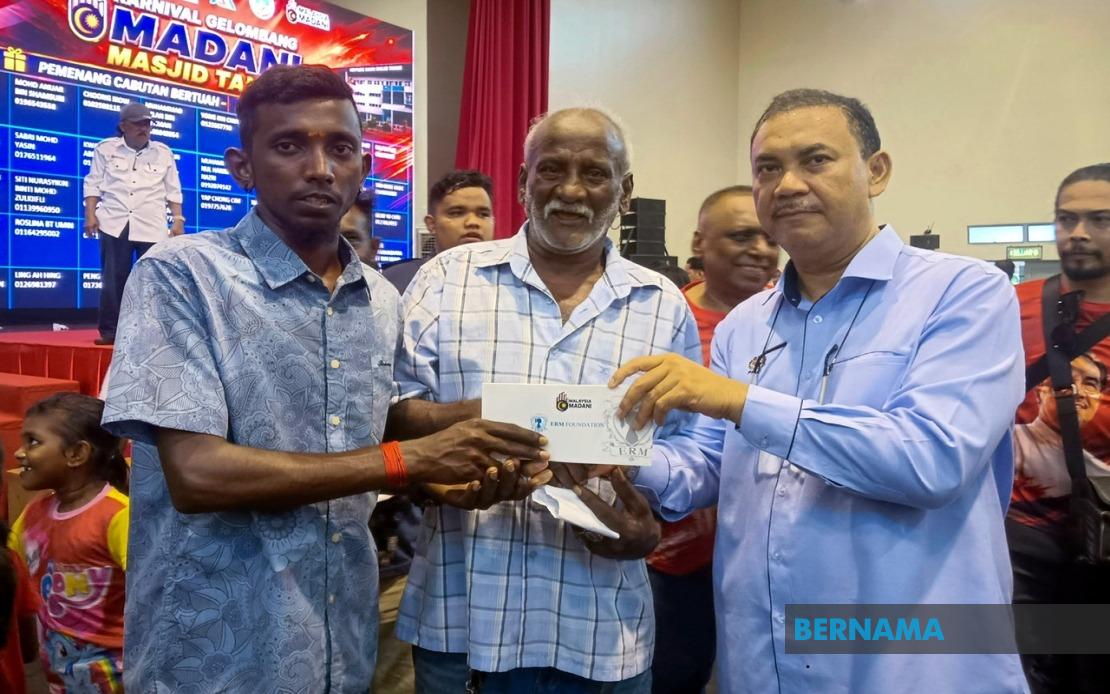
Approximately 2,000 low-income residents in the Masjid Tanah parliamentary constituency have benefited from a direct cash assistance programme held during the Gelombang MADANI Carnival in Alor Gajah. The Sentuhan MADANI Donation initiative, which took place at the Masjid Tanah Sports Complex, provided each recipient with RM200 in financial support aimed at alleviating immediate household expenses and reducing financial strain on vulnerable segments of the population.
Datuk Azman Abidin, the Prime Minister's political secretary, oversaw the distribution and outlined the programme's scope during remarks at the ceremony. The initiative deliberately encompassed recipients from all five state constituencies that constitute the Masjid Tanah parliamentary division, ensuring geographic coverage across Kuala Linggi, Lendu, Tanjung Bidara, Ayer Limau and Taboh Naning. This territorial approach reflects a coordinated strategy to address poverty and economic vulnerability uniformly across the entire parliamentary area rather than concentrating assistance in select urban centres.
The targeting criteria for aid distribution was deliberately broad, encompassing households classified within the bottom 40 percent income bracket, individuals living with disabilities, senior citizens, and low-income earners. This multi-categorical approach recognises that economic hardship extends across diverse demographic groups, from working-age individuals unable to achieve adequate earnings to elderly persons facing fixed incomes and disabled individuals facing additional care costs. The programme thus functions as a form of targeted social protection rather than narrowly focused welfare.
For many recipients, the RM200 assistance represented meaningful supplementary income during a period of sustained economic pressure. Ramlah Othman, a 63-year-old resident from Tanjung Bidara, expressed appreciation for the contribution, emphasising its practical value in addressing daily household expenditure. Her comments underscore how modest sums can provide tangible relief when distributed to households operating on constrained budgets where every ringgit carries consequence for food security and essential utilities.
N. Mariappan, a 69-year-old stroke patient residing in Ladang Sungai Baru, similarly noted the programme's symbolic and material significance. For persons with disabilities and elderly individuals, such targeted assistance acknowledges the additional financial burdens imposed by medical care, reduced earning capacity, and age-related expenses. His recognition that the initiative reflected government concern for vulnerable groups highlights the psychological dimension of social assistance alongside its immediate financial impact.
The Sentuhan MADANI Donation initiative represents part of a broader MADANI framework—the government's overarching social and economic policy—that emphasises compassionate governance and inclusive development. By operationalising this commitment through direct cash transfers rather than in-kind assistance, the programme respects recipient autonomy in allocating resources according to household priorities, whether food, medicine, utilities, or education expenses.
The scale of the distribution, involving 2,000 beneficiaries across five constituencies, suggests a significant financial commitment at the constituency level. With each recipient receiving RM200, the total outlay reached RM400,000, representing substantial budgetary allocation to direct poverty alleviation. This scale indicates the government's investment in immediate relief measures alongside longer-term development initiatives.
From a Southeast Asian perspective, Malaysia's approach to targeted cash assistance reflects evolving thinking about social protection mechanisms. Rather than implementing only contributory schemes reliant on formal employment or conditional assistance programmes, direct unconditional transfers to identified vulnerable groups provide a safety net for populations excluded from traditional welfare systems. This strategy has gained traction across the region as governments seek to address pandemic-related economic disruption and persistent structural poverty.
The geographic distribution across five state constituencies within a single parliamentary division demonstrates administrative capacity for precision targeting in assistance delivery. This requires coordinated planning between federal, state, and local government levels, coupled with effective beneficiary identification systems. Such coordination, when functioning effectively, maximises programme efficiency and minimises exclusion errors where eligible households are overlooked.
Recipient testimonies emphasising the assistance's role in easing daily expenses provide important outcome feedback for programme evaluation. These accounts suggest that the initiative successfully reached intended beneficiaries experiencing genuine financial strain, rather than being captured by undeserving populations. The authentic articulation of gratitude and practical benefit indicates that the programme resonated with recipient needs and circumstances.
Looking forward, the MADANI Carnival model of combining direct assistance with community engagement creates opportunities for integrated service delivery. Beyond cash transfers, such events can facilitate information distribution about available government support programmes, health screenings, skills training enrolment, and microenterprise development initiatives. This ecosystem approach to poverty alleviation moves beyond isolated interventions toward holistic support structures.
The initiative also reflects acknowledgment that poverty reduction requires both emergency relief and structural reform. While RM200 provides immediate breathing room for vulnerable households, sustained poverty alleviation requires complementary investments in education, healthcare, employment creation, and skills development. The Sentuhan MADANI Donation should therefore be understood as one component within a broader anti-poverty framework rather than a comprehensive solution to systemic inequality.

