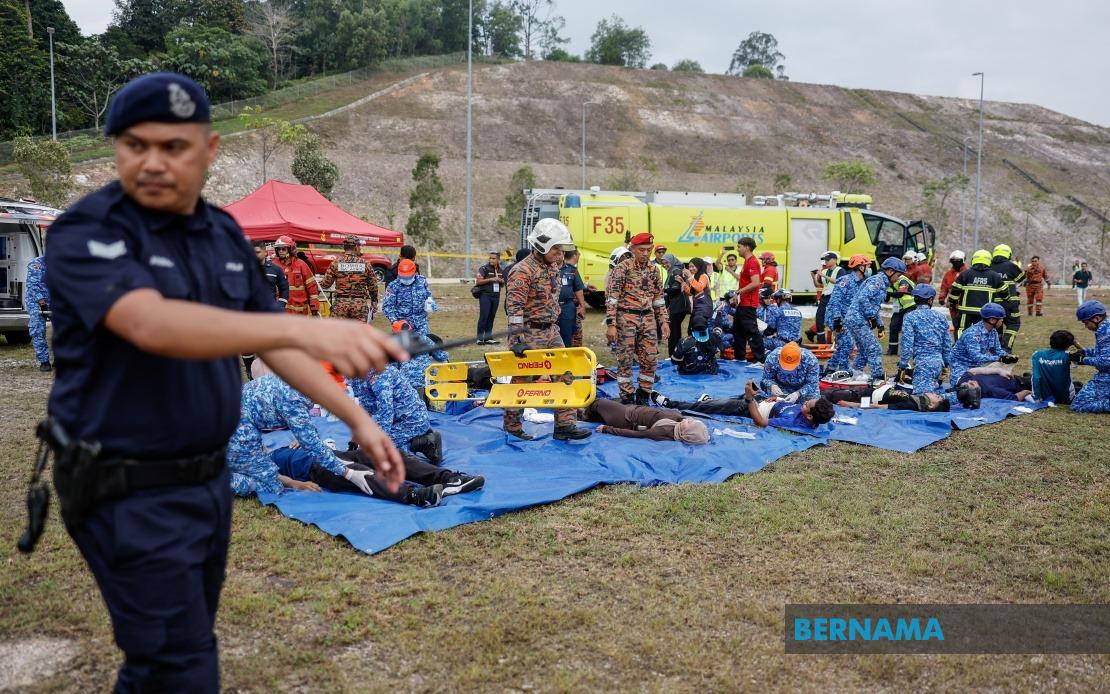
Malaysian aviation authorities conducted an unprecedented full-scale emergency exercise on July 16, marshalling resources from more than 20 government and private-sector agencies to rehearse coordinated disaster response procedures for an aircraft accident occurring beyond airport confines. The Ex Urban Falcon 2026 simulation took place at the Denai Alam Rest and Service Area along the Damansara-Shah Alam Elevated Expressway, where participating teams responded to a scenario involving an ATR72 aircraft crash positioned approximately six kilometres from Sultan Abdul Aziz Shah Airport in Subang.
The exercise represented a significant departure from historical practice. Muhammad Hidayat Ismail, general manager of Airport Fire and Rescue Services (AFRS), underscored that previous drills had focused predominantly on incidents occurring within or near airport boundaries, whereas this simulation specifically examined response capabilities when disasters strike in populated areas beyond direct airport control. This distinction matters considerably for Malaysia's aviation safety framework, as it expands institutional knowledge about managing crises in civilian environments where urban infrastructure, road networks, and civilian emergency services intersect with specialist aviation response teams.
According to the National Aeronautical Search and Rescue Manual (NAMSA), AFRS maintains responsibility for emergency operations within an eight-kilometre radius from the airport's midpoint. The exercise parameters therefore tested operational boundaries that represent realistic scenarios given Malaysia's geography and the proximity of commercial aviation routes to residential and commercial zones. With 450 participants drawn from Malaysia Airports Holdings Berhad (MAHB), the Selangor state government, NADMA, PROLINTAS-DASH, and numerous critical public and private agencies, the drill assembled comprehensive representation of the disaster response ecosystem.
One of the foremost challenges identified during the exercise involved logistical impediments to rapid scene arrival. Response teams must navigate narrow roads, negotiate multiple toll plaza passages, and coordinate across jurisdictional boundaries when accidents occur outside airport perimeters. These practical constraints differ markedly from controlled airport environments where dedicated taxiways and coordinated ground operations facilitate rapid access. The simulation revealed that delays during initial response phases could compound casualties and complicate rescue operations, necessitating pre-established protocols that anticipate transportation bottlenecks and alternate routing strategies.
The terrain characteristics of off-airport crash sites present distinct medical and forensic challenges. Muhammad Hidayat explained that uneven ground conditions typical of areas beyond airport infrastructure reduce victim survival probabilities compared to controlled airport environments where emergency facilities and personnel concentrate. This reality demands heightened emphasis on mass casualty management protocols and integrated coordination of Disaster Victim Identification (DVI) operations, traditionally spearheaded by the Royal Malaysia Police. The exercise provided participating forensic and medical teams with realistic scenarios where casualty numbers potentially exceed survivor counts, fundamentally altering triage protocols and identification procedures compared to lower-impact incidents.
Technological preparedness emerged as a strength in Malaysian aviation emergency response. AFRS currently operates modern aircraft firefighting vehicles engineered to comply with International Civil Aviation Organisation (ICAO) specifications and standards established by the Civil Aviation Authority of Malaysia (CAAM). These platforms represent substantial capital investment and demonstrate commitment to meeting international benchmarks for aviation safety infrastructure. However, technological capability alone proves insufficient without inter-agency coordination mechanisms that translate equipment advantages into cohesive operational responses involving police, military, medical, and civilian emergency services.
The strategic partnership underlying Ex Urban Falcon 2026 involved collaboration among MAHB, NADMA, Selangor state authorities, and PROLINTAS-DASH, reflecting recognition that effective disaster response transcends any single organisation's mandate. This multi-stakeholder approach acknowledges that contemporary aviation accidents occur within complex governance landscapes where state, federal, airport, and highway authorities must function seamlessly. Malaysia's institutional development has increasingly emphasised such integrated frameworks, recognising that siloed responses amplify casualties and impede recovery operations.
Muhammad Hidayat noted that response agencies executed their assigned duties according to established procedures, with firefighting and rescue operations performed competently throughout the simulation. This positive assessment suggests that procedural training has achieved measurable effectiveness at operational levels. Nevertheless, identifying improvement opportunities remains crucial. The AFRS general manager emphasised that findings and operational challenges identified during Ex Urban Falcon 2026 would undergo detailed review at a dedicated workshop scheduled for July 26 and 27, where inter-agency representatives would formulate enhancement measures and strengthen coordinated response capabilities.
This exercise carries implications extending beyond immediate aviation safety concerns. As Southeast Asia experiences accelerating air traffic growth and urbanisation increasingly places residential populations near flight corridors, the capacity to manage off-airport disasters becomes strategically important for regional aviation governance. Malaysia's willingness to conduct comprehensive testing of multi-agency coordination in realistic scenarios positions the nation as a benchmark for aviation emergency preparedness within the region. Other Southeast Asian countries operating major aviation hubs face comparable challenges regarding accident response in civilian environments, and lessons derived from Malaysia's experience offer transferable insights.
The commitment demonstrated by all participating agencies reinforces public confidence in Malaysia's aviation safety architecture. Muhammad Hidayat characterised the exercise participation as evidence of sustained institutional dedication to disaster preparedness, thereby enhancing trust in the nation's capacity to manage aviation emergencies competently. This perception matters significantly for international aviation markets and passenger confidence in Malaysian carriers and airports. When regulatory authorities transparently conduct large-scale exercises and systematically refine response protocols based on findings, they signal that safety represents a continuously evolving priority rather than static compliance exercise.
Looking forward, the workshop sessions in late July will synthesise operational observations and establish concrete improvement initiatives. The structured approach to post-exercise analysis reflects maturing disaster management culture within Malaysian aviation authorities. By identifying specific procedural gaps, jurisdictional coordination obstacles, and resource constraints highlighted during simulation, participating agencies can develop targeted enhancements. This cyclical process of exercise, evaluation, and refinement ensures that emergency response capabilities continually advance rather than stagnate around existing protocols.

