More than 62,000 Malaysian national flags have been circulated throughout the Federal Territories of Kuala Lumpur, Putrajaya and Labuan since the start of August as part of preparations for the nation's upcoming National Day and Malaysia Day festivities in 2026. The distribution drive aims to foster patriotic sentiment across urban centres and residential neighbourhoods, with flags prominently displayed along designated protocol routes and in community spaces throughout the three federal entities.
Minister in the Prime Minister's Department overseeing the Federal Territories, Hannah Yeoh, announced the initiative while launching a parallel campaign that emphasises proper flag etiquette and respectful display of the Jalur Gemilang. Speaking at the Aspirasi Jalur Gemilang: Mural Kemerdekaan programme in Putrajaya, Yeoh stressed the importance of maintaining standards when raising the national emblem, particularly among government agencies and business establishments that have a responsibility to set an example for the broader population.
Yeoh's message went beyond merely encouraging flag displays; she sought to demystify concerns about correct flag protocol that may prevent some Malaysians from participating in these patriotic displays. Many citizens hesitate to fly the Jalur Gemilang due to uncertainty about proper positioning and handling, a barrier the minister identified as counterproductive to building national unity and pride. By removing this anxiety through accessible guidance, the government hopes to transform flag-flying from an activity reserved for official institutions into an inclusive expression of citizenship.
The minister directed organisations to consult available online resources and guidelines that detail the correct methods for displaying the national flag in various contexts. These digital resources serve as practical tools for both individuals and corporate entities, ensuring that participation in national symbolism does not require specialised knowledge. Yeoh emphasised that such protocols should become ingrained through education systems, with schools and families playing central roles in instilling proper flag respect from childhood onwards, creating generational continuity in how Malaysians relate to their national symbols.
Business operators received specific guidance to train their workforce appropriately, with management expected to conduct quality checks before flags are raised in commercial or public-facing locations. This approach delegates responsibility while empowering employers to become stakeholders in maintaining national dignity. The emphasis on workplace standards reflects a broader understanding that symbols of nationhood require collective stewardship across all sectors of society rather than remaining confined to government institutions.
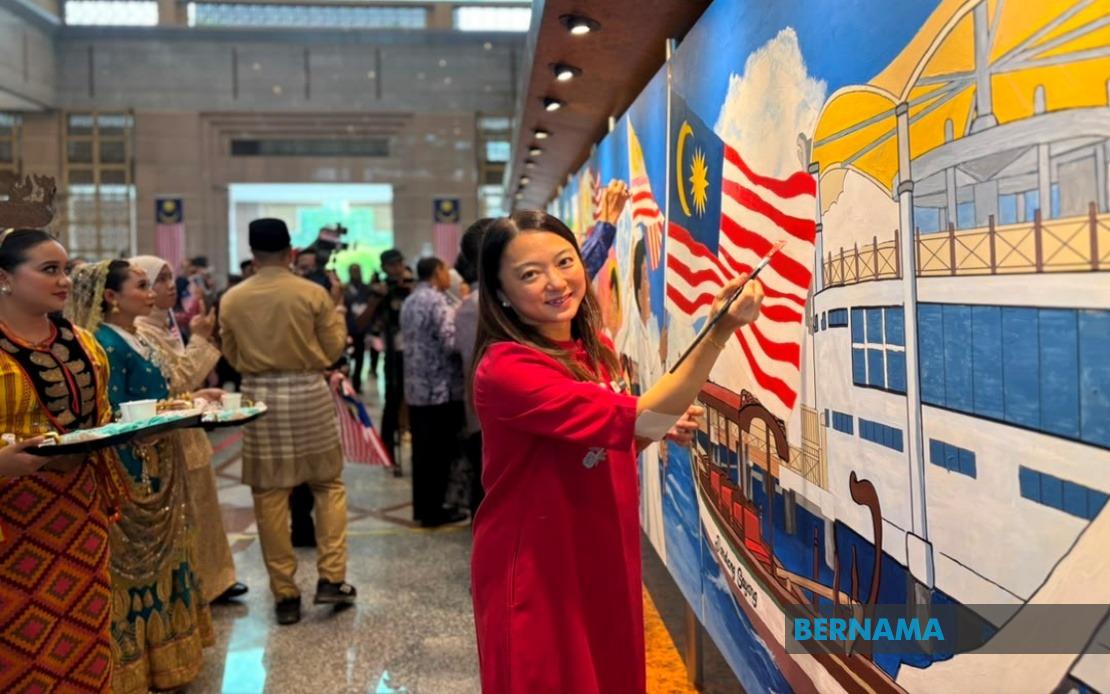
At the event itself, officials participated in completing a monumental 25.40-metre independence mural at Menara Seri Wilayah, a public art installation that serves as a focal point for HKHM 2026 commemoration efforts. The mural incorporates visual representations of iconic structures from each of the three Federal Territories—Kuala Lumpur, Putrajaya and Labuan—unified under the Jalur Gemilang to symbolise national cohesion and sovereignty. This artistic approach complements the flag distribution campaign by creating tangible, visible manifestations of patriotic sentiment in urban landscapes.
For Malaysian readers, these initiatives carry significance beyond ceremonial gesture-making. The Federal Territories occupy special constitutional status as direct federal administration zones, making their National Day observances matters of heightened symbolic importance. When Kuala Lumpur, the capital and economic engine, demonstrates coordinated patriotic messaging alongside the administrative centre of Putrajaya and the maritime territory of Labuan, it signals unified national commitment across diverse geographical and functional spaces. This geographical spread emphasises that Malaysian identity transcends regional divisions.
The 62,386 flags represent a substantial logistical undertaking reflecting government investment in national commemoration. For context, this volume indicates that flag distribution reaches beyond token gestures to achieve saturation across Federal Territory neighbourhoods, creating visual environments where the Jalur Gemilang becomes ubiquitous rather than episodic. Such visibility normalisess the national symbol and provides repeated exposure that reinforces collective identity markers.
Yeoh's call for social media participation introduces contemporary dimensions to traditional flag displays, acknowledging that modern patriotism manifests across digital and physical domains simultaneously. By encouraging online sharing alongside street-level visibility, the campaign recognises that younger demographics especially engage with national identity through multiple platforms. This multi-channel approach reflects evolving communication patterns while maintaining emphasis on physical flag presence in communities.
The involvement of the Federal Territories Department director-general and Putrajaya Corporation president demonstrates institutional coordination across administrative entities, with multiple agencies working toward aligned messaging and execution. Such cross-organisational collaboration ensures that flag distribution and patriotic campaigns reach comprehensively rather than fragmenting across competing bureaucratic initiatives. For Malaysian governance, this represents functional coordination that produces tangible public outcomes.
Looking toward 2026, these early mobilisation efforts establish momentum for what promises to be particularly significant National Day and Malaysia Day celebrations, marking the nation's continued progression as an independent state. The extended lead time allows for sustained visibility and repeated messaging that can deepen patriotic resonance. For Southeast Asian observers, Malaysia's coordinated national symbol campaigns contrast with approaches in some neighbouring states, offering a model of how governments can foster civic pride through accessibility and inclusive participation rather than top-down mandate.
The broader context involves Malaysia's ongoing project of nation-building and social cohesion amid its multicultural and multiethnic composition. National symbols function as shared reference points that transcend communal divisions, and the government's emphasis on universal participation in flag displays reflects an understanding that democratic patriotism requires voluntary engagement. By removing barriers to participation through clear guidance and abundant flag availability, authorities expand the base of citizens who can express national identity through conventional means.
As preparations continue toward 2026, the success of these campaigns may influence how future national commemoration efforts are structured, particularly regarding public engagement and accessibility. The emphasis on proper protocol combined with encouragement for widespread participation represents a potentially sustainable model for balancing ceremonial respect with democratic inclusivity, a balance essential for long-term public buy-in to national symbolism in ethnically diverse societies.

