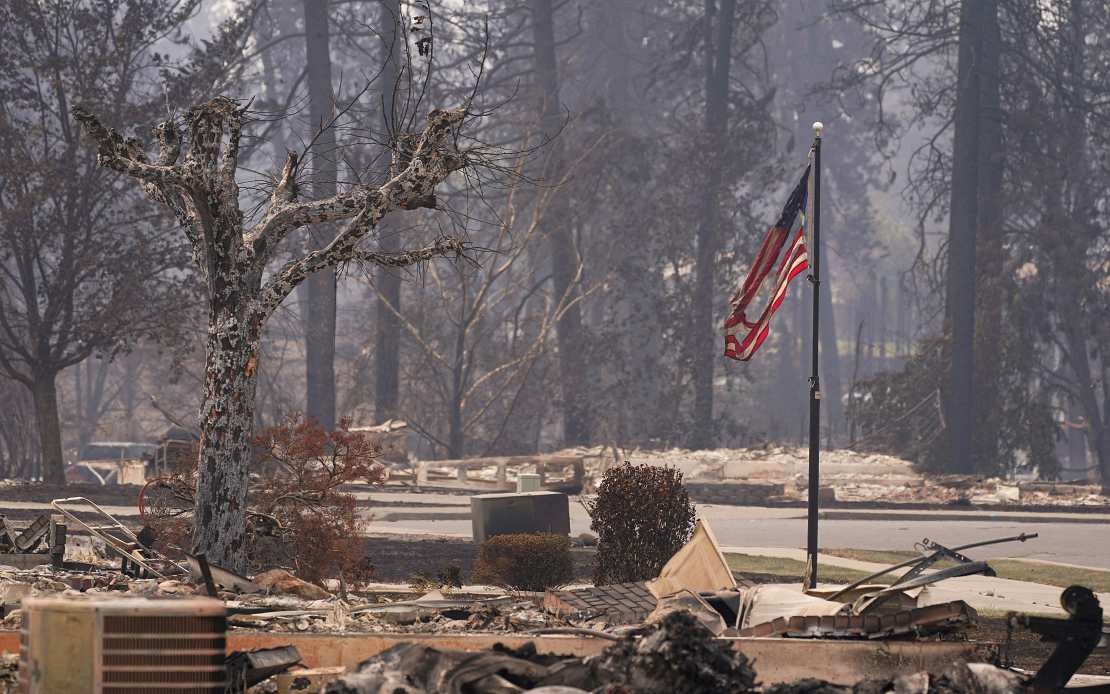
Catastrophic wildfires sweeping across Washington state have forced the evacuation of more than 65,000 residents as flames continue to advance across the landscape with alarming speed. The American Red Cross confirmed the scale of the displacement on Monday, noting that preliminary damage assessments reveal the destruction of at least 700 residential structures, concentrated primarily in Spokane County. The crisis reflects the intensifying wildfire threat facing the Pacific Northwest during peak fire season, a pattern increasingly familiar to residents across the western United States and a cautionary tale for communities worldwide grappling with climate-driven environmental hazards.
Authorities have made a significant arrest in connection with at least one of the destructive blazes. Spokane County Sheriff John Nowels announced that a 37-year-old man, Aaron F. Farinacci, was taken into custody on Monday afternoon and charged with first-degree arson. He is being held on a $1 million bond and is suspected of involvement in the Old Trails Fire, one of several active blazes threatening the region. The arrest signals that not all of the current outbreak stems from natural causes such as lightning strikes, adding a criminal dimension to an already complex emergency response.
The fire situation near Spokane and Stevens counties presents a daunting challenge for emergency management officials. Data from InciWeb, the interagency wildfire management system, indicates that fires in this zone have already consumed 8,026 acres—roughly 3,248 hectares—since Saturday. Most critically, these fires remain at zero percent containment, meaning firefighting crews have yet to establish any firm perimeter around the blazes. The lack of containment underscores the rapid spread and unpredictable behaviour of these fires, which can create dangerous conditions for both evacuees and responders.
The situation is considerably worse in other parts of Washington. The Sinlahekin fire, which was sparked by lightning on July 26, has ballooned to a staggering 85,000 acres (34,398 hectares), making it the largest active fire in the region. More than 820 personnel have been deployed to battle this single blaze, yet it too remains completely uncontained. To the northwest, near Leavenworth, the Little Giant Fire has burned across 51,298 acres (20,759 hectares) within the Okanogan-Wenatchee National Forest. The sheer scale of these fires—each spanning tens of thousands of acres—demonstrates the extraordinary challenge facing state and federal firefighting resources, which must be stretched across multiple simultaneous threats.
Weather conditions have begun to shift in favour of firefighting efforts, providing a sliver of hope for crews battling the Spokane Complex Fire. The Incident Management Team coordinating response to that particular fire reported that more favourable atmospheric conditions are enabling ground crews to make progress along fire lines. This tactical advantage, however temporary, highlights how weather remains the decisive factor in wildfire management. A return to hot, dry, and windy conditions could rapidly reverse these gains and intensify the threat to communities still under evacuation orders.
Governor Bob Ferguson has focused response efforts on accounting for the safety of all residents in affected areas. Authorities have successfully made contact with virtually all residents who requested assistance during the evacuation, but officials are still attempting to locate and verify the safety of 14 additional individuals. Ferguson clarified that these 14 people are not classified as missing, but rather as individuals with whom authorities have not yet established contact to confirm their wellbeing. As of the governor's statement, no deaths have been confirmed from these fires, a positive outcome given the scale of destruction and displacement, though the risk remains as evacuation and containment efforts continue.
The evacuation of 65,000 people represents a massive logistical undertaking with profound consequences for affected communities. Thousands of families have lost their homes and possessions in an instant, facing an uncertain timeline for return and rebuilding. The American Red Cross and other relief organizations are coordinating shelter, food, and essential services for evacuees, but the psychological and economic toll of such mass displacement extends far beyond immediate relief efforts. Schools may be disrupted, workplaces face operational challenges, and the social fabric of entire communities can be strained by rapid dispersal of residents.
These Washington wildfires reflect a broader pattern affecting western North America with increasing frequency and intensity. Climate scientists link the extended wildfire seasons and larger burned areas to rising temperatures, earlier snowmelt, and extended periods of low precipitation. For Malaysian and Southeast Asian observers, these distant events carry significance as they demonstrate the global dimensions of climate-related disasters and the cascading effects on infrastructure, displacement, and emergency response systems. The experience of Washington communities offers lessons in evacuation planning, interagency coordination, and the importance of building resilience into regional planning.
The immediate focus remains on firefighting operations and supporting displaced residents. As crews push to contain the Spokane Complex Fire and suppress the larger Sinlahekin and Little Giant fires, the outcome will depend on sustained suppression effort, favourable weather, and the availability of sufficient personnel and equipment. The arrest of Aaron F. Farinacci suggests that investigating the origins of these fires will be part of the overall response, particularly for the Old Trails Fire. Meanwhile, the broader question of preparedness and prevention looms as Washington and other western states confront what appears to be an increasingly severe fire season with each passing year.

