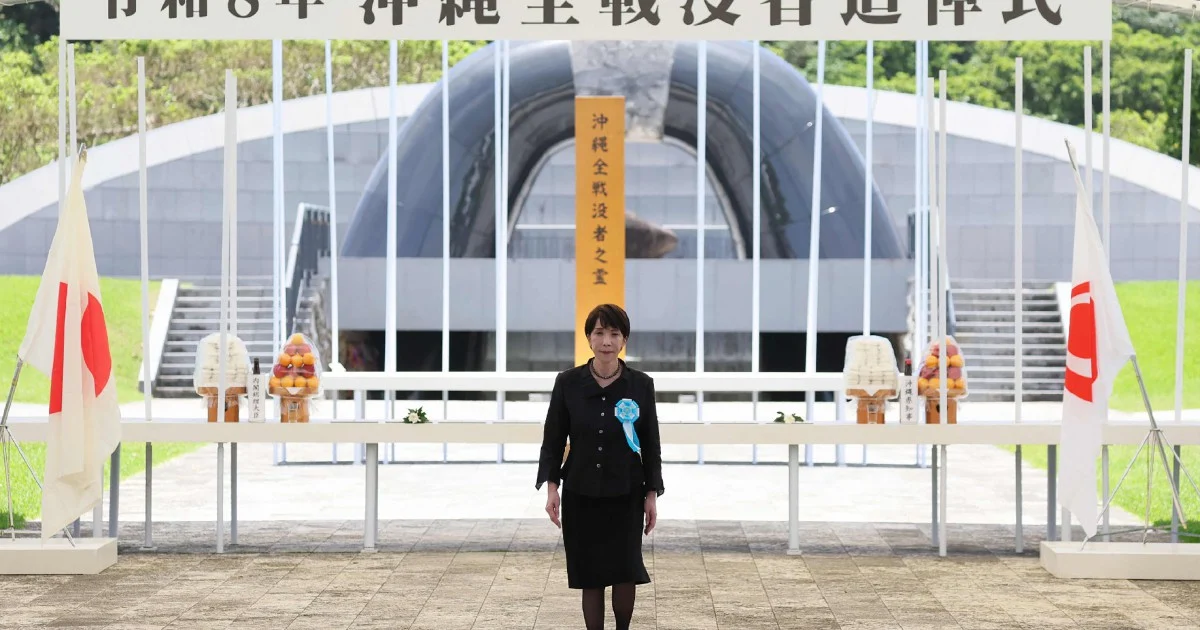
Prime Minister Sanae Takaichi found herself at the centre of a contentious public confrontation during a World War II commemoration ceremony, as demonstrators disrupted proceedings to voice their objections to Japan's shifting defence policies. Television coverage documented the heckling incident, capturing the tension between government leadership and a segment of the Japanese public increasingly uneasy about the nation's military trajectory.
The disruption at the memorial event underscores a deepening divide within Japanese society over how far Tokyo should venture from the pacifist framework embedded in the country's post-war constitution. For nearly eight decades, Article 9 of Japan's Constitution has served as a symbolic cornerstone of the nation's identity, renouncing war and the threat of force as a means to resolve international disputes. Yet successive governments, particularly in recent years, have been gradually reinterpreting and stretching the boundaries of what Japan's Self-Defence Forces are permitted to do.
Takaichi's tenure as Prime Minister places her at a critical juncture in this ongoing debate. Japan has been steadily expanding its military capabilities and international security role, moves that supporters argue are necessary given the increasingly assertive posture of China and concerns about regional stability. The government has justified incremental policy changes as practical responses to evolving geopolitical circumstances in East Asia rather than ideological shifts.
However, the heckling at the memorial gathering reveals the persistent and vocal opposition among ordinary Japanese citizens who view these developments as a fundamental betrayal of post-war principles. Many Japanese, particularly older generations who lived through the devastation of World War II, regard pacifism not merely as policy preference but as a moral commitment—a pledge that Japan would never again initiate or enthusiastically pursue military conflict. The memorial event, intended as a solemn occasion for reflection on the costs of war, became instead a flashpoint for this broader societal disagreement.
From a regional perspective, Japan's military evolution carries significant implications for the entire Indo-Pacific. Southeast Asian nations, many of which maintain delicate diplomatic balances with both China and the West, have watched Japan's moves with careful attention. While some countries appreciate Japan's enhanced security presence as a counterweight to Chinese influence, others worry about historical echoes and the potential destabilisation that could accompany a more militarily assertive Japan.
The generational dimension of this conflict deserves particular attention. Japanese citizens who came of age after 1945 were educated in a school system that emphasised the horrors of militarism and the virtues of peaceful resolution. For them, the incremental dismantling of pacifist constraints feels like a repudiation of lessons their predecessors paid dearly to learn. The protesters who disrupted Takaichi's memorial ceremony represent a continuity of this historical consciousness—people determined to ensure that Japan's wartime suffering and responsibility are not gradually erased from national memory.
Government officials counter that constitutional pacifism, while symbolically important, cannot be maintained in a world where threats are real and immediate. They point to North Korea's missile development, China's military modernisation, and the uncertainty surrounding American security guarantees. From this view, constrained rearmament represents rational statecraft, not militarism. The Takaichi administration has positioned each policy adjustment as a measured, proportionate response rather than ideological pivot.
The incident also reflects broader questions about democratic legitimacy and how sweeping national security changes should be authorised. Constitutional amendments theoretically require super-majority Diet approval and public referendums, but Japan's political establishment has achieved substantial military expansion through creative reinterpretation of existing constitutional language rather than formal amendment. This technocratic approach, while legally defensible, has left many Japanese citizens feeling that fundamental questions about their nation's future are being decided without proper democratic deliberation.
Within the ruling coalition, there exists genuine debate about the pace and scope of military expansion. Some politicians advocate for explicit constitutional revision to clarify Japan's security rights, believing this would be more honest and democratic than continued reinterpretation. Others prefer the incremental approach, reasoning that it faces less organised opposition and allows policy to evolve without repeatedly forcing voters to choose sides on emotionally charged security questions.
For Malaysia and other Southeast Asian nations, these developments warrant close observation. A Japan that maintains pacifist constraints operates within a very different framework than one embracing fuller military autonomy. Malaysian policymakers must consider how Japanese military expansion might reshape regional power dynamics and whether it creates new opportunities for cooperation or introduces new tensions in an already complex security environment.
The memorial ceremony heckling episode ultimately reveals that despite decades of post-war stability, the fundamental question of what Japan's role should be remains unresolved within Japanese consciousness. Takaichi's government can advance its policies, but it cannot escape the deeper historical reckoning that such commemorative moments provoke. The tension between acknowledging past suffering and preparing for future threats continues to define Japan's national identity debate.