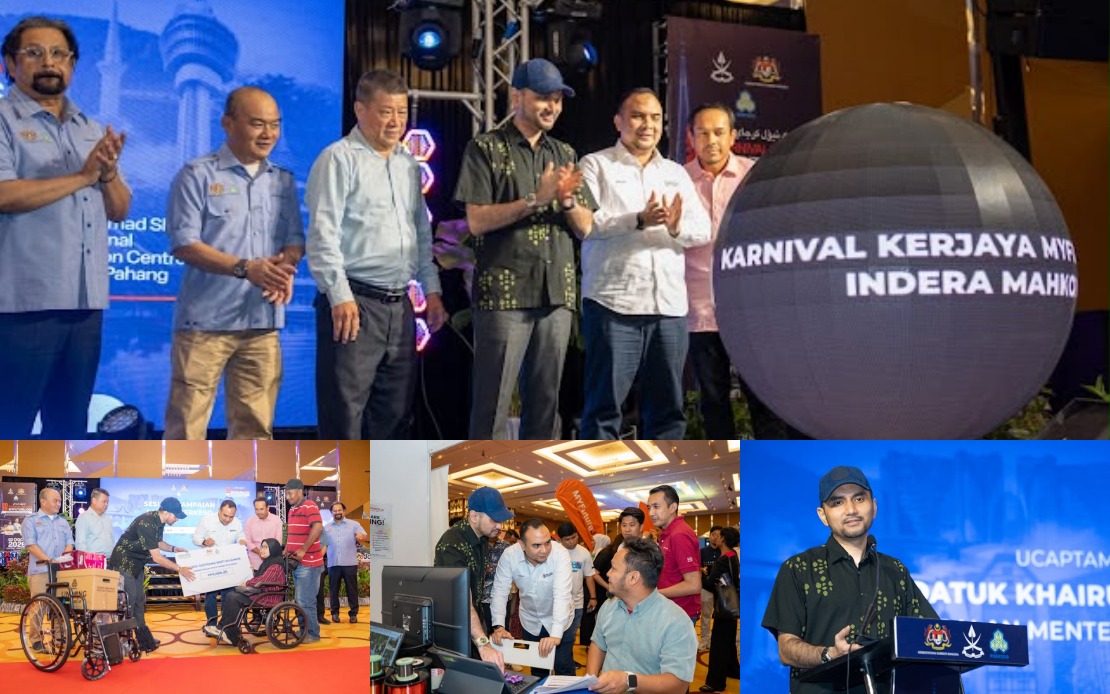
Pahang has emerged as the employment leader across Malaysia's east coast region, recording a labour force participation rate of 65.3 per cent during the first quarter of 2026 while maintaining an unemployment rate of just 1.9 per cent. These figures underscore a sustained commitment to job creation and workforce development in a state that has historically faced economic challenges compared to more industrialised regions, positioning Pahang as a model for employment stability within the broader east coast corridor.
Deputy Human Resources Minister Datuk Khairul Firdaus Akbar Khan attributed these outcomes to a comprehensive suite of employment initiatives designed to connect job seekers with available opportunities across diverse industries. Speaking at the Indera Mahkota MyFutureJobs Career Carnival 2026 in Kuantan, he emphasised that the Social Security Organisation's MYFutureJobs programme has become instrumental in bridging the gap between employers and workers. This platform-based approach represents a modernisation of traditional labour matching services, leveraging technology and centralised coordination to streamline recruitment processes that previously operated in fragmented channels.
The scale of PERKESO's operational footprint in Pahang demonstrates the institutional resources dedicated to employment services. Between 2023 and late July 2026, the platform facilitated employment for 26,877 job seekers across the state. Simultaneously, the organisation conducted 1,277 interview programmes and career carnivals throughout Pahang, signalling an intentional strategy to decentralise recruitment activities and reach workers in areas beyond urban centres. These outreach efforts have generated momentum, with more than 10,000 job vacancies advertised through the portal and 11,857 job seekers registered during 2026 alone, reflecting both employer confidence and worker engagement.
The Indera Mahkota career carnival showcased this ecosystem in action, offering 6,000 immediate job openings sourced from 30 employers representing multiple sectors. Such concentrated recruitment events serve dual purposes: they provide tangible employment pathways for participants while generating data on skills mismatches and workforce preferences that inform broader policy interventions. For Malaysian readers, particularly those in non-metropolitan areas, these carnivals represent rare opportunities to directly engage with established employers without geographic barriers that have traditionally limited rural workers' access to competitive labour markets.
Beyond job matching, the ministry has identified skills development as essential infrastructure for sustainable employment. Datuk Khairul Firdaus explicitly encouraged workers to participate in training programmes designed to align worker competencies with industry requirements. This recognition reflects evolving labour market realities where technical certifications and adaptability command premium compensation. For Malaysia's transition towards higher-value manufacturing and services sectors, workforce upskilling is not merely advantageous but structural necessity, particularly in states like Pahang where employment traditionally concentrated in lower-skill resource extraction and agriculture.
The Sahabat MADANI initiative, launched at the carnival by Prime Minister's political secretary Datuk Ahmad Farhan Fauzi, introduces a complementary community mobilisation dimension to employment programming. Rather than operating purely as government service delivery, this volunteer movement positions young people as grassroots intermediaries between official agencies and communities. The programme emphasises volunteerism and social cohesion alongside economic objectives, reflecting a broader governance philosophy that employment security and community development reinforce each other. Having already enrolled 2,000 members in Pahang, Sahabat MADANI demonstrates capacity for rapid scaling while maintaining locational rootedness.
Ahmad Farhan's framing of Sahabat MADANI as a "bridge between government and local communities" carries particular significance for rural and marginalised populations who often experience service delivery gaps. Young volunteers equipped with knowledge of government programmes, employment platforms, and skills training initiatives can effectively disseminate information through informal networks where official communications penetrate weakly. This grassroots approach acknowledges that information asymmetry, not merely opportunity scarcity, constrains labour force participation in peripheral regions. For Southeast Asian context, where rural populations frequently lag urban counterparts in formal employment access, such bridging mechanisms offer replicable models beyond Malaysia's borders.
The integration of MYFutureJobs with Sahabat MADANI represents institutional coordination that extends employment services into previously underserved geographies. By positioning volunteers as "eyes and ears" for government implementation, the initiative creates feedback loops that allow rapid identification and resolution of service gaps. This bottom-up monitoring complements traditional top-down performance metrics, potentially improving programme effectiveness through granular awareness of community-specific barriers and preferences. For Malaysian policymakers, particularly those managing employment portfolios, such integrated approaches suggest that technology platforms and human intermediation generate superior outcomes than either channel independently.
The unemployment figure of 1.9 per cent warrants careful interpretation, as it reflects labour force participation rates rather than absolute joblessness. At 65.3 per cent participation, Pahang's working-age population engagement indicates either strong employment opportunities or economic necessity driving workforce entry across demographic groups. Regional comparison strengthens Pahang's position, as east coast participation rates traditionally lag national averages due to geographic remoteness, limited industrial diversification, and skill-education gaps. Achievement of participation leadership status within this region, while maintaining low unemployment, suggests either recent structural improvements or effective programme targeting that deserves scrutiny for replicability elsewhere.
For Malaysian businesses, particularly those expanding beyond Klang Valley and Penang, Pahang's employment indicators signal a maturing labour market with available workers, growing skills infrastructure through training programmes, and governmental institutions committed to reducing friction in recruitment processes. This institutional commitment, demonstrated through sustained PERKESO investment and now through Sahabat MADANI volunteer networks, reduces recruitment risks and signalling costs for employers considering east coast expansion. The competitive advantage this creates invites strategic investment decisions that could further diversify Pahang's economy beyond traditional sectors.
Looking forward, sustaining these employment gains requires addressing structural challenges inherent to peripheral regions. While 65.3 per cent participation and 1.9 per cent unemployment represent strong current indicators, they depend on continued skills-training access, employer confidence in worker quality, and infrastructure enabling easy employer-worker connection. The Sahabat MADANI initiative's expansion plans, combined with MYFutureJobs platform development, suggest recognition of these requirements. However, demographic trends in Pahang, including youth migration to urban centres, could constrain future labour supply unless non-monetary factors such as community engagement and quality-of-life improvements accompany economic opportunity expansion.
Malaysia's broader policy challenge involves replicating Pahang's employment success across remaining states while ensuring distributional equity in programme access. The east coast region has historically absorbed less development investment and attracted fewer private industrial projects than western states. Pahang's current employment metrics suggest that targeted government programming, properly resourced and coordinated across ministries, can meaningfully improve outcomes even in geographically and economically peripheral locations. This finding carries implications for ASEAN neighbours grappling with similar regional disparities, suggesting that institutional commitment and volunteer network building merit comparable investment as infrastructure and manufacturing incentives.
The career carnival format itself merits examination as a scalable model for emerging markets where formal employment markets function less efficiently than developed economies. Concentrating employer recruitment, job-seeker information, and skills assessment within defined events reduces search costs and information asymmetry while creating observable success metrics through immediate hiring. This approach suits contexts where digital labour platforms penetrate incompletely and geographic fragmentation remains significant. For Malaysian policymakers and Southeast Asian governments pursuing inclusive growth, the Indera Mahkota carnival and its counterparts across Pahang represent tested methodologies worthy of systematic expansion and refinement based on accumulated operational experience.

