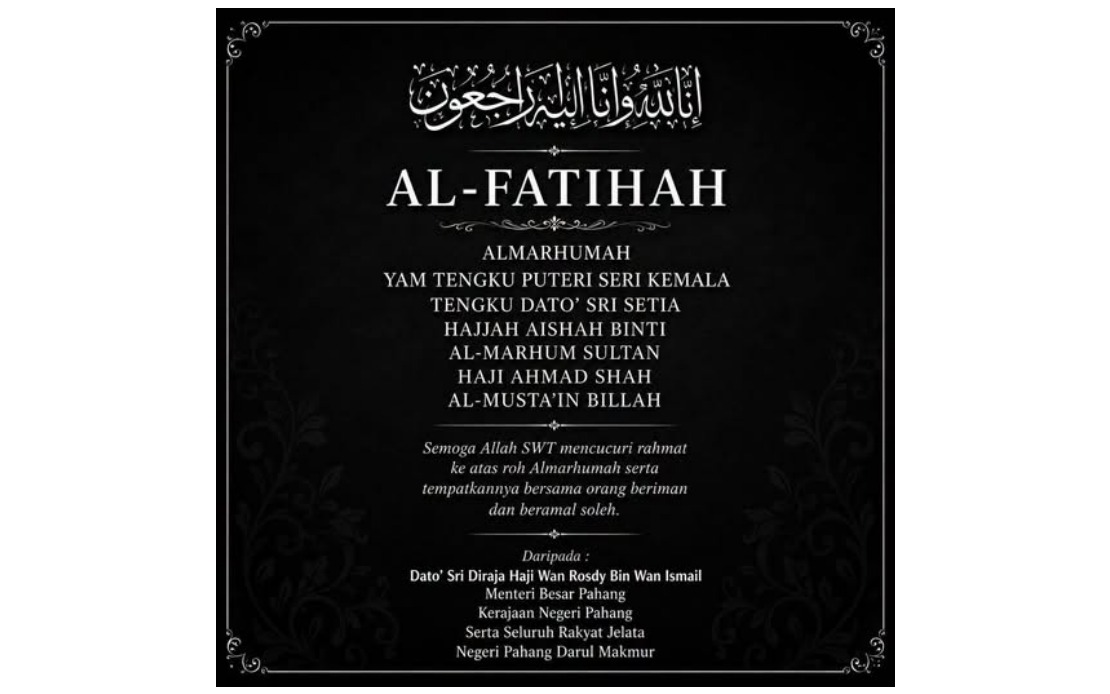
The Pahang State Government has formally expressed condolences following the death of Tengku Puteri Seri Kemala Tengku Datuk Seri Aishah Almarhum Sultan Ahmad Shah, the elder sister of the reigning Sultan of Pahang. Menteri Besar Datuk Seri Wan Rosdy Wan Ismail, in his official capacity, acknowledged the loss as a significant moment for both the royal household and the state he leads, underscoring the gravity with which the state administration treats matters affecting the sultanate.
Tengku Datuk Seri Aishah, a member of the Pahang Royal Family with deep historical roots in the state's governance, passed away at a Kuala Lumpur hospital on August 26 at 9.15 pm. Her death marked the end of a life spent within the rarified circles of Malaysian royalty, where members of the royal families maintain prominent positions in the cultural and institutional fabric of their respective states. The passing of an elder sibling of a reigning monarch carries particular significance in Malaysian constitutional monarchies, where the royal family structure extends beyond the immediate ruler and influences state affairs across multiple generations.
Wan Rosdy's statement, delivered through official channels, reflected the protocol traditionally observed when state leadership acknowledges losses within the royal hierarchy. His message emphasized that the grief extended beyond the immediate family to encompass the broader Pahang Royal Family, including Tengku Ampuan Pahang Tunku Azizah Aminah Maimunah Iskandariah. This articulation of collective mourning serves to align state institutions with royal sentiment, reinforcing the symbolic relationship between the government apparatus and the institution of the sultanate in Pahang's constitutional framework.
The Menteri Besar's condolence, conveyed through both public statements and social media platforms, incorporated religious sentiments reflecting Malaysia's Islamic framework. His invocation of divine mercy and forgiveness, coupled with prayers for the deceased's righteous standing, demonstrated how state leadership weaves Islamic principles into official pronouncements during moments of national or state significance. Such language resonates deeply within Malaysian political culture, where acknowledgment of Islamic values forms an expected component of high-level governmental communication.
Tengku Datuk Seri Aishah's final resting place was designated as the Pahang Royal Mausoleum in Pekan, the royal capital of the state. This selection underscores the hierarchical geography of royal Pahang, where Pekan maintains its traditional role as the seat of royal authority and the repository for members of the royal lineage. The mausoleum itself functions not merely as a burial ground but as a physical manifestation of dynastic continuity, linking past and present members of the royal house through shared sacred space.
The incident illustrates the complex interplay between Malaysia's state governments and their respective sultanates. While Pahang operates as a constitutional monarchy within Malaysia's federal framework, the state government maintains formal protocols for acknowledging significant events within the royal household. These protocols, while ceremonial in nature, reinforce institutional relationships and demonstrate the state's respect for the constitutional position held by the Sultan as the paramount ruler of Pahang.
For Malaysian observers, such events highlight the continued prominence of royal institutions in state-level governance and public life. Unlike many Commonwealth nations that have substantially diminished the ceremonial role of monarchy, Malaysia's constitutional structure accords significant constitutional and cultural weight to the rulers of its component states. The careful articulation of condolences by state leaders thus becomes an important mechanism through which government officials publicly reaffirm their recognition of royal preeminence and their commitment to established protocols.
The passing of royal family members occasionally prompts broader reflection within Malaysian society regarding succession planning, the evolving demographics of the royal households, and the institutional adaptability of these centuries-old structures. While Tengku Datuk Seri Aishah's role did not directly involve executive governance, her position within the royal family constellation nonetheless represented continuity with Pahang's historical past, including the tenure of her father, Sultan Ahmad Shah, who reigned during the 1980s and 1990s.
State governments across Malaysia maintain similar protocols for acknowledging such events, creating a consistent national pattern in how the government apparatus engages with royal institutions. These expressions of condolence, while following established templates, nonetheless carry weight as official recognition of loss and affirmation of the state's institutional relationship with its ruling house. In the Malaysian context, where questions of royal prerogative and constitutional position occasionally surface in public discourse, such moments of demonstrated respect help maintain the delicate balance between elected government officials and constitutional monarchy.
The arrangements surrounding Tengku Datuk Seri Aishah's funeral, conducted according to royal protocols and Islamic tradition, exemplified the fusion of customary practices and religious observance that characterizes Malaysian state ceremonies involving the royal households. The public acknowledgment of her passing through official channels ensured that the broader Pahang population understood the occasion as one warranting collective recognition and respect, even as the intimate processes of mourning remained centered within the royal family circle.

