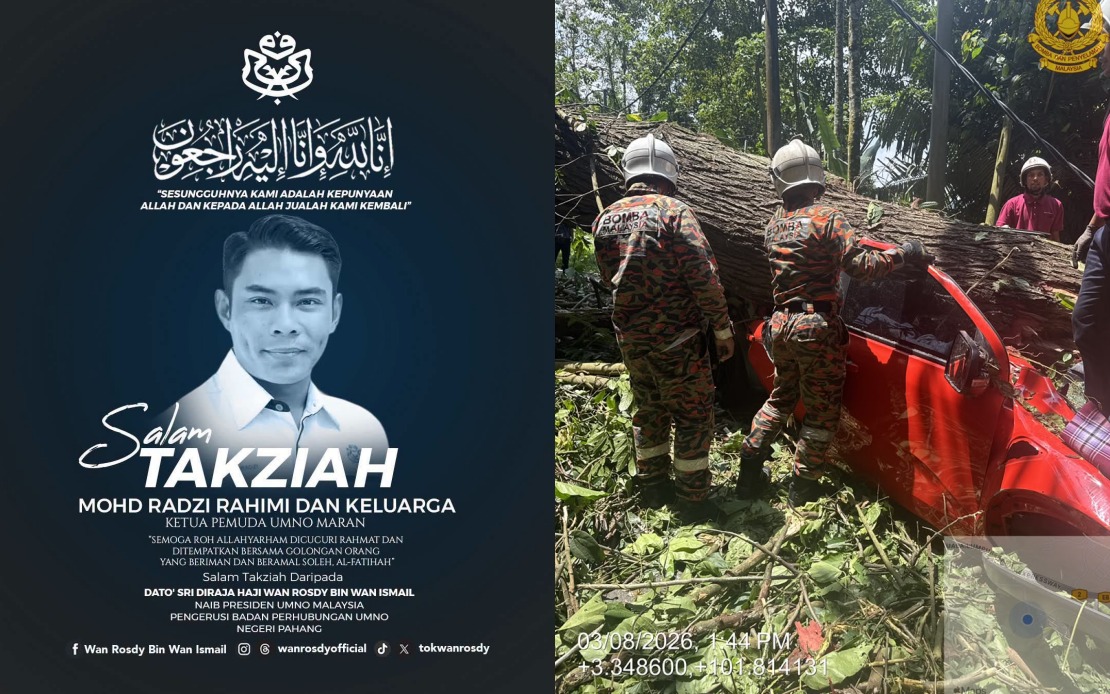
The Pahang political establishment is grappling with the sudden loss of a rising youth leader after Mohd Radzi Rahimi, commonly known as Edy Radzi, perished in a tree-fall incident that claimed four lives in the Bentong district. The accident occurred along the old Kuala Lumpur-Bentong road near Janda Baik when a tree collapsed onto the four-wheel-drive vehicle carrying the occupants, leaving another child injured in what authorities describe as a tragic mishap.
Mohd Radzi, who held the position of Maran UMNO Youth chief, was widely recognised within party circles as someone whose work bridged the gap between political structures and grassroots communities. Pahang Menteri Besar Datuk Seri Wan Rosdy Wan Ismail, speaking in his capacity as chairman of the Pahang UMNO Liaison Committee, characterised the late leader as someone whose entire approach to public service revolved around placing community welfare at the centre of decision-making. This characterisation reflects the broader sentiment circulating through UMNO ranks that Radzi represented a particular breed of youth politician increasingly focused on tangible community benefit rather than purely partisan concerns.
The ripple effects of Radzi's passing extend across multiple layers of the Pahang UMNO structure. Beyond the immediate loss to his immediate family, the impact is being felt acutely within the Maran division where he served as youth chief, throughout the broader Pahang UMNO Youth wing, and within the wider Pahang UMNO Liaison Committee apparatus. For a relatively young political operative, Radzi had managed to establish connections across these various organisational tiers, suggesting he possessed the kind of cross-factional appeal that often marks individuals destined for higher office within the party hierarchy.
The accident also claimed the lives of three other individuals: Nuriani Mohammad Jafri, her son Muhammad Rizz Hazim, and her younger brother Mohammad Nizam. Their deaths underscore the indiscriminate nature of the tragedy and the profound loss experienced by multiple families in a single devastating moment. The incident has prompted reflection among officials about safety conditions along rural highways in the region, particularly concerning the maintenance of vegetation in areas prone to weather-related hazards.
Wan Rosdy's statement, delivered through a Facebook post that reached party members and the general public simultaneously, emphasised both his personal sorrow and his official capacity to articulate collective grief on behalf of institutional structures. His invocation of Islamic prayers and expressions of condolence to bereaved families represented standard practice in Malaysian political discourse, yet the specific emphasis on Radzi's people-centred approach suggested recognition of qualities that transcended conventional partisan rhetoric. The Menteri Besar's framing of Radzi as someone genuinely dedicated to community first rather than self-advancement carries particular weight given the frequent public scepticism toward political motivations.
UMNO Youth chief Datuk Dr Muhammad Akmal Saleh added his own condolences from the national party level, indicating that Radzi's reputation and contributions had registered beyond the Pahang state structure into the upper echelons of UMNO's youth wing. This cross-level acknowledgement from party leadership reinforces perceptions that Radzi was being groomed for expanded responsibilities within the broader party machinery. His loss therefore represents not merely a personal tragedy but a setback to institutional continuity and the development pipeline within UMNO's youth leadership corps.
The tragedy has prompted broader discussion within Pahang political circles about the working conditions and safety measures affecting public servants and community leaders. Radzi's death in a preventable accident—a fallen tree during travel—raises questions about infrastructure maintenance and road safety standards in areas serving the state's hinterland communities. For Malaysian readers, particularly those in rural regions, the incident serves as a stark reminder of environmental and infrastructural vulnerabilities that affect daily life beyond the urban centres where national news narratives typically concentrate.
From a succession planning perspective, Radzi's sudden departure creates a significant gap within Maran UMNO's youth leadership. The search for a replacement figure who can command similar levels of community respect and multi-factional credibility will likely occupy state party officials in coming weeks. Such transitions within party structures often generate internal dynamics as various factions position preferred candidates, potentially influencing the broader balance of power within Pahang UMNO beyond the youth division itself.
The emotional tone of official statements reflects genuine respect for Radzi's work ethic and approach to public service. References to his commitment and people-centred methodology, rather than focusing on partisan achievements or factional alignment, suggest that his reputation was built on substantive engagement with constituents rather than factional manoeuvring—a characteristic increasingly rare in Malaysian political discourse. For aspiring young politicians observing from the sidelines, Radzi's approach and the respect it earned offer a model worthy of emulation, even as his untimely death stands as a sobering reminder of life's fragility regardless of professional status or communal standing.

