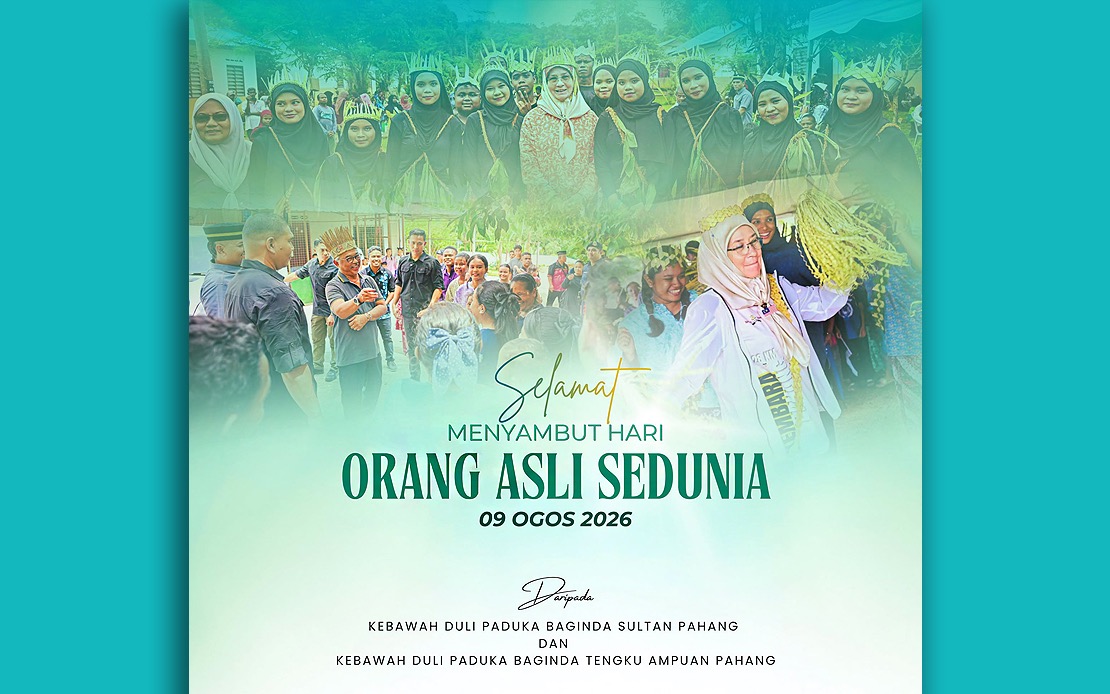
The Sultan of Pahang, Al-Sultan Abdullah Ri'ayatuddin Al-Mustafa Billah Shah, and Tengku Ampuan Pahang Tunku Azizah Aminah Maimunah Iskandariah have publicly acknowledged the profound cultural contributions made by the Orang Asli community to the state's identity, recognizing their integral role in shaping Pahang's rich tapestry of customs, traditions, and heritage.
In a statement released through the Kesultanan Pahang's social media channels, the royal couple outlined their vision for advancing the welfare of Pahang's indigenous population. Rather than offering abstract platitudes, Their Royal Highnesses moved beyond ceremonial recognition to articulate specific domains where meaningful progress could be achieved, signalling a commitment to translate acknowledgment into substantive action.
Central to their message was an emphasis on educational advancement for the Orang Asli community. Access to quality education remains a longstanding challenge for indigenous populations across Malaysia, with disparities in school infrastructure, teacher training, and curriculum relevance continuing to disadvantage students in remote settlements. The royals' focus on this sector suggests awareness of education's multiplier effects—improved educational outcomes can unlock pathways to employment, skill acquisition, and intergenerational mobility for Orang Asli families.
Equally significant was the couple's attention to economic development and skills training. Many Orang Asli communities face limited employment prospects beyond subsistence agriculture or informal livelihoods, with underrepresentation in formal economic sectors. By highlighting skills development and human capital formation, the royals recognized that sustainable prosperity requires building competitive advantage rather than relying on extractive or low-value activities. This signals potential alignment with broader initiatives to expand vocational pathways and entrepreneurial opportunities in disadvantaged regions.
A distinctive element of their statement was the explicit commitment to preserve Orang Asli identity, customs, and heritage alongside these development efforts. This dual emphasis addresses a central tension in indigenous policy: the risk that economic integration and modernization may erode cultural distinctiveness. The royals' insistence that heritage preservation remain "central to their cultural identity" and not be "overlooked" reflects nuanced understanding that progress need not come at the expense of cultural authenticity.
The timing of this pronouncement, aligned with the 2026 International Day of the World's Indigenous Peoples, places Pahang within a global conversation about indigenous rights and recognition. Malaysia, as a signatory to various international frameworks on indigenous welfare, faces scrutiny regarding the advancement of its own indigenous populations. Pahang's royal statement, though limited to expressions of hope and appreciation, represents the state's positioning on this international stage and domestically within Malaysia's multicultural federation.
For Malaysian readers, particularly those tracking indigenous policy development, the statement carries implications beyond ceremonial significance. Royal patronage can translate into bureaucratic prioritization, budget allocation, and institutional focus. When senior figures like the Sultan and Tengku Ampuan publicly commit to specific development domains, government agencies and state-level policymakers often respond by elevating these concerns within their planning frameworks. The emphasis on education, skills, and economic opportunity may therefore influence how the Pahang state government structures programs and directs resources toward Orang Asli communities in coming years.
The couple also invoked broader values of unity, respect, and cooperation, framing Orang Asli welfare not as a sectional interest but as integral to collective prosperity and social cohesion. This rhetorical move positions indigenous advancement as a shared responsibility benefiting all Pahang residents, rather than a specialized minority concern. In Malaysia's context of managing diversity across multiple ethnic and religious communities, such framing can facilitate consensus-building around inclusive policies.
However, the statement remains largely aspirational. While acknowledgment and royal endorsement matter for raising the salience of indigenous issues, translating expressions of hope into concrete programs requires coordinated effort across state agencies, sustained funding, and measurable accountability mechanisms. The extent to which Pahang's government will operationalize these royal intentions—whether through dedicated funding streams, institutional frameworks, or performance benchmarks—remains to be seen.
The peninsula's Orang Asli population, estimated at approximately 200,000 individuals across numerous ethnolinguistic groups, continues to experience socioeconomic indicators below national averages, with poverty rates, health outcomes, and educational attainment persistently lagging counterparts in non-indigenous populations. Pahang, home to one of the largest concentrations of Orang Asli communities, bears particular responsibility for addressing these disparities. Royal statements, while symbolically important, must be accompanied by material investment and institutional commitment to produce meaningful change.
Looking forward, observers of Pahang's indigenous policy will monitor whether this royal affirmation catalyzes new initiatives or programmes specifically benefiting Orang Asli communities. The emphasis on heritage preservation alongside development suggests a model that neither romanticizes indigenous communities as static cultural exhibits nor subsumes their development into generic economic growth frameworks. Whether this vision translates into tailored, community-responsive policies that genuinely enhance Orang Asli welfare and autonomy will ultimately determine the substance of this royal endorsement.

