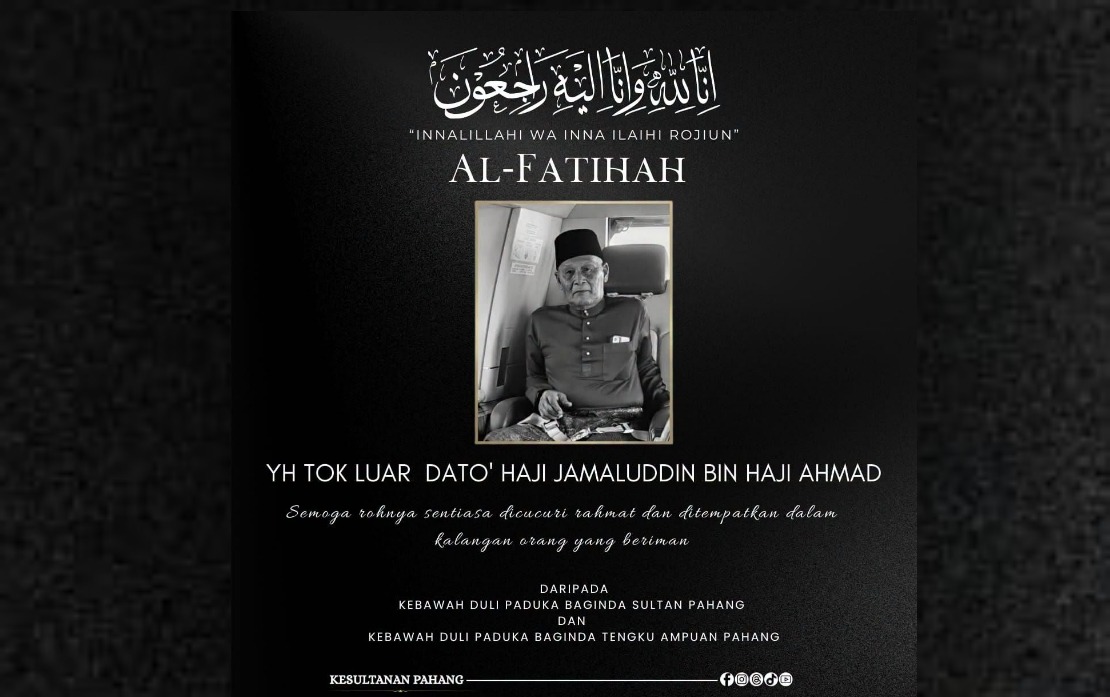
The Sultan of Pahang Al-Sultan Abdullah Ri'ayatuddin Al-Mustafa Billah Shah and Tengku Ampuan of Pahang Tunku Azizah Aminah Maimunah Iskandariah have offered their deepest sympathies to the family of Tok Luar Datuk Jamaluddin Ahmad, who passed away on the morning of June 28 at Tengku Ampuan Afzan Hospital (HTAA) at 6.48 am.
The royal couple's condolences were communicated through the official Kesultanan Pahang Facebook page, underscoring the significant role that Jamaluddin held within Pahang's institutional circles. His death marks the loss of a figure who had maintained close ties with the state's royal establishment over many years, earning recognition for his steadfast commitment to the Sultanate and its traditions.
In their official statement, Their Royal Highnesses articulated profound sorrow at Jamaluddin's passing, acknowledging his unwavering loyalty to the Pahang Sultanate institution. The royal couple characterised him not merely as an associate but as someone whose dedication to supporting the sultanate's mission and values had been consistent and noteworthy throughout his years of service and involvement.
The statement conveyed a spiritual dimension to their grief, with the Sultan and Tengku Ampuan invoking Islamic prayers and blessings for the departed. They specifically prayed that Jamaluddin's soul would receive divine mercy, that his transgressions would be forgiven, and that his virtuous deeds would be recognised and accepted by Allah. These traditional Islamic expressions of condolence reflect the deeply rooted spiritual values that underpin Malaysia's constitutional monarchy and state institutions.
Beyond their personal expressions of sorrow, the royal couple extended their sympathies to Jamaluddin's surviving family members, recognising that his death would leave a significant void in their lives. The Sultan and Tengku Ampuan explicitly wished that the bereaved family would be granted the inner strength, emotional fortitude and patience necessary to navigate their grief and adjust to his absence. Such expressions are customary in Malay-Muslim society, where collective mourning and communal support for grieving families hold considerable cultural importance.
The timing of the royal condolences, issued on the same day as Jamaluddin's death at the hospital, demonstrates the close monitoring of significant developments within Pahang's social and institutional circles. The prompt acknowledgment by the Sultan and Tengku Ampuan underscores how central figures connected to state institutions maintain visibility and recognition within royal consciousness, even as Pahang continues to manage numerous affairs of state.
Tok Luar is a traditional title of respect within Pahang's social hierarchy, one often bestowed upon individuals of considerable standing within their communities or institutional spheres. The addition of the Datuk honorific to Jamaluddin's name indicates formal recognition of his contributions and status, suggesting a career or life of service worthy of state acknowledgment. His passing therefore represents not merely a personal loss to his immediate circle but a departure of someone whose influence extended into broader institutional and community contexts.
The reliance on social media platforms to disseminate royal statements reflects contemporary changes in how Malaysian state institutions communicate with the public. The Kesultanan Pahang's Facebook page serves as an official channel through which the Sultan and Tengku Ampuan can directly reach citizens without intermediation, enabling rapid and transparent communication of significant announcements, particularly those of a ceremonial or compassionate nature.
Jamaluddin's death and the royal response highlight the interconnected nature of Pahang's formal and informal power structures, where loyalty to state institutions and the monarchy remains a defining characteristic of social relationships and public service. His recognition as a loyal supporter emphasises how traditional concepts of fealty continue to shape institutional dynamics within Malaysian states, even as the country navigates modernisation and institutional evolution.
The passing of individuals closely associated with state institutions often prompts reflection on questions of succession and continuity within both formal and informal networks. Jamaluddin's death may therefore carry implications for various initiatives, communities or institutional arrangements in which he held significant involvement, though such specific details typically emerge only through subsequent reporting and community discourse.

