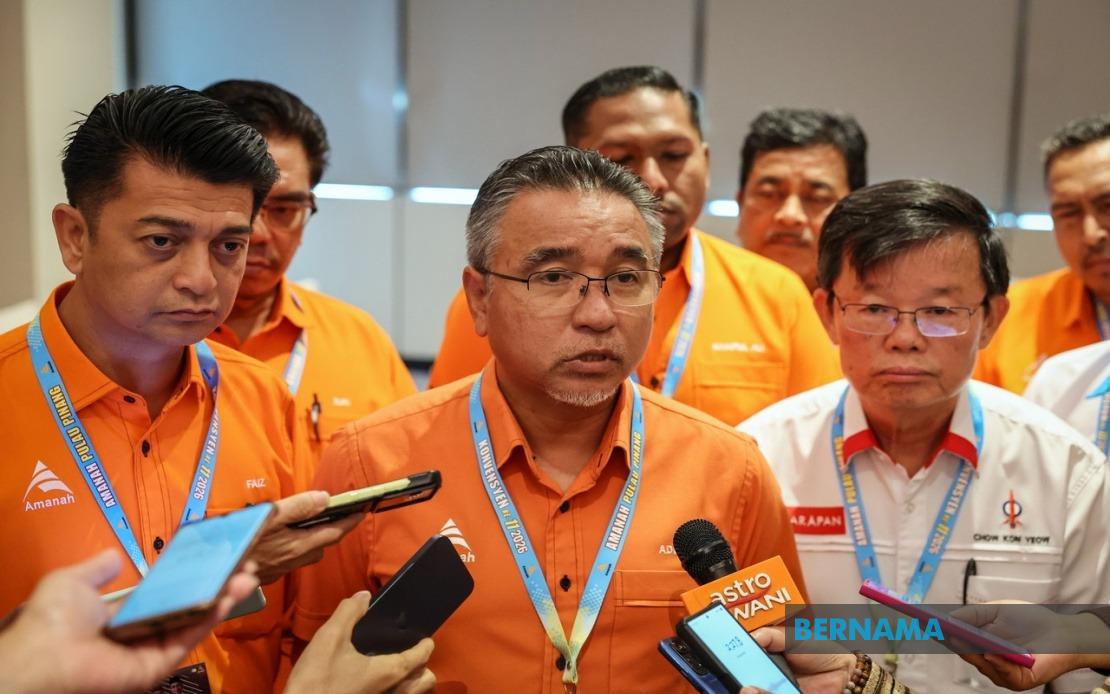
Pakatan Harapan remains steadfast in its foundational commitment to values-driven politics and demonstrated governing capability despite recent electoral disappointments, coalition leaders said on Friday. Speaking after the Penang Amanah Convention in Bukit Mertajam, Amanah vice-president Adly Zahari underscored that the coalition's core philosophy—centred on integrity, ethical conduct, and administrative competence—would continue to guide its political direction even as it reassesses operational strategies in response to shifting political dynamics.
Adly's remarks came in the wake of Negeri Sembilan's state election held on August 1, where Barisan Nasional secured a commanding majority by capturing 18 of 36 seats, leaving Pakatan Harapan with just 11 seats and Perikatan Nasional with seven. The results represented a notable reversal for the federal ruling coalition and prompted urgent internal soul-searching within PH's leadership ranks across multiple state governments.
The PH vice-president stressed that voters ultimately judge political coalitions and governments on tangible matters affecting their pocket books and quality of life. Cost of living pressures, employment opportunities, educational standards, and the visible delivery of government services form the real metrics by which citizens evaluate their leaders, Adly suggested. This assessment reflects growing recognition within PH circles that abstract principles, while important for party identity and long-term legitimacy, must translate into concrete policy outcomes and demonstrable improvements in citizens' circumstances to retain electoral support.
Acknowledging that recent results exposed vulnerabilities in PH's current approach, Adly indicated the coalition would undertake comprehensive post-mortem analysis to identify strategic shortcomings and operational inefficiencies. This self-critical posture signals that senior PH figures recognise yesterday's outcomes did not occur in a vacuum but rather reflect genuine gaps between the coalition's messaging, its governing record, and public perception thereof. The willingness to examine internal processes rather than blame external factors suggests a degree of institutional maturity, though whether such analysis translates into meaningful reform remains an open question.
Penang PH chairman Chow Kon Yeow announced that coalition leadership would convene on August 8 for a comprehensive review encompassing both the Negeri Sembilan defeat and earlier disappointing results in Johor's state election. This scheduled meeting represents a formal mechanism through which PH intends to chart strategic recalibration and prepare contingency planning should Prime Minister Anwar Ibrahim call a snap general election before the constitutionally mandated timeframe. The compressed timeline reflects anxiety within coalition ranks that current momentum has shifted unfavourably.
A critical deficiency identified by PH leadership concerns communication strategy and narrative control. Chow highlighted that the coalition must dramatically improve how it articulates government achievements, explains economic policy directions, and showcases initiatives designed to enhance public welfare and living standards. This admission reveals a potentially fundamental disconnect: PH may have pursued creditable policies and achieved concrete results, yet failed to translate these accomplishments into compelling public narratives that resonate with voters making electoral calculations.
This communications gap holds particular significance for Malaysia's political landscape. In an information environment saturated with competing claims, social media amplification of criticism, and growing voter cynicism toward all political actors, mere policy success proves insufficient without effective articulation and strategic messaging. PH's struggle to communicate its narrative suggests that technical competence in governance, while necessary, does not automatically generate electoral loyalty or public appreciation—a lesson increasingly relevant for ruling coalitions across Southeast Asia.
The coalition must also confront whether its values-based messaging, once a distinguishing feature after the 2018 political transition, retains persuasive power for ordinary Malaysians facing economic headwinds, housing affordability crises, and employment uncertainty. Voters in Negeri Sembilan and Johor apparently decided that integrity and clean governance, while desirable, could not outweigh concerns about immediate material welfare and economic security. This recalibration of voter priorities presents an uncomfortable reality for PH: moral leadership and institutional reform, however genuine, cannot substitute for sustained economic performance and visible improvements in living standards.
Moving forward, PH faces a strategic balancing act. Abandoning its values-based positioning entirely risks surrendering the coalition's distinctive identity and alienating the urban, educated demographics that provided crucial support in 2018. Yet doubling down on principles while neglecting economic messaging and tangible service delivery invites further electoral erosion, particularly among working-class and lower-income voters increasingly receptive to opposition appeals. The August 8 leadership meeting will reveal whether PH can chart a middle course that preserves principled governance while demonstrating renewed focus on bread-and-butter issues affecting ordinary Malaysians' daily lives and economic prospects.

