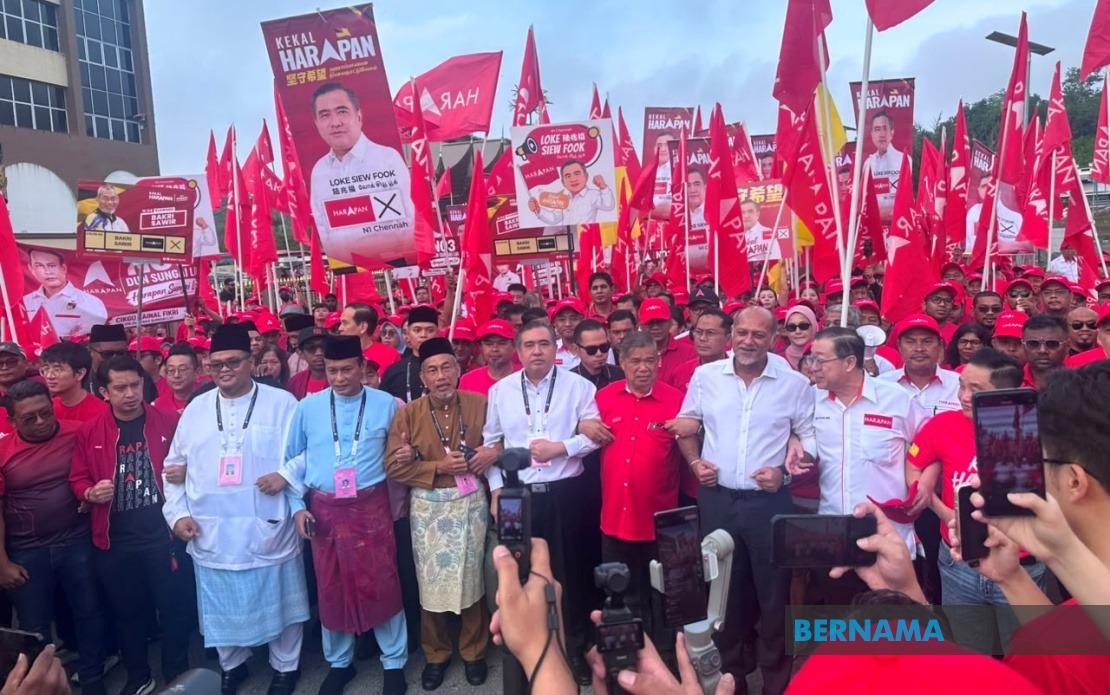
Pakatan Harapan's leadership hierarchy descended on Negeri Sembilan on July 18 in a concentrated show of organisational muscle, personally shepherding the coalition's slate of candidates through nomination procedures across multiple centres. The orchestrated appearances by party principals and government ministers underscored the strategic importance of the state election to the coalition, which holds 17 of 36 seats following the 2023 polls and faces a contest against Barisan Nasional's 14 seats and Perikatan Nasional's five.
Transport Minister Anthony Loke, who doubles as DAP secretary-general, led the charge in Jelebu when he filed his own nomination for the Chennah state seat at Dewan Besar Kuala Klawang. His appearance came laden with symbolic weight, flanked not merely by DAP colleague Gobind Singh Deo but by party adviser Lim Guan Eng and Amanah president Mohamad Sabu. The constellation of figures suggested a united front across the three major PH components, projecting confidence in the coalition's electoral viability despite the fractious politics that periodically strain the partnership.
Parallel operations unfolded in Jempol, where Communications Minister Fahmi Fadzil positioned himself as the central coordinator for four PH candidates pursuing seats in Serting, Palong, Jeram Padang and Bahau. His presence at the nomination centre around 8:55 am, arriving after Deputy Communications Minister Teo Nie Ching had already begun proceedings, suggested a layered deployment strategy wherein senior figures maintained flexibility in their schedules while ensuring continuous high-level representation. Teo Kok Seong's bid for Bahau carried particular weight given his incumbent status from the 14th General Election, contrasting with newcomers Yaacob Mahmood, Muhammad Zahin Zinal Abidin and Manivanan Gowin, whom Fahmi's presence helped legitimise within the PH apparatus.
The Port Dickson centre hosted perhaps the most symbolically dense gathering, where Negeri Sembilan Menteri Besar Aminuddin Harun submitted his Linggi nomination surrounded by DAP deputy secretary-general Hannah Yeoh, PKR secretary-general Fuziah Salleh and the Prime Minister's political secretary Farhan Fauzi. This configuration of federal and state machinery around a sitting Menteri Besar suggested careful coordination at the highest governmental levels, with the Prime Minister's office taking direct interest in the state contest's mechanics and outcomes. The presence of three sitting incumbents—Yew Boon Lye in Chuah, Choo Ken Hwa in Lukut and G Rajassekaran defending Sri Tanjung—indicated PH's bid to consolidate existing territory rather than expand dramatically.
Entrepreneur and Cooperatives Development Minister Steven Sim's appearance at Wisma Majlis Bandaraya Seremban with six PH candidates reflected another coordinated cluster deployment, accompanied by Selangor State Legislative Assembly Speaker Lau Weng San, Bukit Gelugor MP Ramkarpal Singh and PKR vice-president R. Ramanan. The cross-state representation, particularly Selangor politicians attending a Negeri Sembilan event, illustrated the interconnected nature of Malaysian coalition politics, wherein state results reverberate across regional power dynamics and party balance sheets.
The timing and choreography of these appearances deserve scrutiny beyond surface observation. PH's unified projection on nomination day served multiple audiences simultaneously: reassuring their base that party heavyweights remained committed to the state contest; signalling to federal bureaucracy that electoral operations enjoyed top-level endorsement; and communicating to rival coalitions that PH possessed both organisational coherence and ministerial resources to mobilise. The absence of visible fractures or competing faction representations suggested, at least superficially, that the post-2023 tensions within PH had been sufficiently managed for campaign purposes.
The Electoral Commission's designation of August 1 as polling day with early voting on July 28 compressed the campaign window into approximately two weeks from nomination day. This condensed timeline intensified the significance of the opening ceremonies surrounding nomination submissions, as parties sought maximum media amplification from their leadership turnouts before transitioning to ground-level campaigning. The early voting provision furthermore favoured organisations possessing robust administrative machinery to mobilise their supporters within that narrow window—an advantage likely accruing to the better-resourced PH machinery relative to opposition contenders.
Negeri Sembilan's 36-seat configuration and existing PH majority of 17 seats positioned the state as a test case for coalition viability without reaching critical mass. Unlike Selangor or Penang, where PH enjoys commanding majorities, Negeri Sembilan represented contested terrain where boundary shifts or voter sentiment movements could genuinely alter outcomes. The 2023 result, wherein PH gained three seats while losing one from earlier contests, suggested a narrowing margin rather than consolidating strength, creating genuine uncertainty about whether the state would remain firmly within PH's orbit or drift toward opposition recovery.
The June 5 dissolution by Yang Dipertuan Besar Tuanku Muhriz Tuanku Munawir followed standard constitutional procedures but occurred amid broader Malaysian political currents questioning whether regular elections serve the electorate or primarily satisfy intra-elite competition cycles. Negeri Sembilan's election represented the latest in a succession of state polls since 2022 that have collectively exhausted voters and tested the legitimacy of repeatedly revisiting electoral choices across multiple contests in compressed timeframes.
For Malaysian observers, the Negeri Sembilan contest assumes significance beyond state-level implications. The performance of PH's federal-state coordination machinery offers lessons about coalition functionality amid ongoing governance demands. Similarly, the ability of opposition coalitions to mount credible challenges against an incumbent exercising state resources illuminates broader patterns of democratic competition in Malaysia's context. The concentration of PH's top leadership around nomination day procedures suggested party strategists viewed the state election as both achievable and important enough to justify diverting central figures from other pressing engagements, indicating genuine competitive stakes rather than predetermined outcomes.

