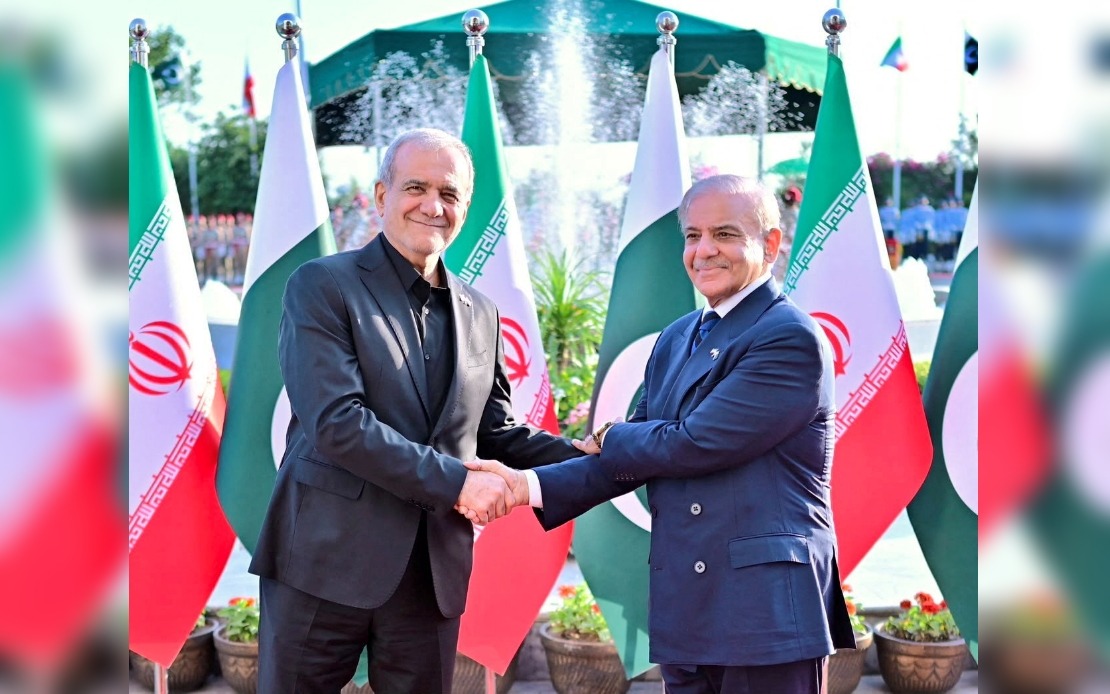
Pakistan's Prime Minister Shehbaz Sharif has thrown his weight behind Iran's possession of ballistic missiles, declaring during talks with Iranian President Masoud Pezeshkian in Islamabad that Tehran's defence capabilities remain entirely separate from the recently brokered US-Iran agreement. The statement represents a forceful assertion of support for Iran at a sensitive moment in regional diplomacy, as Pakistan consolidates its role as a trusted mediator between Washington and Tehran.
Shehbaz made his position unambiguous, stating that Iran's missile programme was never included in negotiations leading to the memorandum of understanding finalised on June 17. He rejected what he characterised as double standards in international security arrangements, emphasizing that if other nations retain ballistic arsenals, Iran should face no impediment to maintaining its own. The Pakistani premier stressed that the topic never appeared on the negotiating agenda and was deliberately excluded from discussions by the Iranian side.
The timing of Shehbaz's remarks holds particular significance given Pakistan's instrumental role in facilitating peace between the two adversaries. Beyond the recent MoU, Pakistan had previously brokered a temporary ceasefire in April, positioning itself as an honest broker in one of the Middle East's most volatile equations. During his address, Shehbaz expressed gratitude for Iran's confidence in Pakistan's mediation, crediting Foreign Minister Ishaq Dar and Chief of Army Staff Field Marshal Syed Asim Munir for their active participation in shuttle diplomacy.
Iran views its ballistic missile capabilities as integral to national defence, a posture hardened by Israeli and American strikes on February 28. President Pezeshkian left no ambiguity about this calculus, stating at the joint press conference that without defensive missiles, Iran would face a fate comparable to Gaza. His remarks underscored how Tehran perceives its weapons programme not as an aggressive tool but as an existential safeguard against external powers.
Interestingly, even US President Donald Trump has acknowledged the logic of Iran's position. In Paris on June 17, Trump conceded that if other nations possess ballistic missiles, it would be unfair to deny Iran similar capabilities. This softening in the American position represents a notable shift and may signal broader acceptance that Iran's missile arsenal need not be a negotiating stumbling block in future diplomatic efforts.
For Malaysian and Southeast Asian observers, Pakistan's stance illuminates how regional powers navigate between competing global pressures. Islamabad's willingness to champion Iran's military prerogatives while maintaining dialogue with Washington demonstrates the delicate balancing act required of countries positioned between great powers. Pakistan's diplomatic success also reflects the region's broader interest in stability, as unresolved tensions in West Asia reverberate through energy markets and security architecture affecting Asian economies.
Shehbaz acknowledged that obstacles to the US-Iran agreement persist globally, referring to what he termed "spoilers" intent on undermining the peace accord. Israel has featured prominently in his analysis as destabilising, with its military operations in Lebanon and occupied Palestine creating wider instability. This framing suggests Pakistan views Israeli actions as the primary threat to regional peace architecture rather than Iran's defence capabilities.
The grandeur of Pezeshkian's reception underscored the diplomatic weight both nations attach to their relationship. The Iranian president's aircraft received a fighter jet escort upon arrival, and ceremonies included a 21-gun salute with receptions from both Prime Minister Shehbaz and President Asif Ali Zardari. Such ceremonial acknowledgment signals Pakistan's commitment to deepening ties with Tehran beyond immediate mediation needs.
Pakistan's advocacy for Iran's missile rights also reflects shared strategic interests. Both nations contend with regional challenges from militant extremism and view consolidated defence capabilities as necessary. Pakistan's own nuclear arsenal has long been defended on similar grounds—as a deterrent essential to national survival. By championing Iran's position, Shehbaz implicitly reinforces the principle that nations in volatile regions merit the right to credible defence mechanisms.
The exclusion of ballistic missiles from the US-Iran MoU represents a significant diplomatic achievement insofar as it permitted agreement without demanding Iran's disarmament. This compartmentalisation allowed both sides to declare success: the US and its allies secured de-escalation commitments, while Iran retained its strategic capabilities intact. Pakistan's role in brokering this outcome, then publicly defending its terms, enhances Islamabad's standing as a responsible diplomatic actor.
Looking forward, Pakistan's explicit defence of Iran's missile programme may influence how other regional actors approach similar security questions. Southeast Asian nations, increasingly concerned about power imbalances in their own waters, may observe how Pakistan justifies Iran's right to defensive weapons while maintaining constructive relations with the United States. This precedent could inform debates about military modernisation and deterrence across Asia.
The convergence of statements from Shehbaz, Pezeshkian, and even Trump suggests a potential recalibration in how the international community addresses Iran's defence posture. Rather than treating missiles as negotiable items subject to bargaining, the emerging consensus appears to accept them as non-negotiable components of Iran's security architecture. This shift, if sustained, could reduce one major flashpoint in West Asian diplomacy and create space for progress on other contentious issues.
Ultimately, Pakistan's forthright backing of Iran's missiles reflects broader patterns in multipolar geopolitics where regional powers increasingly assert independent judgments rather than reflexively adopting positions preferred by distant powers. Shehbaz's comments underscore how nations like Pakistan are charting courses that prioritise regional stability and equitable treatment of all parties over strict alignment with any single external power.