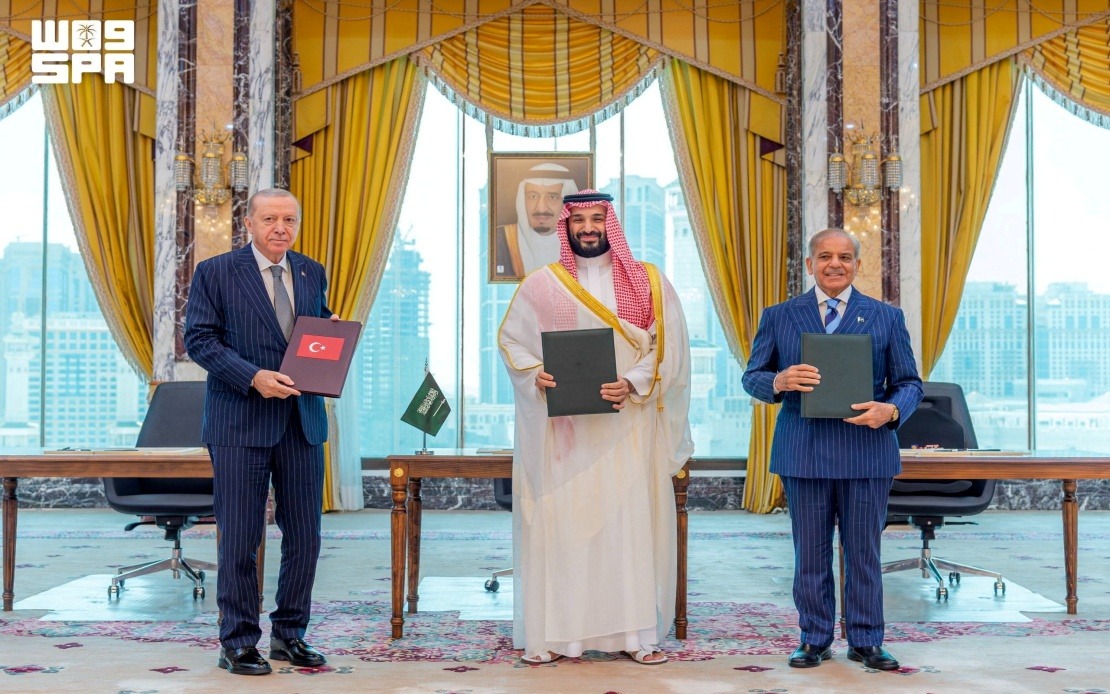
Three major powers in the Islamic world—Pakistan, Saudi Arabia and Türkiye—have cemented a significant security alliance by signing a comprehensive defence pact at Al Safa Palace in Makkah on Friday. The accord, inked by Saudi Crown Prince Mohammed bin Salman bin Abdulaziz Al Saud, Pakistan Prime Minister Shehbaz Sharif and Turkish President Recep Tayyip Erdogan, represents a formal commitment to mutual protection and strengthened military ties among the three nations. The timing and substance of this agreement underscore the trio's determination to establish themselves as a formidable regional bloc capable of deterring threats independently.
The Joint Defence Agreement contains binding provisions that treat any armed assault on one signatory as an attack on all three, creating a deterrent framework analogous to traditional collective security arrangements found in NATO and other alliances. This mutual defence clause transforms the pact from a mere diplomatic gesture into a binding commitment with potential military implications, though the agreement also explicitly states that it neither threatens other regional actors nor represents an escalatory move. The multilateral framework extends beyond crisis response to encompass comprehensive cooperation across all dimensions of defence policy, from training and intelligence sharing to equipment integration and joint operational planning.
For Malaysian policymakers and Southeast Asian observers, this development carries significant implications. The rise of a Pakistan-Saudi Arabia-Türkiye axis represents a consolidation of power among three strategically positioned nations that collectively span three continents—from South Asia through the Middle East to Eastern Europe and the Mediterranean. The bloc commands substantial military resources, including Pakistan's nuclear arsenal, Türkiye's NATO membership and regional air and naval capabilities, and Saudi Arabia's financial prowess and energy influence. This tripartite arrangement could reshape regional dynamics not only in the Middle East but potentially influence security calculations across Asia, particularly if similar mechanisms expand or if other nations seek to join or counter such arrangements.
Pakistan's central position in this pact reflects its traditional role as a bridge between South Asia and the Islamic Middle East. The country maintains longstanding defence partnerships with both Saudi Arabia and Türkiye, relationships cultivated over decades through military aid, training programmes and strategic alignment. The September 2023 bilateral defence agreement between Pakistan and Saudi Arabia established a precedent for formal security commitments, and Friday's trilateral accord represents a natural evolution of these ties. For Pakistan, a nation facing persistent security challenges ranging from militant insurgency to border tensions, the reinforced partnerships provide both strategic reassurance and practical benefits through enhanced military cooperation and information sharing with capable allies.
Saudi Arabia's role in this coalition reflects its broader regional strategy of building security relationships independent of traditional Western frameworks. The kingdom's deputy public diplomacy minister, Rayed Krimly, sought to emphasise that the pact facilitates joint defence capability development, strengthens deterrence mechanisms and enhances integrated readiness without destabilising the region or triggering arms race dynamics. Saudi Arabia's substantial defence budget and its position as a major regional power give substantial weight to any security arrangement it joins, while its close ties to numerous countries across Asia, Africa and the Middle East mean that this pact carries diplomatic implications extending far beyond the immediate signatories. The kingdom's emphasis on burden-sharing and collective defence suggests a measured approach to regional security rather than unilateral assertion.
Türkiye's participation anchors the agreement to the broader Middle Eastern security environment while also connecting it to European concerns. As NATO's only Muslim-majority member state, Türkiye occupies a unique geopolitical position, bridging Western and Islamic frameworks. Its inclusion in this trilateral arrangement signals both its commitment to regional stability and its confidence in managing relationships across multiple security architectures simultaneously. Turkish military capabilities, particularly in drone technology and naval operations, complement Pakistani and Saudi assets, creating a more comprehensive deterrent capability than any single nation could provide independently.
The joint statement accompanying the pact emphasises a shared vision of regional peace, security and prosperity—language that distinguishes this arrangement from openly confrontational alliances. By framing their cooperation as defensive rather than offensive, the three nations attempt to navigate a careful diplomatic path that establishes credible deterrence without unnecessarily provoking other regional or international actors. This rhetorical framing matters significantly in Middle Eastern and South Asian contexts where security arrangements are often scrutinised for hidden aggressive intent or alignment with broader geopolitical competitions.
For Malaysia and other ASEAN members, this development warrants careful monitoring for several reasons. First, any significant shift in Middle Eastern security arrangements can affect energy prices, maritime commerce and regional stability in ways that ripple across the Indian Ocean and into Southeast Asia. Second, the precedent of formal trilateral defence pacts among non-aligned or partially aligned nations could influence similar arrangements elsewhere, potentially affecting Southeast Asian security architectures. Third, as Muslim-majority nations establish their own security frameworks, ASEAN members may find themselves evaluating their positions within or between competing regional blocs, particularly if great power competition intensifies.
The agreement also reflects a broader trend among Muslim-majority nations to develop indigenous security architectures rather than relying primarily on partnerships with non-Muslim powers. This represents a significant shift in international relations, suggesting that religious and civilisational commonalities increasingly intersect with traditional geopolitical interests in shaping alliances. For Malaysia, which maintains diverse security partnerships across Asia, Europe and the Middle East, understanding these emerging alignments remains crucial to navigating regional diplomacy effectively.
Looking forward, the success of this trilateral arrangement will depend on effective implementation and the extent to which the three nations can coordinate defence policies without allowing their partnership to escalate tensions with other regional actors. The agreement provides structural mechanisms for cooperation, but practical realisation requires sustained political commitment, military integration and resource allocation. Whether this pact evolves into a more formal bloc or remains a flexible coordination mechanism will significantly influence its impact on regional security dynamics and broader international relations in the coming years.

