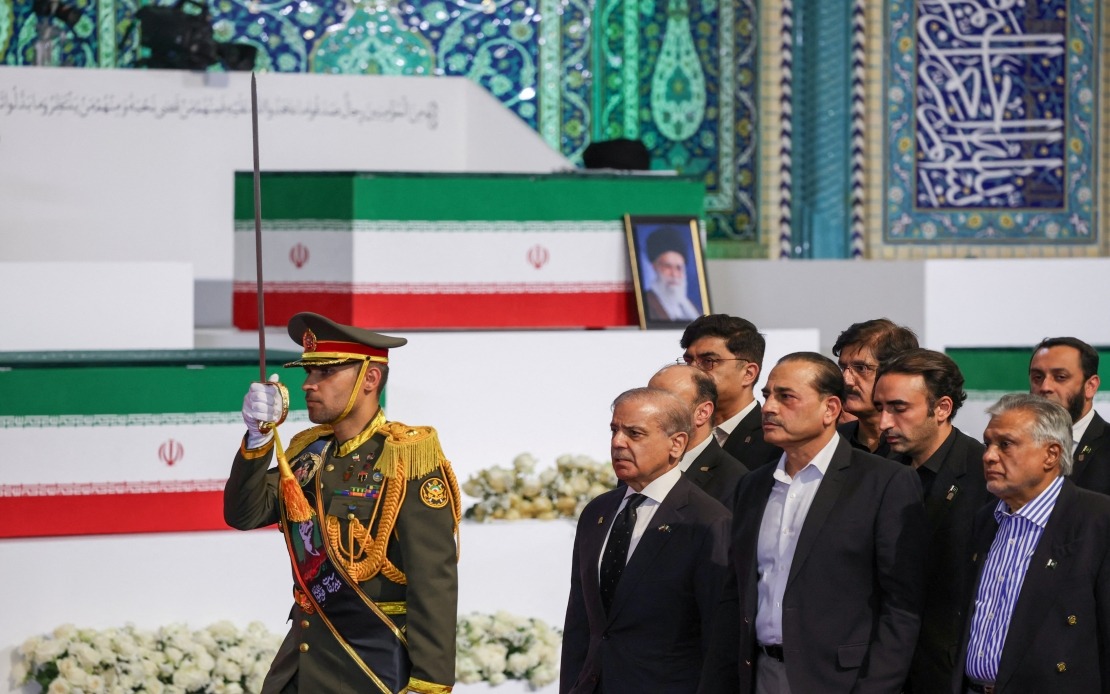
Pakistan demonstrated its strategic commitment to Iran by deploying one of the world's most senior delegations to the funeral of Supreme Leader Ayatollah Ali Khamenei in Tehran on Friday, a move that generated considerable diplomatic goodwill in the Islamic Republic. The participation of Prime Minister Shehbaz Sharif alongside some of the country's most powerful figures underscored the significance Pakistan attaches to its relationship with Iran at a critical juncture in regional geopolitics.
Khamenei's death on February 28 in what Iran characterised as a United States-Israeli attack on his compound marked a seismic event in Middle Eastern politics, necessitating a carefully calibrated international response. The funeral ceremony attracted dignitaries and officials from approximately 100 countries spanning every continent and political alignment, reflecting the deceased leader's influence across the Islamic world and beyond. Among the attendees were representatives from Malaysia, Bangladesh, Saudi Arabia, Turkey, Qatar, Oman, Egypt, Russia, Iraq, China and India, creating an unusual gathering of nations with otherwise divergent interests.
The composition of Pakistan's delegation spoke volumes about how Islamabad weighted this occasion. Beyond Prime Minister Sharif, the contingent included Deputy Prime Minister and Foreign Minister Ishaq Dar, Army Chief Field Marshal Syed Asim Munir, Pakistan People's Party chairman Bilawal Bhutto Zardari, National Assembly Speaker Sardar Ayaz Sadiq, Interior Minister Mohsin Naqvi and Information Minister Attaullah Tarar. This assemblage represented the pinnacle of Pakistan's civilian and military establishments, a fact that did not escape Iranian officials observing the proceedings.
Iranian Ambassador to Islamabad Reza Amiri Moghadam seized upon the moment to underscore the historical significance of Pakistan's participation. In a post on social media platform X, he characterised the Pakistani delegation as the largest sent by any single nation to the ceremony, a distinction that elevated Pakistan's gesture beyond mere diplomatic protocol. Moghadam's language was notably warm and effusive, reflecting a desire from Tehran to cement relations with its western neighbour during a vulnerable period of transition.
The ambassador's rhetoric centred on themes of continuity and deeper bonds between the two Islamic republics. He spoke of Pakistan's representation as a testament to "enduring friendship, mutual respect, and fraternal bonds," terminology that invoked a discourse of kinship extending beyond standard bilateral relations. Moghadam further characterised Pakistan's attendance as a "meaningful and historical gesture" that reflected "the depth of the historic ties and shared values" binding Iran and Pakistan, portraying their relationship as having weathered multiple historical trials.
Prime Minister Sharif offered his own tribute to Khamenei at the ceremony, lauding the deceased leader's "wisdom, leadership and profound influence on Iran and the wider region" and asserting that these qualities would be "remembered for generations." The language employed suggested a recognition of Khamenei's outsized importance not merely to Iran but to the broader Islamic and developing world. For Pakistani leadership, affirming such sentiments represented both respect for a significant regional figure and implicit alignment with Iranian interests.
Khamenei's tenure as Supreme Leader spanned from 1989 until his assassination at age 86, making him one of the longest-serving leaders in the modern Middle East. His death triggered a succession process that would reshape Iran's internal dynamics and its foreign policy orientation. The funeral proceedings, which commenced publicly on Saturday with burial scheduled for July 9 in Mashhad—Khamenei's native city—stretched across multiple days, allowing the Iranian establishment time to consolidate power and manage the transition.
For Malaysia and other Southeast Asian nations observing this event, Pakistan's prominent role offers instructive lessons about navigating great power competition and regional tensions. Pakistan's decision to dispatch its highest-ranking officials reflected a calculation that strengthening ties with Iran served broader strategic interests, particularly given Pakistan's own vulnerabilities and its evolving relationship with Gulf Arab states. The delegation's size and calibre suggested that Islamabad was not prepared to cede influence in Iran to any other regional actor, despite historical tensions between the two countries.
The presence of such eminent Pakistani figures also carried domestic political messaging. For Prime Minister Sharif and other civilian leaders, participating visibly in this major international event demonstrated their continued relevance and influence on the global stage. For the military establishment, represented by Army Chief Munir, the attendance reinforced the armed forces' role as custodian of Pakistan's strategic interests. These parallel dynamics suggest that Pakistan's Iran policy reflects a consensus across its fractious political and institutional landscape.
The broader context of this gathering merits attention from regional observers. Iran faces significant internal pressures following Khamenei's death, with questions about succession, economic management, and nuclear negotiations looming large. Pakistan's warm embrace of Iran at this moment positions it as a reliable ally, potentially enabling Islamabad to exercise influence during a period when Tehran's attention is necessarily focused inward. For Malaysia, the spectacle illustrates how middle powers navigate the complex terrain of international relations during moments of transition in neighbouring regions.
Looking forward, Pakistan's gambit at Khamenei's funeral may yield dividends in terms of enhanced bilateral cooperation, security coordination, and economic collaboration. The Iranian government's public appreciation of Pakistan's gesture suggests receptiveness to deeper engagement. However, this development also underscores the persistent volatility of regional geopolitics, where major leaders' deaths can rapidly reshape the landscape and where timely diplomatic positioning becomes critical. The funeral thus served not merely as a moment of mourning but as a checkpoint in the ongoing calculation of regional alignments and influence.

