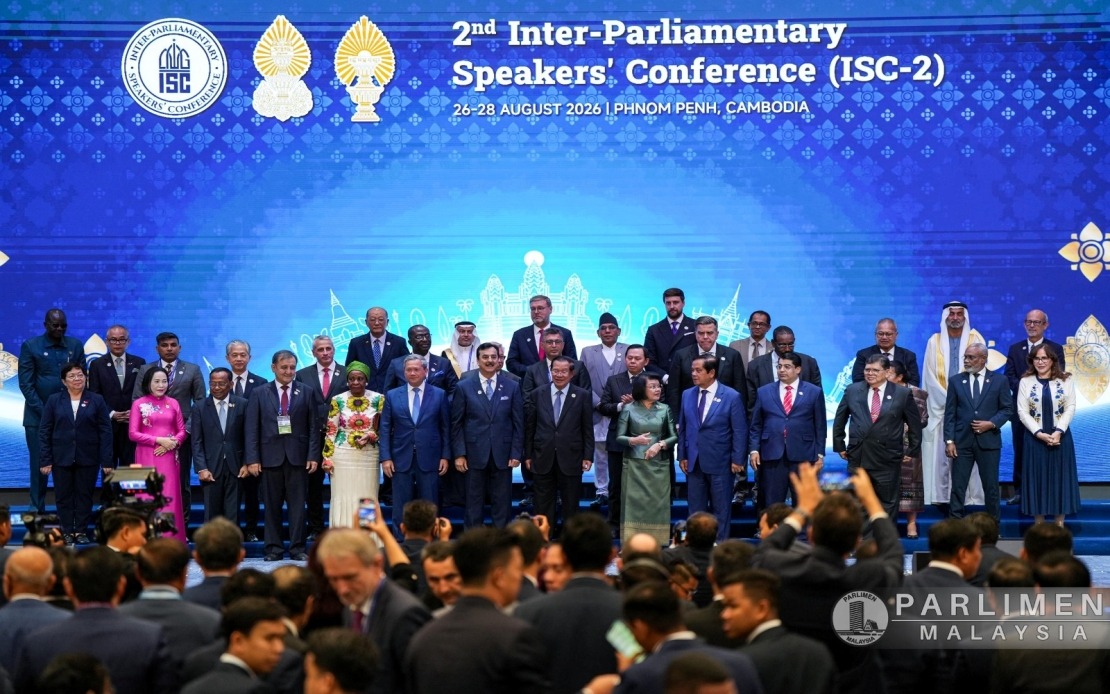
Dewan Rakyat Speaker Tan Sri Dr Johari Abdul has called for parliaments worldwide to assume a more prominent position in tackling the array of conflicts and geopolitical challenges confronting the international community, arguing that legislative bodies cannot remain sidelined while executives chart the course of global affairs. Speaking at the Second Inter-Parliamentary Speakers' Conference in Phnom Penh on Friday, Johari underscored that the traditional division of labour between executive and legislative branches must evolve to reflect the complexity of contemporary global issues, which increasingly demand input from multiple institutional perspectives.
The conference, held jointly by Cambodia's National Assembly and Senate from 26 to 28 August under the theme "Solidarity for Peace and Shared Prosperity: Strengthening International Law and Resolving Conflicts Peacefully," provided the backdrop for Malaysia's call to elevate parliamentary involvement in international diplomacy. Johari stressed that inter-parliamentary forums such as this gathering offer invaluable opportunities for legislatures to collectively examine challenges affecting populations across borders, particularly in contexts where geopolitical rivalries threaten stability and climate-related crises displace communities.
Central to Johari's argument is the recognition that parliaments possess distinctive vantage points that executive branches may overlook. Whereas governments often approach transnational disputes through narrow political calculations, legislatures typically maintain closer connections to grassroots sentiment and can articulate the broader concerns of their constituents. This structural difference, he suggested, means that genuine progress on contentious issues requires genuine partnership between the two branches, with each contributing its particular strengths to forge durable solutions. The speaker noted that sidelining parliamentary perspectives creates institutional imbalance and leaves decision-making vulnerable to narrow political interests rather than informed by public welfare.
In his address during the general debate, Johari painted a sobering picture of the contemporary geopolitical landscape. Conflicts have grown more intricate, he observed, with traditional patterns of interstate dispute giving way to multifaceted crises involving non-state actors, transnational networks, and interconnected challenges spanning security, resources, and ideology. Meanwhile, the international institutions established in the post-war period to maintain order and prevent escalation face unprecedented strain as major powers contest fundamental principles. The human toll of these conflicts extends far beyond casualty figures and economic damage. Families are uprooted from ancestral homes, children lose access to schooling, and the social fabric binding communities together unravels under the weight of violence and displacement.
Parliamentary diplomacy, according to Johari, represents a crucial counterweight to the brittleness of official state relations. When tensions between governments create impasses in formal negotiations, parallel tracks involving legislators can preserve communication and prevent complete breakdown of dialogue. This back-channel function becomes particularly valuable when political rhetoric hardens positions or when domestic pressures constrain executive flexibility. By maintaining conversation across partisan and national boundaries, parliaments create space for trust-building and help prevent misunderstandings from metastasising into confrontation. Johari emphasised that disagreement between nations need not inevitably lead to conflict if institutional mechanisms exist to channel differences toward peaceful resolution.
For Malaysia and the wider Southeast Asian context, these principles carry particular resonance. The Association of Southeast Asian Nations was explicitly founded on principles of dialogue, consultation, and the conviction that regional peace requires constant cultivation and commitment. Malaysia's position, as articulated by Johari, rests on foundational beliefs that sovereignty must be respected, territorial integrity protected, international law observed, and disputes resolved through peaceful means rather than coercion. These commitments reflect hard-won regional consensus achieved through decades of dialogue after earlier periods of confrontation.
Acknowledging that disagreements inevitably emerge among Southeast Asian nations, Johari stressed that ASEAN's institutional framework must continue functioning as the region's primary forum for constructive engagement. This role extends naturally to national parliaments, which can amplify understanding between peoples and foster solutions grounded in mutual respect and adherence to international legal principles. Rather than parliaments serving merely as rubber stamps for executive decisions, legislators should actively shape regional policy by building grassroots support for peaceful resolution and holding governments accountable to the region's founding commitments to non-interference and peaceful settlement.
The ISC-2 gathering itself reflects growing recognition that international relations require multilayered engagement. Beyond formal government-to-government diplomacy, legislators bring legitimacy derived from democratic processes and can mobilise public opinion in support of peaceful approaches. They also possess comparative knowledge of how different societies address similar challenges, enabling cross-pollination of successful conflict-prevention strategies. Moreover, parliamentary involvement in international matters strengthens the democratic accountability of foreign policy, ensuring that decisions affecting national survival are not concentrated in executive hands but subject to broader institutional scrutiny.
Looking forward, Indonesia's commitment to host the third Inter-Parliamentary Speakers' Conference next year signals sustained momentum behind this initiative. The progression from Pakistan's inaugural conference in 2025 to Cambodia's second gathering and Indonesia's forthcoming venue demonstrates that parliamentary diplomacy is becoming institutionalised within global governance architecture. For Malaysia, participation in this growing network allows the Dewan Rakyat to contribute Malaysian perspectives shaped by regional experience while gaining insights from legislative bodies navigating similar challenges in other continents.
The broader implication of Johari's advocacy is that addressing the defining challenges of this era—from regional geopolitical competition to global climate disruption—requires mobilising all legitimate institutions toward coherent solutions. Concentrating power exclusively in executive hands risks producing policies disconnected from public sentiment and vulnerable to short-term political calculations. By empowering parliaments as genuine partners in international affairs, societies tap into repositories of legitimacy, representation, and deliberative capacity that executives alone cannot provide. For Malaysia, embracing this vision means not merely attending international parliamentary gatherings but actively asserting legislative prerogatives in foreign policy formation, particularly where ASEAN consensus and regional stability are at stake.

