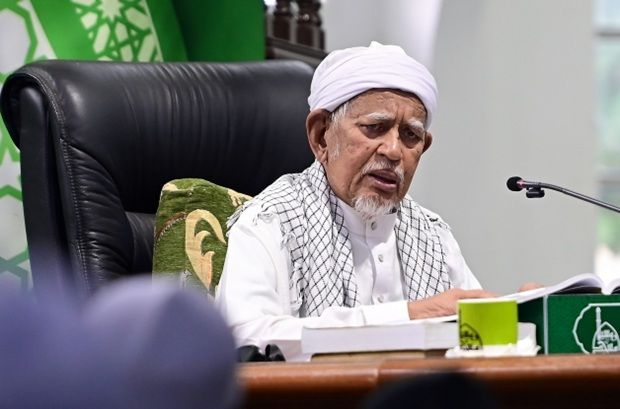
The jubilation expressed by PAS president Abdul Hadi Awang following Barisan Nasional's success in the recent Johor state election has opened fresh fissures within Malaysia's coalition politics, extending consequences that reach far beyond the southern peninsula. His public assertion that PAS played an indispensable role in delivering electoral victory carries implications for the delicate balance sustaining federal governance, particularly affecting regions whose political cultures diverge substantially from peninsula-centric dynamics.
The ramifications ripple outward because contemporary Malaysian politics cannot be understood through a peninsula-only lens. Developments in one region increasingly constrain options and shape expectations across the federation. The assertion of PAS's newfound prominence within Barisan Nasional architecture therefore becomes a matter of immediate concern to political actors in Negri Sembilan and the two Borneo states, who sense that the foundational principles underlying their own political participation may be shifting in ways they neither endorsed nor anticipated.
In Negri Sembilan specifically, observers note an underlying tension. The state's ruler, Tuanku Muhriz, has cultivated a public image as a champion against corruption and a leader who personally identifies with accessibility through his self-styled "Boss Ku" designation. The intensification of PAS's ideological voice within governing coalitions generates discomfort precisely because the state's political trajectory has traditionally reflected its ruler's preferences for transparent, corruption-free administration rather than religious mobilisation as a primary electoral driver. Questions multiply about whether PAS fully comprehends the distinctive political culture the Negri Sembilan throne has sought to establish.
The arithmetic of power further complicates matters. Johor's Menteri Besar Hafiz Onn possesses authority to appoint an additional five state representatives, potentially strengthening his assembly majority from 46 to 51 seats. Meanwhile, Barisan's strategy in Negri Sembilan involves contesting 26 of 36 seats through collaboration with PAS alongside Wawasan and Gerakan. This coordinated approach appears to some observers as a direct challenge to Prime Minister Anwar Ibrahim and cabinet ministers who have invested political capital in working alongside Barisan despite historical rivalries.
Borneo's political leadership views these peninsular developments through an entirely different prism. The 56 parliamentary seats distributed across Sabah and Sarawak constitute a genuinely decisive force in national politics, yet the priorities animating Borneo-based parties diverge substantially from those dominating peninsula discourse. Development projects, equitable federal budget allocation, and protection of state constitutional prerogatives consistently rank above ideological contestation in Borneo's political calculus. Political leaders in these states have repeatedly demonstrated an unmistakable preference for pragmatic, moderate governance structures that facilitate inter-ethnic and inter-religious accommodation as operational necessities rather than aspirational ideals.
The cultural and historical foundations supporting this Borneo approach run deep. These societies have evolved governance systems where religious and ethnic diversity functions not as a challenge to be managed but as a fundamental feature of everyday political life. Consequently, parties operating within this environment have developed institutional reflexes favouring caution regarding approaches perceived as overly ideological or dependent upon religious mobilisation for electoral success. When PAS celebrates working quietly and now openly alongside Barisan, when Wawasan under Hamzah Zainuddin represents reconstituted political forces with different ideological moorings, Borneo's leadership recognises a potentially destabilising shift in the coalition's character.
The constitutional underpinnings of Malaysia's 1963 formation hold particular salience for East Malaysian political consciousness. Questions concerning state autonomy, religious harmony, multicultural governance, and federal-state relations embed themselves within conversations about Malaysia's foundational compact in ways they typically do not within peninsula-dominated discussions. Political leaders in Sabah and Sarawak evaluate all peninsular developments through this constitutional lens, assessing how they might ultimately affect national cohesion and the preservation of the carefully constructed balance among Malaysia's diverse regions and communities. An increasingly assertive PAS narrative claiming indispensability to electoral victories triggers legitimate anxieties about whether this implies a recalibration of Malaysia's pluralist framework.
The challenge facing coalition partners extends beyond electoral arithmetic into the realm of mutual confidence. Parties sustaining broader coalitions require genuine respect for their partners' differing circumstances and priorities. Claims that PAS has become the indispensable force behind victories involving UMNO, MCA, and MIC may energise PAS's own supporters, yet simultaneously they complicate relationships with coalition members whose electoral bases operate under profoundly different social, religious, and ethnic conditions. Borneo's political traditions have simply not evolved within contexts requiring the same religious appeals that may prove effective in parts of the peninsula.
This divergence does not suggest that PAS possesses no legitimate democratic role. Like all registered political parties, PAS retains every constitutional right to contest elections, present policy alternatives, and seek public support through lawful means. Democratic competition forms an essential feature of Malaysia's parliamentary system, and no party deserves exclusion based on ideological orientation alone. However, democratic legitimacy also demands sensitivity towards the federation's broader composition and the regional variations it encompasses.
The historical strength of Malaysian coalition-building has resided precisely in its capacity to accommodate substantial differences among participating parties while maintaining national stability and accommodating regional diversity. This flexibility has enabled governments of varying compositions to function effectively. Yet such flexibility depends upon all participants understanding that electoral success in one region does not automatically translate into acceptance across the federation. Coalition partners must remain attentive to how their assertions of political power register among allies whose constituencies inhabit different political universes.
For Borneo's leadership, the question becomes whether an increasingly prominent PAS within Barisan Nasional architecture portends a systematic recalibration of coalition priorities away from the development focus and regional autonomy concerns that have traditionally anchored their participation. If PAS's growing influence means that religious or ideological considerations increasingly overshadow regional development and constitutional questions, then Borneo's political actors face difficult decisions about continued coalition engagement. The jubilation in Johor sends unmistakable signals that coalition priorities may indeed be shifting, and that realisation alone warrants serious reflection among East Malaysian leaders contemplating their federation's future trajectory.

