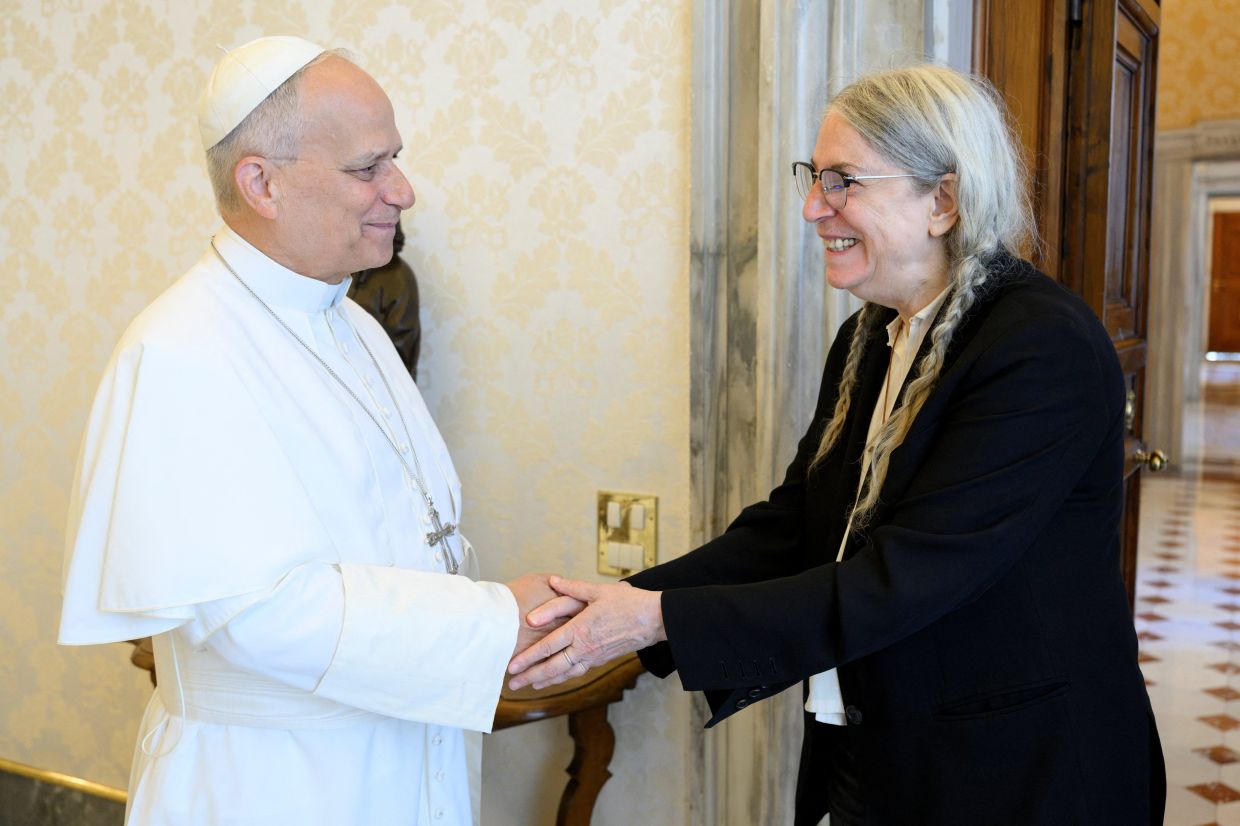
American rock and punk icon Patti Smith found herself momentarily speechless during a private audience with Pope Leo XIV on Friday, greeting the pontiff with a simple and understated "Hi" as she settled into a chair across from him at his desk in the Apostolic Palace. The unassuming nature of the exchange belied the significance of the moment for Smith, a Chicago-born artist whose unlikely spiritual journey has made her an increasingly recognizable presence within Vatican circles in recent years.
Smith's connection to the Holy See has deepened considerably through her friendship with Rev Antonio Spadaro, a senior figure in the Vatican's culture ministry who holds the position of undersecretary. The reverend has played a crucial role in facilitating Smith's visibility and engagement with Church leadership, enabling the American performer to participate in significant Vatican events and occasions. Despite her self-identification as a non-Catholic, Smith has articulated a profound admiration for the institution's spiritual values and leadership, particularly during the tenure of her predecessor Pope Francis.
Her affinity for the late Pope Francis, who passed away on April 21, 2025, ran deep and personal. Smith has spoken extensively about being drawn to Francis's distinctive approach to faith and humanity, which she characterized as embodying a "gentle, open, and steadfast sense of humanity." When news of his death reached her, she took to social media to express her grief through poetry, composing a moving tribute that compared Francis to a humble yet resilient dandelion. In that poetic memorial, she wrote that "Nature and poetry and the suffering shall miss their champion," capturing the sense of loss felt by many who had connected with the late pontiff's compassionate worldview.
Smith's engagement with the Vatican has extended beyond private audiences into the realm of public performance and cultural participation. Earlier this year, on May 8, which marked the anniversary of Leo's election to the papacy, Smith performed at the inauguration of the Holy See's pavilion during the Venice Biennale, one of the world's most prestigious contemporary art festivals. This appearance demonstrated the Vatican's recognition of Smith's cultural significance and her ability to bridge the worlds of contemporary music and religious institution.
The physical presentation of Smith at the audience on Friday reflected her enduring artistic identity. She arrived wearing her trademark long braids and a crucifix necklace, maintaining the distinctive visual aesthetic that has defined her public persona across decades of artistic work. This sartorial choice underscored the integration of her spiritual interests with her artistic identity, suggesting that these elements are not separate compartments in her life but rather intertwined aspects of her worldview.
According to Spadaro's account of the meeting, the forty-minute conversation transcended the formality typically associated with papal audiences. Rather than functioning as a ceremonial encounter marked by protocol and distance, Spadaro described the interaction as feeling "more like a conversation between two people discovering they were old friends, sharing memories woven from words and music, dreams, visions, and hopes - both from yesterday and for today." This characterization suggests a genuine rapport between Smith and Leo, despite their vastly different positions and backgrounds, grounded in their shared status as Chicago natives and their mutual appreciation for artistic and spiritual expression.
Smith's history with the papacy extends back further than her current engagement with Pope Leo XIV. She first met Pope Francis in 2013 and subsequently sang for him in 2014, experiences that evidently left a lasting impression on her spiritual consciousness. Her earlier affinity for Pope John Paul I, evident in a 1979 musical composition, indicates a longstanding fascination with papal figures and their significance within her broader artistic framework. When she performed for Leo on Friday, the pope demonstrated his familiarity with her work, describing one of her pieces as "marvelous" and suggesting his own appreciation for her artistic contributions.
The Vatican's cultivation of relationships with international cultural figures like Smith reflects a broader institutional strategy to remain engaged with contemporary artistic and intellectual currents. By facilitating Smith's participation in major events and granting her private access to the pontiff, the Church signals its openness to dialogue with secular artists and cultural influencers who operate outside traditional religious frameworks. For Smith, these opportunities allow her to explore and express her spiritual inclinations in a way that respects her independence from formal Catholic identity while acknowledging her reverence for certain aspects of the Church's spiritual mission.
Smith's Vatican presence also carries particular resonance for Southeast Asian audiences, particularly those interested in the intersection of spirituality, artistic expression, and institutional power. As religious traditions and contemporary culture increasingly intersect in complex ways across the region, Smith's example demonstrates how artists can maintain intellectual and spiritual independence while engaging meaningfully with established religious institutions. Her approach suggests that dialogue between secular and religious spheres need not involve capitulation or compromise from either party.
The timing of Smith's audience with Leo came in the midst of a broader week of papal engagement with musical figures. On Wednesday, July 29, Leo had attended a concert performed in his honour by tenor Andrea Bocelli, a celebrated international vocalist. This sequence of events demonstrates the Pope's sustained interest in engaging with musicians and artists, positioning music and artistic expression as legitimate vehicles for spiritual and cultural dialogue at the highest levels of the Church.
Smith's continued presence in Vatican spaces and her genuine connection with Church leadership reflect both her evolving spiritual interests and the institution's recognition that cultural relevance in the modern world requires engagement with artists and thinkers who operate beyond traditional ecclesiastical structures. Her friendship with Spadaro has proven instrumental in establishing these connections, creating a pathway through which Smith's artistic voice can intersect with Catholic institutional platforms. As she departs from her Friday audience, Smith carries with her the continued ability to move between worlds—the secular and the sacred, the artistic and the spiritual—demonstrating that such boundaries need not be absolute.

