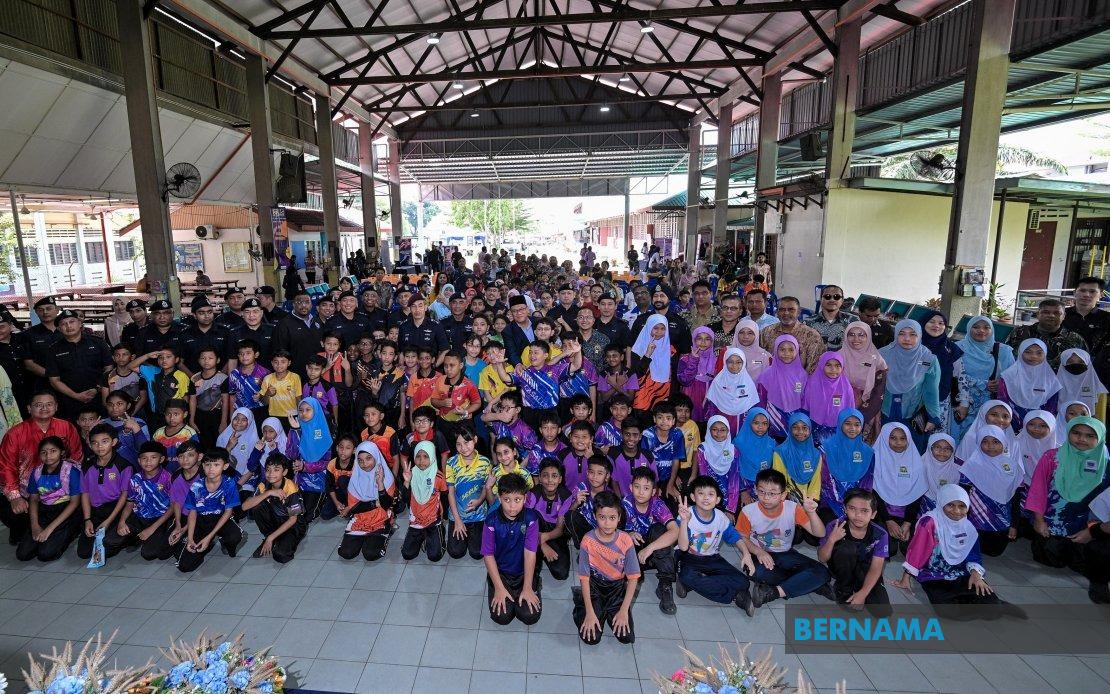
The Royal Malaysia Police (PDRM) is bringing its established character-building and discipline initiative down to the primary school level throughout Kuala Lumpur, marking a strategic shift to reach students at an earlier, formative stage of their academic careers. The programme, previously confined to secondary schools, aims to instil foundational values and ethical principles among younger pupils while simultaneously reducing exposure to social vices and criminal behaviour. Education officials unveiled the expanded initiative at Sekolah Kebangsaan La Salle 2 Jinjang, signalling confidence in the model's effectiveness across different age groups and educational contexts.
The Federal Territory of Kuala Lumpur Education Department (JPNWPKL) director Megat Affandi Datuk Ismail emphasised that the programme's extension flows naturally from measurable gains achieved through police-education partnerships in secondary institutions. Over recent years, the collaborative framework between PDRM and schools has yielded concrete outcomes, including reduced disciplinary infractions, fewer criminal cases involving students, and notably improved school attendance rates. These improvements suggest that strategic intervention by law enforcement, combined with educational support structures, can tangibly shift student behaviour and institutional safety profiles.
One of the most striking achievements emerging from the secondary school collaboration has been the documented decline in bullying incidents within school premises and especially in residential hostels. PDRM's proactive presence through regular facility visits and structured engagement appears to have created a deterrent effect while simultaneously sending a signal to students that safeguarding measures are taken seriously. This element holds particular relevance for Malaysian parents and educators who have grappled with persistent concerns about campus safety and student wellbeing. The expansion to primary schools reflects confidence that early intervention and positive role-modelling can prevent behavioural escalation before it solidifies.
Academic outcomes have bolstered the case for broader programme implementation. Kuala Lumpur achieved its strongest Sijil Pelajaran Malaysia (SPM) results in a decade, while corresponding improvements marked Sijil Tinggi Persekolahan Malaysia (STPM) and Sijil Tinggi Agama Malaysia (STAM) examinations. While multiple factors contribute to educational attainment, officials attribute a meaningful portion of this success to the stabilising influence of collaborative police-school frameworks that reduce disruptive behaviour and foster disciplined study environments. This connection underscores an often-overlooked dimension of educational quality—that institutional safety and student conduct directly influence academic performance.
Megat Affandi stressed that parental vigilance remains essential to programme success, particularly during the adolescent years when behavioural shifts become pronounced. He encouraged families to monitor their children closely and to engage school counselling services when concerning patterns emerge. This emphasis on shared responsibility—extending beyond police and educators to encompass family units—reflects contemporary understanding that sustainable behaviour change requires multi-layered involvement. In the Malaysian context, where extended family networks and community social structures remain influential, activating parental partnership proves strategically sound.
Vaping and substance-related concerns represent another focus area for the expanded initiative. JPNWPKL has committed to conducting joint spot-check operations with PDRM and allied enforcement bodies while coordinating with Kuala Lumpur City Hall (DBKL) to strengthen regulatory compliance and surveillance. This coordinated approach acknowledges that youth substance use, particularly vaping among primary and secondary students, presents a contemporary challenge that requires multi-agency responses spanning education, law enforcement, municipal regulation, and public health. The integration of these enforcement mechanisms reflects lessons learned internationally regarding adolescent risk behaviour intervention.
The institutional infrastructure supporting the initiative spans more than 200 schools overseen by JPNWPKL across Kuala Lumpur's diverse landscape. Strategically deployed school liaison officers concentrate on geographically and socioeconomically designated high-risk areas, enabling targeted resource allocation and customised intervention strategies. This geography-sensitive approach acknowledges that student vulnerability and institutional challenges are not uniformly distributed; schools serving lower-income neighbourhoods or high-density urban zones typically encounter greater disciplinary pressures and require enhanced support. By concentrating police liaisons in these zones, authorities attempt to level the playing field across disparate school contexts.
The programme's expansion carries broader implications for how Southeast Asian governments conceptualise the relationship between security and education. Rather than treating policing and schooling as separate institutional domains, the Kuala Lumpur model positions law enforcement as an educational stakeholder whose presence contributes to safe learning environments. This integration reflects international best practices in school safety frameworks, though implementation contexts in Malaysia warrant careful attention to cultural expectations and community sensitivities regarding police presence in educational spaces. Community buy-in and transparent communication about programme objectives become essential to sustaining these partnerships over time.
For Malaysian policymakers and educators monitoring these developments, the Kuala Lumpur initiative offers a tested framework worthy of consideration for broader national application. The demonstrated improvements in attendance, discipline, and academic outcomes suggest that similar partnerships could yield benefits in other state and federal territories. However, successful replication would require sensitivity to local contexts, adequate police resourcing, and sustained commitment from school leadership. The programme also invites reflection on preventive rather than purely reactive approaches to youth delinquency—positioning character development and discipline within standard educational provision rather than treating them as supplementary interventions reserved for problem students.
Looking forward, the success of this expanded programme will depend on consistent resourcing, clear role delineation between educators and enforcement officers, and ongoing evaluation of outcomes across primary school cohorts. As the initiative embeds within younger age groups, longitudinal tracking will become important to establish whether early-stage character-building translates into sustained behavioural improvements and reduced crime involvement as students progress through secondary education. The Malaysian education sector will watch closely whether the secondary school success story can authentically extend downward without inadvertently creating overly security-focused environments that conflict with primary education's developmental objectives of fostering curiosity, creativity, and age-appropriate social development.

