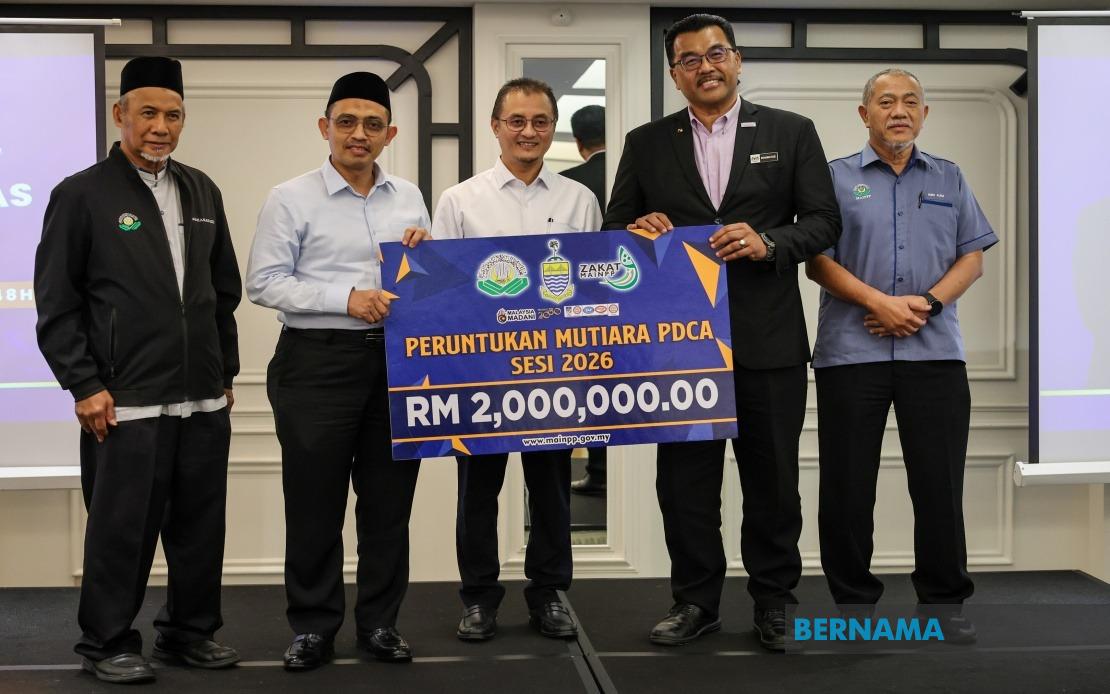
The Penang State Islamic Religious Council (MAINPP) is channelling RM2 million into its Mutiara Didik Cemerlang Akademik (MPDCA) Programme for 2026, reaching nearly 7,500 Bumiputera students across the state through targeted educational interventions. This commitment, announced by Penang Deputy Chief Minister I Datuk Dr Mohamad Abdul Hamid at a coordinating teachers' briefing in Kepala Batas, represents MAINPP's ongoing effort to strengthen educational outcomes among disadvantaged student populations through structured academic support.
The funding will be distributed across a comprehensive range of educational initiatives designed to elevate student performance and university preparedness. Participating students will access tutoring sessions, customised learning modules, seminars focused on specific subjects, and specialised workshops teaching examination techniques and strategies. The breadth of support reflects recognition that academic advancement requires multifaceted intervention beyond classroom instruction alone, addressing knowledge gaps, test-taking confidence, and subject-specific mastery simultaneously.
Established nearly two decades ago, the MPDCA programme operates as a collaborative venture involving MAINPP, the Penang State Education Department, the Bumiputera Participation Coordination Division operating under the Prime Minister's Department Implementation Coordination Unit, and the Penang Regional Development Authority. This institutional partnership underscores the programme's integration into both state and federal educational frameworks, ensuring resource coordination and alignment with broader national development priorities centring on Bumiputera advancement.
For 2026, the programme mobilises 698 coordinating teachers deployed across 71 primary schools and 38 secondary schools, creating a substantial teaching workforce dedicated to supplementary instruction. This infrastructure reflects a recognition that effective academic support requires sustained, personalised engagement—a labour-intensive undertaking that demands substantial human capital investment alongside financial allocation.
At the primary level, the MPDCA tuition programme concentrates on four foundational subjects: Bahasa Melayu, English, Mathematics, and Science. These subjects form the bedrock of Malaysia's educational assessment framework and determine progression pathways. Secondary students preparing for the Sijil Pelajaran Malaysia examination can access support across thirteen subjects, encompassing core academic disciplines alongside Arabic and specialised Integrated Dini Curriculum subjects including Dini-Lughatul Arabiyyah Mu'asirah, Dini-As Syariah, and Dini-Usuluddin—recognition that Bumiputera students, particularly those from religious school backgrounds, require tailored support spanning both secular and Islamic learning domains.
Data accumulated since the programme's 2006 inception demonstrates measurable positive outcomes in academic achievement and student performance trajectories. These documented results provide empirical foundation for continued investment, justifying the annual resource commitment and informing programme refinement. For policymakers evaluating educational spending in the Southeast Asian context, such evidence-based outcomes become increasingly important as governments navigate competing budgetary pressures and demand accountability in social spending.
Beyond the MPDCA programme, MAINPP's broader educational investment portfolio reveals institutional commitment extending well beyond tutoring support. The council has allocated RM22.36 million for higher education bursaries enabling university access, RM6.3 million for the Permulaan IPT scheme supporting initial tertiary placement, RM3 million for early schooling assistance reducing entry barriers at pre-primary stages, and RM3 million for school uniform support removing financial obstacles to school participation. Collectively, these initiatives total approximately RM37.66 million directed toward human capital development, representing a substantial state-level investment in Bumiputera socioeconomic mobility.
Frontline educators confirm the programme's practical value in classroom contexts. Hartina Arjan, a Bahasa Melayu teacher at Sekolah Kebangsaan Permai Indah in Bukit Minyak, credits MPDCA's systematically developed learning modules with strengthening student language mastery across competency levels. She notes that the programme's free access removes financial barriers that would otherwise exclude lower-income families, while its emphasis on speaking, reading, and writing skills directly supports students' preparation for classroom-based assessment and year-end evaluations—critical junctures determining academic progression.
Sadiah Roslan, an educator at Sekolah Rendah Islam Al-Masriyah Halimatun in Bukit Mertajam, emphasises the programme's particular significance for students from economically disadvantaged households unable to access private tuition markets. She observes that interactive learning approaches incorporating quiz-based activities and updated pedagogical materials enhance student engagement and participation, translating into demonstrable academic improvements. These classroom-level testimonies ground the programme's impact in tangible educational experiences rather than abstract statistics.
For Malaysia's regional standing, programmes like MPDCA address fundamental questions about educational equity and inclusive development. As Southeast Asian nations compete economically and demographically, human capital quality increasingly determines competitive positioning. Malaysia's specific challenge involves ensuring Bumiputera populations benefit fully from educational opportunities, preventing capability divides that could stratify society along ethnic lines and undermine social cohesion. MAINPP's sustained investment, therefore, carries implications extending beyond individual student advancement to encompass broader national competitiveness and social stability.
The programme's design reflects accumulated understanding about effective educational intervention. Rather than assuming disadvantaged students simply require longer school days, the MPDCA approach targets specific skill deficiencies, employs trained coordinators, and organises instruction around measurable learning objectives. This evidence-informed strategy contrasts with less structured approaches, positioning Penang as an exemplar of pedagogically sophisticated educational equity investment within the Malaysian context.
Moving forward, programme sustainability depends on continued funding commitment and adaptation to evolving educational landscapes. As Malaysia's school system incorporates digital learning tools, revised curricula, and updated assessment methodologies, the MPDCA programme must evolve correspondingly, ensuring its interventions remain aligned with contemporary educational requirements. The council's consistent annual allocations suggest institutional determination to maintain this trajectory, though budgetary pressures and competing priorities will inevitably test this commitment in coming years.

